
Diamond miner, De Beers is on an ambitious drive to surpass the carbon emissions targets it has set, in accordance with the Paris Agreement, with the Venetia Underground Mine, which is in the final leg of completion, being a showcase asset in implementing key ‘green’ initiatives.
 The Paris Agreement’s overarching goal is to hold “the increase in the global average temperature to well below 2°C above pre-industrial levels” and pursue efforts “to limit the temperature increase to 1.5°C above pre-industrial levels.”
As such, businesses are implementing measures to lower their carbon emissions and progress sustainability programmes to meet the stated aspirations, guided by science-based emissions reduction targets.
De Beers, the world’s leading diamond miner, set out its Building Forever goals in 2020. These are a blueprint for creating a positive and sustainable impact in its host countries and throughout the diamond value chain. Its goals span four pillars: leading ethical practices, partnering for thriving communities, protecting the natural world, and accelerating equal opportunity.
Kirsten Hund, head of carbon neutrality at De Beers, explains that in line with working towards being carbon neutral by 2030, the miner has several initiatives at play and continues to seek out new opportunities to progress its mission.
During 2022, De Beers saw advances across all four Building Forever pillars and all 12 goals, which included reduction in water use and energy intensity, innovations in diamond tracing technology, increased representation of women in senior leadership and progress towards its climate commitments.
The subsidiary of JSE-listed entity, Anglo American, has set near-term emission reduction targets that aim to reduce, by 42 per cent, Scope 1 and Scope 2 emissions by 2030 and absolute Scope 3 emissions by 25 percent within the same timeframe. In setting the targets across all three scopes, which have been validated by the Science Based Targets initiative (SBTi), De Beers is extending its climate ambition over and above its existing commitment to be carbon neutral across Scope 1 and 2 emissions by 2030.
“At De Beers,” says Hund, “we are working to meet and surpass the targets, using our three strategic levers of ‘reduce, replace and remove’, with the category of ‘reduce focused on improving efficiencies by innovating and applying the newest technologies’. By being more efficient, we can lower the quantity of emissions produced. For instance, when we operate at peak levels of efficiency, we use less electricity and diesel, which translates to cost savings. Importantly, as we move towards a lower carbon footprint, we unlock several benefits for the company, communities, and the planet.”
Clean energy drive
Although the miner is on a speedy drive to move away from fossil fuel-based electricity towards renewable energy, given that most of De Beers operations are in Africa means that its mines are grid-tied and powered by fossil fuels, which constitutes a large chunk of its emissions.
In a bid to ramp up its uptake of renewable energy, the diamond miner has partnered with parent company, Anglo American, to progress renewable energy (solar and wind) initiatives in and around its areas of operation.
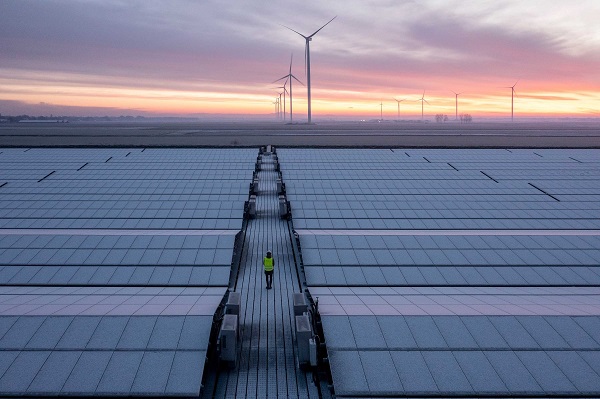
Anglo American in partnership with EDF Renewables recently formed a jointly owned company, Envusa Energy, to develop a regional renewable energy ecosystem (RREE) in Southern Africa, which will see the miner realise 600 MW of wind and solar projects in the first phase.
As such, the miner is busy with the development of a wind farm at its Namdeb operations in Namibia and a solar farm at its South African Venetia mine.
Hund explains that the company is also seeking nature-based solutions to aid in removing carbon from the atmosphere, to offset remaining hard-to-abate emissions as it works to eliminate as much as 70% of its carbon emissions through absolute reductions.
“De Beers understands that for its business and host communities to thrive, it must protect the natural world and follow best practices for biodiversity and water management, air quality, greenhouse gas emissions, waste and mine closure and rehabilitation.”
To this end, as a first project, the miner has invested US$2 million in a startup – Kelp Blue, a Netherlands-based company – pioneering the planting of large-scale giant kelp forests off the coast of Namibia to help restore the natural ocean wilderness, while capturing excess CO2 from the atmosphere.
It is estimated that kelp forests can absorb carbon up to 50 times faster than land-based forests.
“The aim,” Hund continues, “is to harvest the kelp to produce a bio-stimulant, which will be used in agriculture. Interestingly, one of the key characteristics of kelp is that it absorbs a significant portion of the carbon produced by humans. The project is an example of a nature-based solution being adopted by De Beers that not only helps address our climate goals but also supports skills development and job creation in Namibia.”
The start-up is fast becoming an engine for growth and innovation in the area, estimated to create about 300 jobs in Lüderitz and providing much needed employment to the local community.
The programme is receiving high level interest from masters and PhD students and encouraging the uptake of a whole new generation of Namibian oceanographers. Kelp Blue has also set up the Blue School, which teaches local children to appreciate the wonders of the natural world, with a particular focus on the desert and marine environments of Lüderitz. It has also developed an initiative that teaches local children to swim. In an area where there are few opportunities to learn to swim, children drown each year. The start-up has also initiated an ocean education programme to educate coastal communities on ocean related aspects. “The Kelp Blue project is an extremely inspiring and innovative one,” says Hund.
Aside from adopting equipment that runs on clean energy sources, including hydrogen trucks piloted by Anglo American, the miner is also evaluating the option of using synthetic fuels as they are cleaner and significantly improve efficiency levels.
Another interesting initiative is a diesel replacement pilot project Debswana is executing with the University of Botswana, which entails testing the use of beef tallow as a feedstock for biofuel.
Further to this, De Beers has committed to working with suppliers in its value chain to further reduce its Scope 3 emissions. By calling on its suppliers to reduce their carbon footprints, the miner is thus influencing its entire mining value chain.
“A large part of our Scope 3 emissions come from the equipment we use, as well as the raw materials, such as steel and cement. To achieve the 25% reduction of our Scope 3 emissions target, De Beers is negotiating and signing MOUs with key suppliers to fulfill the biggest part of our Scope 3 emissions reduction commitment,” explains Hund.
Further to this, the company is evaluating several initiatives, including partnering with the local community to advance sustainable farming and agriculture.
“In a broad sense, we consider prudential, regenerative agriculture and other such projects that will help us sequester carbon emissions. As we continue to innovate and implement projects, we are also constantly recalibrating to ensure our programmes are holistic and deliver to what we set out to deliver,” says Hund.
Venetia – a poster child for sustainability
The miner, which is ramping up development of the Venetia Underground Project (VUP) and delivering its first underground production in the second quarter of this year, has a number of initiatives in place, including those related to reducing emissions in Scope 1 (related to direct emissions) and Scope 2 (related to indirect emissions emanating from the use of fossil fuel generated electricity) at the mine.
According to Louw Swartz (energy and carbon manager), De Beers is committed to achieving Scope 1 and Scope 2 carbon neutrality at Venetia by 2030, with the mine expecting to reduce its carbon emissions from 380 000 t-CO2e per annum to 25 000 t-CO2e per annum by 2030 through efficiency initiatives and fossil fuel and fossil electricity replacement initiatives. In addition, the mine is currently considering several carbon capture and offset initiatives as part of its strategy to abate the remaining 25 000 t-CO2e and achieve carbon neutrality in 2030.
From an Opportunity Scoping pipeline of some 30 initiatives, De Beers has prioritised around 12 Key Opportunities that have been quantitatively ranked in terms of emissions abatement, energy reduction, payback period, reliability of technologies to deliver and technology readiness, and ease of implementation, that the miner is in the process of executing.
“De Beers is looking to abate as much as 15% of its Scope 1 and 2 emissions at Venetia Mine through energy efficiency measures. In addition, electrification and renewable replacement measures will play a major role. With the transition to underground mining most of Venetia’s energy consumption will shift to electrical energy – as much as 85%, where previously, when the project was an open pit mine, 80% of the portfolio was powered by diesel and fossil fuels and only 20% by electrical energy. Plans are also afoot to adopt battery electric and tethered electric equipment for underground mining,” explains Swartz.
By electrifying equipment at Venetia mine, De Beers is improving its level of efficiency not just enabling replacement of energy with renewable sources.
“A battery electric loader or truck is about 52% to 55% more efficient than a diesel-powered counterpart. Underground mining typically has lower duty cycles than open-pit mining and allows for the implementation of battery electric trackless mobile machinery. Venetia Mine is aiming to adopt battery electric production equipment as opposed to diesel equipment as part of its electrification strategy review. This includes addressing the infrastructure requirements, such as charging stations. In another example, we are planning to trial a battery electric LDV later this year. Although we know that OEMs are likely to produce off-the-shelf battery electric LDVs, we want to investigate the option of retrofitting our second-hand chassis and converting them to battery electric LDVs in order to ensure feasible transition by 2030,” explains Swartz.
Hund notes that in areas where it is difficult to eliminate emissions generated by fossil fuels, the objective is to reduce the emissions count to as low as possible.
Other initiatives being executed at Venetia Mine include the implementation of Advanced Process Control (APC) measures in its processing plant and the vent-on-demand system in the VUP, which delivers optimum levels of ventilation to designated areas.
“Essentially, we are changing the way we operate at Venetia – which will be extremely positive for reducing our carbon footprint,” says Swartz.
Meanwhile, De Beers is partnering with Anglo American as an off taker of wheeled renewable energy to site, and is in the pre-feasibility stage of establishing a 50 MW solar facility near the mine, which will provide significant renewable energy penetration for the delivered power to the VUP.
The solar energy project will unlock opportunities for behind the meter (BTM) power to ensure security of energy supply at Venetia.
“BTM allows for more security of supply, further reduces energy charges and also helps with availability of emergency energy,” explains Swartz.
He adds: “We have done some really good work in terms of understanding our requirements and how to go about achieving these at Venetia underground mine. Importantly, a couple of measures have been implemented even before the project comes online. To ensure that we are achieving the energy savings we set out to, we have Energy Management Information systems to track and help validate our progress against our Carbon Neutrality Pathway,” he concludes.