

With technology developments advancing at lightning speed, mining houses can unlock significant opportunities. However, to be future ready and achieve the required gains, they will need to partner with leading technology providers, says Maptek’s Gideon Slabbert, General Manager for Africa. By Nelendhre Moodley.
 Maptek, a supplier of innovative software, hardware and services for the mining industry, continues to play a pivotal role in helping mines to harness these benefits. The company develops 3D design and modelling, spatial analysis, and mine optimisation software.
“Individuals need future ready technology capabilities to succeed in the technologically advanced and rapidly changing mining industry. Those in the mining sector need to align with skills to manage technological solutions for mining,” explains Slabbert.
“For personnel in the sector to unlock value and efficiently perform their daily duties, they need to keep abreast of the functionality in the latest tools,” Slabbert continues. Maptek aids mining houses and tertiary institutions with online and in-person training, aligning them to the latest evolving technology.
He explains that given the strong demand for its expertise, the business, which has been in operation for over 40 years, is seeing a spike in the uptake of its product line.
Mining houses in Africa have been quick to adopt latest technologies, with the uptake being “so fast that mining industry skills development hasn’t kept up”. The company is thus working to fill the gap.
“The challenge in South Africa and Africa relates to the historical issue of limited local employment at mines, with much of the expertise residing in the hands of foreign professionals. Even when training was available, it was often not offered to local employees,” says Slabbert.
Although many more local employees are being trained today, a huge gap remains in the technological skillset. Slabbert argues that this historical disadvantage has meant the African mining industry has lagged in acquiring the full value of Maptek’s industry knowledge and resources.
Given that Africa is resource rich, with many countries highly dependent on the wealth it generates, the industry remains focused on improving production rates to keep abreast of global demand. This has resulted in a significant appetite from industry and tertiary institutions to fill the educational gap.
Slabbert says that “Every year the number of miners aligning with latest technology has soared, driven largely by the push for increased efficiency, a lower mining carbon footprint and improved safety at mining operations. The industry, which employs thousands of people, continues to invest heavily in training to upskill existing employees and new recruits.
“Increasingly the industry is making use of the latest technologies, such as artificial intelligence (AI) and cloud computing, to gain insight into how better to plan and mine more efficiently, with reduced costs and improved safety. This drive is being adopted across all mining processes, from exploration through to production systems and plant environments. Moreover, there is a big push for enhanced data capture as it promotes improved decision making.”
Maptek’s aim is to help mining personnel use data for better outcomes, especially technology related tools that aid miners and explorers to interrogate their reserves and deposits.
“Miners operating across a variety of commodities are keen to adopt Maptek online and in-person training programmes. As part of our service-level agreement, Maptek encourages mining houses to make a set amount of days available each year to allow our consultants to upskill mining employees. We flag mining houses a year in advance to ensure that set days are mapped out for training and skills development. To ensure that personnel get the most value out of the technological solutions offered, our programmes include revision of key technologies and tools. Our comprehensive, hands-on training ensures that our customers’ employees can implement the tools in their daily activities and unlock the full value of our solutions to keep abreast of the rapid adoption of technology.”
Maptek’s offering to the mining sector
The technology specialist has a vast suite of products for the mining sector, including the Maptek Compute Framework (MCF), which applies machine learning algorithms and cloud computing to process large tracts of data. This provides an ideal solution for intensive computing tasks such as stope design and modelling and Blast MCF for optimised blast design, from drilling to charging specific parameters for optimised outcomes.
“Technologically advanced tools,” says Slabbert “harness vast quantities of data within hours, allowing mining personnel, such as mining engineers and geologists, time to undertake higher value work and interrogate the resulting models for the best outcomes.”
Maptek partners with tertiary institutions
The technology specialist also collaborates with tertiary institutions to ensure that graduates entering the workforce have insight into and interact with the latest technology.
According to Slabbert, the uptake of science and technology at tertiary level has been exponential, with significant demand for Maptek training and support – in fact, the company has several partnerships with regional universities.
The University of Lubumbashi is one of the most recent tertiary education institutions to partner with Maptek. Within its academic programme, Maptek provides students with free access to the company’s mine planning and geological tools.
“Students are extremely eager to take up our free online training classes, which offer structured courses with a certificate on completion. The qualification allows students in professional fields such as mining engineering, geology or quantity surveying to gain skills that distinguish them right from the start of their careers.”
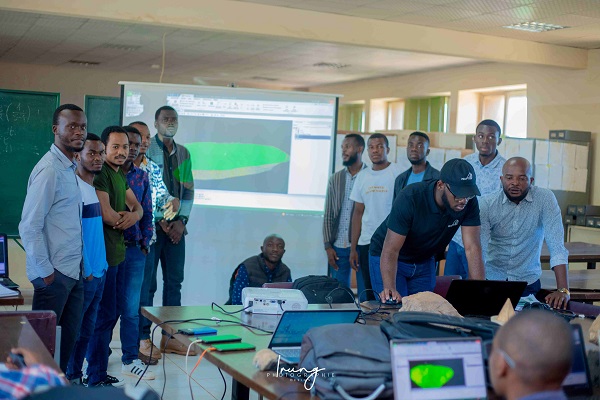
As of 2023, a total of 57 students, comprising 53 final year and four Masters level mining engineering students from the University of Lubumbashi, have undergone in-person training in Vulcan and PointStudio software. The courses were conducted by two of Maptek’s French-speaking technical specialists.
“The Vulcan training covered the basics of importing files, creating lines and polygons through to more advanced topics such as in pit design, dump design, block models, and short-term mine planning. For PointStudio, the training encompassed point cloud data importation to the creation and manipulation of 3D models. Maptek is also continuing to work with three of the Masters students to help them complete their qualifications using Maptek solutions.”
In addition, the students at the University of Lubumbashi have access to the Maptek online training platform, which enables them to hone their newly developed mining technology skills.
Maptek also has longstanding partnerships with Wits University and the University of Pretoria.
“Interest in adopting the latest mining tools and technologies varies across Africa, with the big mining districts showing a healthy interest in Maptek training,” says Slabbert “Our university footprint has grown to such an extent that we have established an official university council to ensure all students have access to the necessary support. The mining department of the University of Pretoria, with which Maptek has been collaborating for the past decade, continues to derive great value from our programmes, making use of our online training modules to allow students to learn at their own pace.”
So great is the demand for Maptek support and skills in the sector that between two to five universities ink partnerships with the technology specialist each year.
But Governments – a key player in the mining sector – are reticent about taking up the programmes.
According to Slabbert, this essential segment which holds and manages key data related to the mining sector, including exploration licences and mineral deposits, is slower to upskill the personnel who can effectively advise on critical aspects such as health and safety.
Slabbert notes though that Goverment officials visiting mines are often exposed to Maptek technology, which in turn influences their views on health and safety measures. Using the information gleaned, Government officials often advise smaller mining operations on safety standards that they have seen administered.
“Maptek’s aim, Slabbert says, “is to contribute to efficient mining operations to ensure that every miner, using our technology, can make better decisions. We offer cutting edge tools and technologies and want to be a key partner in the journey with mining houses and universities.”
VisionV2X – keeping people and machinery safe
In May this year, the technology specialist launched VisionV2X, a collision avoidance and proximity detection tool for underground mines.
Slabbert explains: “The advanced ranging system allows equipment operators to detect other vehicles and personnel in proximity and is dedicated to improving safety standards in underground mines. Since the launch, Maptek has been garnering much attention and traction in the market. Given that mining houses in South Africa have a strong safety drive, we foresee VisionV2X being integral to local underground mining operations.”
Prior to launch, Maptek piloted VisionV2X at a mine in Mongolia, where the technology was deployed for over a million vehicle hours. “We worked extensively with the mine to ensure the product was ready for implementation before the official launch.”
Maptek – a global entity with an international footprint
The global entity, headquartered in Australia, has a presence in all key mining regions. According Slabbert, this international footprint means that insights gleaned from various regions are integrated into the solutions, consulting and support offered.
“Where features are developed to target regional or professional segment regulatory requirements, we can roll them out to benefit all our customers, regardless of geographic region. For instance, South Africa has stringent rules relating to safety; thus, the tools we customise for the South African mining sector become a standard for products adopted by the rest of the mining world. As a result, our products serve the international community – ensuring that all mines benefit.”