
The University of Pretoria’s (UP’s) Department of Electrical, Electronic and Computer Engineering has conferred an honorary doctorate on Professor Justin Jonas in recognition of his contribution to observational radio astronomy, instrumentation for radio telescopes, and his role in advancing South Africa’s position in global scientific and engineering research.
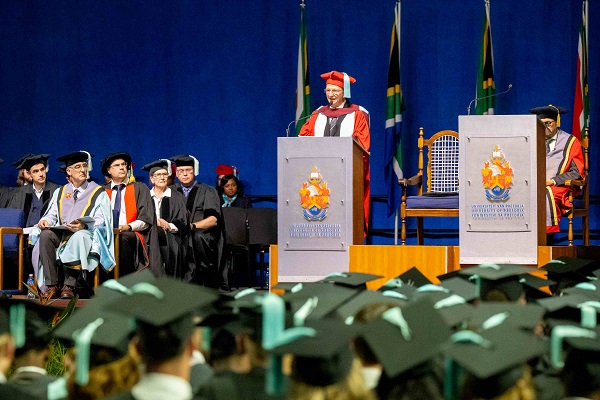
Prof Jonas is one of the more than 13 221 students graduating during UP’s Autumn Graduation season, with ceremonies taking place across all faculties from Monday 4 May to Friday 29 May 2026.
He has been one of the key figures behind the development of the MeerKAT radio telescope and the Square Kilometre Array (SKA), the largest radio astronomy network ever built. Over four decades, his work has contributed to the growth of South Africa’s radio astronomy capabilities, while also supporting the development of engineering expertise, scientific collaboration and human capital in the field.
“Under his decades-long stewardship, South Africa became a global leader in engineering for radio astronomy beyond MeerKAT and SKA, making major contributions to such projects as the Event Horizon Telescope, which captured the first images of a black hole in 2019, as well as several other global radio astronomy consortia,” said Professor Wynand Steyn, Dean of UP’s Faculty of Engineering, Built Environment and Information Technology (EBIT).
Prof Jonas served as Chief Technologist of MeerKAT and played a central role in developing the telescope’s science case (the scientific goals and questions the telescope was designed to address), system design and engineering implementation. Under his leadership, South Africa became a significant contributor to global radio astronomy initiatives, and the MeerKAT team received the 2023 Royal Astronomical Society Group Achievement Award.
“Apart from his significant technical contributions to the specific instruments developed under his leadership, and the development of the local engineering industry, his efforts in engineering human capital development elevated South African universities to the forefront of radio astronomy and related instrumentation research globally,” Prof Steyn said. “Through the grants and bursaries programmes he helped establish, our own Department is now contributing to several global radio astronomy consortia, including the African Millimetre wave telescope and the Atacama Large Aperture Submillimeter Telescope.”
Prof Jonas currently serves as Director of the Centre for Radio Astronomy Techniques and Technologies (RATT) at Rhodes University. All his degrees were obtained from Rhodes University, culminating in a PhD in Radio Astronomy in 1999 with research titled ‘The Rhodes/HartRAO 2326 MHz radio continuum survey of the Milky Way’.
He has held several academic, scientific and leadership roles in Rhodes University’s Department of Physics and Electronics, where he progressed from technical and research positions to Professor and Head of Department, while also serving in senior leadership roles linked to South Africa’s radio astronomy programme. These include Managing Director of HartRAO (Hartebeesthoek Radio Astronomy Observatory), Associate Director for Science and Engineering at the SKA South Africa Project Office, Chief Technologist for SKA South Africa, and Director of RATT.
Prof Jonas said the honorary doctorate highlights the collaborative nature of large-scale scientific and engineering projects. “It has been a privilege to work alongside highly skilled scientists, engineers, students and industry partners over many years on projects that have expanded both scientific knowledge and South Africa’s technical capability. What has always mattered to me is building systems, institutions and opportunities that allow people to contribute meaningfully to work at a global level while rooted in South Africa.”
Beyond astronomy, Prof Jonas also contributed to South Africa’s COVID-19 response. “He served the country through his role as Technical Advisor to the National Ventilator Project, taking a leading role in the government’s initiative to produce 20 000 non-invasive ventilators during the COVID-19 pandemic,” Prof Steyn said. “Here, too, his leadership led to the development of technology for the public good. Throughout his career, Prof Jonas has upheld the highest traditions of the engineering profession, applying technology and resources for the good of all mankind on a global scale.”