Emergency lighting and in particular, escape route lighting and markings are perhaps the most neglected aspect in adherence to regulatory requirements in buildings.
Research over the past two years on a national basis, however, clearly illustrates the majority of installations falling short of complying with compulsory National Building Regulations. More worrying is the lack or misunderstanding of the requirements of the Regulations, this being the case in both the private and public sectors.
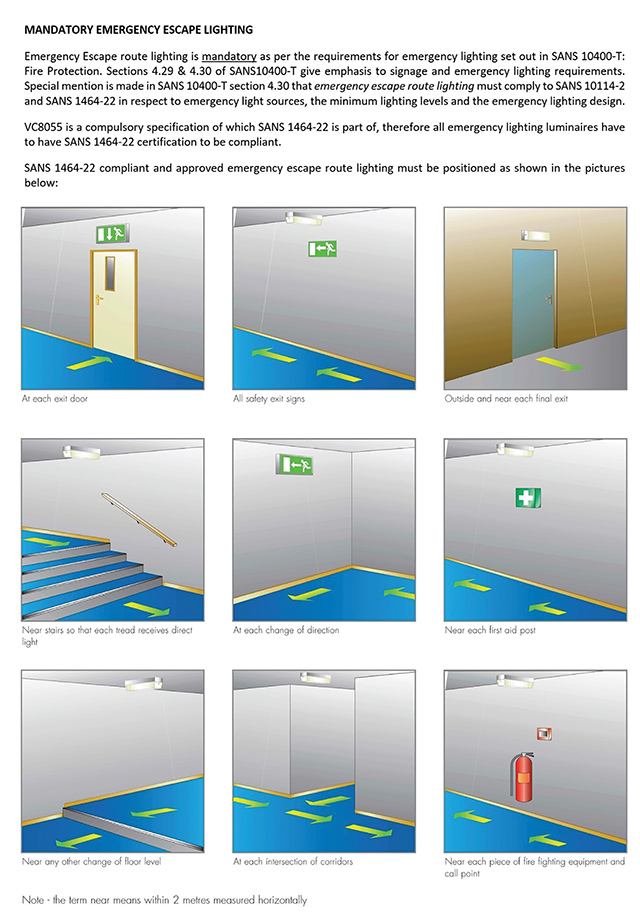
A set of pictograms, illustrating the important aspect of escape route identification and lighting.
This research and actual experiences realized that Emergency Lighting is probably the most neglected safety aspect of all practices to be controlled and led to the founding of the Emergency Lighting Association of South Africa (ELASA). The founding members decided to combine their experiences and dedicate their efforts to the betterment of practices and adhere hence to regulations
In September, the Mmabatho Palms Hotel in Mahikeng burnt down. Deputy Minister of Agriculture, Zoleka Capa, who was a guest at the hotel at the time of the blaze, bemoaned a lack of emergency evacuation processes “It was the worst moment of my life. At around about half-past-one I felt the heat and I could see some light smoke. I ran out of the room and started shouting ‘fire’. There was no security in place. No one giving us directions, we did not know where the assembly point was. It was just a mess.”
Drew Donald, Chairman of ELASA, says “Many building owners seem to be under the impression that they are compliant, which is mostly not the case. Neither are Regulatory Authorities executing their duties to do inspections and insist on corrective action to improve the status quo. The respective insurance entities that we have thus far engaged seem to be more property and asset focussed and less concerned about the safe evacuation of people from a building experiencing an emergency.”
Donald continues: “After intensive engagement with the City of Johannesburg EMS Services, we are in agreement as to the specifications of both product and installation practices in respect of Emergency Escape Route Lighting. The primary specification being SANS10400-T: Fire Protection, to be read in conjunction with SANS 10114-2, VC8055 and SANS1464-22.”
VC8055 is a compulsory product specification meant to be strictly enforced by the NRCS. Sadly, there is no evidence of this being the case. Our Association offers various training courses to interested parties at no cost to participants.
Recent happenings where fires occurred clearly illustrate that emergency and escape route lighting and signage were either not working or non-existent. People’s lives are being placed at risk because those who are custodians of ensuring compliance, for whatever reason, are not fulfilling their responsibilities to the levels required.
“No matter where we go, lack of knowledge, lack of education and therefore lack of application is overwhelming,” says Donald. People in government, the head of the fire services and the head of national disaster are all in agreement that this needs to change, but the resources are not available.
With this in mind, the company is embarking on an education programme and recently made a breakthrough with the Fire Protection Association which runs training for fire services and fire inspectors. “We’ve done a full training programme that they will run in their curriculum, but that’s a 3-5 year programme before we get through to every inspector,” he says, noting that a whole chain of events needs to occur to ensure that all buildings are compliant in the future.
The Charlotte Maxeke fire
When the Charlotte Maxeke fire caused the evacuation of 700 patients and the destruction of an estimated R40m in hospital supplies, Gauteng Health denied reports that the hospital did not meet fire regulations.
Just weeks before a fire tore through parts of Charlotte Maxeke Academic Hospital in Johannesburg on 16 April 2021, a fire safety audit at the hospital was signed off and in March a hospital fire and safety team met, according to Gauteng Health. Yet the department's spokesperson Kwara Kekana also confirmed that “the smoke doors are not used as the magnetic system on the doors was no longer effective and they were recommissioned”.
The Charlotte Maxeke fire was the fourth in six years at public health facilities in Gauteng. In February 2021, a fire broke out at Carletonville Hospital, in May 2019 there was a fire at Bheki Mlangeni Hospital in Soweto, and one at Tambo Memorial Hospital in Boksburg in May 2015. A blaze in September 2018 devastated the provincial health department’s head office in the Bank of Lisbon building in Joburg’s inner city and claimed the lives of three firefighters.
Nana Radebe, spokesperson for Joburg Emergency Services, confirmed they currently have just over half of the equipment – 51 of 92 items – needed for the fire service to meet national fire safety standards (the SANS 10090). Radebe also says high levels of non-compliance to fire and safety by-laws within the city continue to be a headache for the 1,271 firefighters employed at the city’s 29 fire stations.
The Charlotte Maxeke Hospital fire adds to a long-standing and tightly knotted occupational health and safety crisis in the public health sector in the province. Worryingly, Democratic Alliance member of the provincial legislature, Jack Bloom, noted that in 2019, former Gauteng health MEC Dr Bandile Masuku, who was axed in October 2020, admitted that “no state health facility in Gauteng had been assessed as complying with the Occupational Health and Safety Act”. This included general machinery regulations, electrical installation regulations, firefighting equipment, lift regulations, storage, exits, stairs and aisles.
Property, building owners and conglomerates must accept responsibility for safeguarding the health and safety of their staff and customers and not assume that by having a building permit their staff and customers are in any way assured of quick and safe exit from a building in the event of an emergency.
“Our extensive research of existing emergency lighting conformance is that the majority of South African companies do not meet the necessary requirements when everyone’s slogan should be ‘Your safety is our primary concern’,” concludes Donald.
Enquiries: Drew Donald: +27 (0)83 226 2708; Stirling Marais: +27 (0)83 448 7721; Cliffy Graff: +27 (0)71 890 5719; Brett Urquart: +27 (0)72 054 0672.