With abundant sunshine, load shedding issues and rural areas that are not connected to the grid, South Africa is the perfect melting pot for a thriving solar street light industry. However, as is often the case when such opportunities arise, nefarious activities are never far behind.
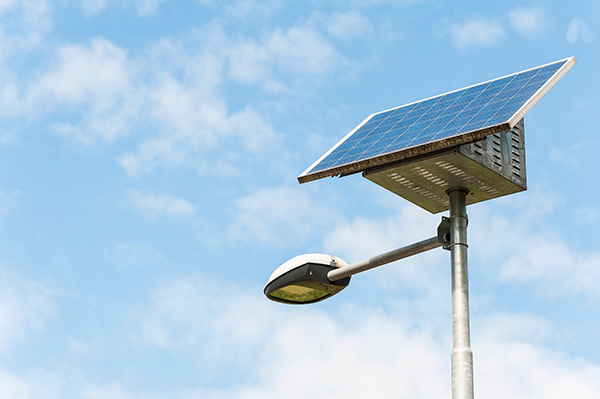 Otto Horlacher, managing director of Giantlight, a manufacturer, supplier and installer of LED lighting, has noticed a worrying trend and invited Sparks Electrical News to visit the company to investigate. “You buy a solar street light, and it says it is 800 W. Generally, it is a nice looking, well-engineered fitting, but I have approached the manufacturers and asked what the 800 W means and have been met with silence. These are false claims,” he says.
One answer he received was that it was a reference to old incandescent lighting, yet when doing the maths, it doesn’t track. “The issue is that it is all fine and well if you understand what you are looking at, but for a rookie town planner, he or she could get strung along by the numbers presented on a product. They want to light up a public area and can go buy an 800 W solar light from the China Mall and we’re only offering a 30 W, which is more expensive,” says Horlacher.
He explained that a 400 W solar panel is the size of a door, so a solar street light cannot conceivably operate off an 800 W panel. “The batteries are 3.2 volts by 32 amp hour, so the total wattage coming out of the battery is 102,4 W – nowhere near 800 W, so it doesn’t matter how you present it, this is a 15 W post top being sold as 800 W.”
On data sheets, which we looked at, again, the calculations did not add up. So why is this happening? Is it a lack of knowledge on the manufacturer’s side or are they trying to pull the wool over people’s eyes by making these false claims? “They just do it because other people are doing it,” says Horlacher. “These manufacturers also print IP65 on everything; whether it’s IP65 or not, it’s printed big and it’s the first thing you see. We’re in a situation where tenders are going out for 200 or 300 of these fittings, and the client has no idea what they are buying. This isn’t to say that they don’t work, but the manufacturers are not being honest, possibly deliberately ambiguous. There is no way I can come back to any of the wattage claims, even if I total everything electrical in the product and add it up.”
Daniel Kasper, General Manager of BEKA Schréder, Africa’s leading manufacturer of LED luminaires and Glass Fibre Reinforced polyester (GRP) Poles, is confident that solar solutions will in future provide lighting for many applications at reasonable costs due to technical improvements in view of storage, load and solar module technologies. It is the technical complexity and the lack of standards, in addition to the large price difference between a solar powered light and a grid powered light, which drives the poor performance solutions on the market. “We need to educate the end user and work together as industry to set up standards to ensure that the correct technical information is provided,” Kasper says.
“While BEKA Schréder offers three very different purpose designed solar options, including a highmast solution, our focus is to train our commercial team continuously and provide training and guidance on a very fast developing solution for customers,” he continues. “Batteries constitute the major contributing cost to solutions, and we find many presented solutions offered in the market are based on small battery sizes – that are very questionable in terms of calculating the system operation – to make the system seem cost effective.”
Often, 120 and 150 W solutions are offered with very small batteries installed. The offer uses movement sensors to ramp up to the stated wattages for 5-10 seconds and for the rest of time remain in a dimmed state of under 10% of the stated output. Installation heights are normally decided based on the maximum wattage and therefore very little, if any, light would reach the lit surface below in the dimmed state. Effectively the customer pays the premium price based on the wattage and gets very little light out of the solution.
Good solar solutions are based on clearly stated technical information supplied to a prospective client which could easily be verified by use of simple tools like BEKA Schréder’s Energy Storage Calculator, which is distributed at no cost to professionals and clients in the industry.
In closing, Kasper mentions that the secret is to design the most cost effective, technically balanced system which ensures the life of the system's heart, the battery is protected and does not suffer abuse due to a poorly designed system. But most importantly, good quality LEDs with specifically designed optical solutions used to distribute the Light Emitting Diode (LED) output suited for each application will always be the key to offering the right light for each application. “You can have the most efficient light source, but if it provides a ball of light, which is a result of poor light distribution, this will always remain a challenge.”
Let’s not forget that at the end of the day, lighting manufacturers are selling a light fitting; not a solar panel, not a battery. So, the question that should be answered is, what is the size of the light fitting? Companies should declare the lumens and the wattage of the light fitting, along with the size of the battery and the size of the solar panel, as anyone in the know will understand what they are looking at. It is those who aren’t in the know who are the ones who could be swayed by the false claims, and it is the public that suffers when the product doesn’t provide adequate illumination.
Enquiries: www.giantlight co.za and za.schreder.com