
Architectural lighting transforms thoughtful design visions into a cohesive panorama which attracts attention, sparkles imaginations, creates symbolism, provides intimacy, and defines focal points. It infuses lighting into a coordinated system to achieve an integrated and unified visual, functional and architectural purpose that is characteristic of the architecture’s personality.
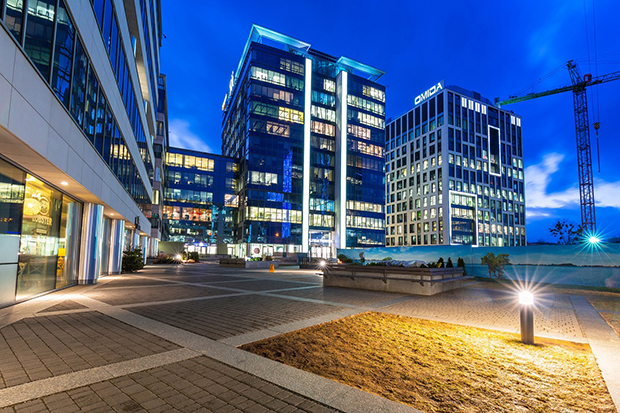 An integral architectural lighting concept includes façade lighting. Adding a splash of high drama to sweeping, monotonous façades with lighting is just as important as structure, hardscape and softscape lighting. Engaging illumination of building façades can convey emotionality, echo a theme, add dimensionality to a building, and heighten the visual impact of architecture.
Wall washing
Façade lighting is typically done in one of two ways: wall washing and wall grazing. Wall washing is a technique which is used to create a fully saturated wash effect on vertical surfaces like walls or façades. Uniform illumination across the vertical surface completely eliminates shadows from the surface texture and produces a flattening effect. In wall washing applications, the wall itself is the focus of the lighting and uniform illumination creates a visually smooth, flat surface. This technique is intended to reduce the visibility of the visually uncomfortable textures of the materials used in the construction of the wall or façade.
Wall grazing
The ability of wall washing to flatten the visual appearance is advantageous for hiding imperfections in a vertical surface. On the other side, wall grazing is a technique used to emphasise or enhance a textured surface or architectural element. The textured beauty of brick, stone, stucco walls, interesting masonry or architectural details becomes a striking feature when grazed with steeply angled light. Wall grazing lighting enhances the visibility of the surface texture and accentuates details through high-contrast shadows. Wall grazing lights are mounted very close to the surface to be illuminated, whereas wall washing lighting requires an adequate setback distance to eliminate shadows and flatten textures.
Linear lighting systems
A linear LED wall washer or grazer typically has an extruded aluminium construction. The anodized aluminium channel, clear tempered glass lens, die cast aluminium end caps, one-piece silicone rubber gasket, and pressure equalising air vents form a water-tight, dust proof enclosure with a typical IP66 ingress protection rating. The LEDs can also be protected from water, dust and other atmospheric influences with silicone-potting.
The aluminium housing provides structural strength as well as conductive and convective thermal transfer for the LED module. The LED module consists of a linear array of LEDs assembled on a metal-core printed circuit board (MCPCB). The light distribution of the LEDs is individually controlled by secondary optics which can be reflectors, TIR lenses or freeform lenses. These optics typically produce asymmetric beam patterns with horizontal and vertical beam angle options ranging from narrow to wide.
The LEDs operate on DC power which is regulated by an LED driver running directly from a commercial alternating current (AC) power source or a low voltage DC power supply. The AC-DC LED driver must transform the AC power into an appropriate direct current, while protecting the LEDs from power surges as well as overcurrent, short-circuit, overvoltage and over-temperature conditions.
Multiple fixtures can be wired in series or in parallel, and installed in an end-to-end configuration or using jumper cables to add space between fixtures in a series. The maximum number of fixtures each circuit can support is determined by specific configuration details which include fixture power rating, fixture length, fixture spacing, circuit size, supply voltage, and leader cable length.
LED technology
Linear architectural LED light fixtures come in a diversified range of output colour options, including solid white, solid colour, intelligent white, and colour-changing light. LEDs are p-n junction devices fabricated from indium gallium nitride (InGaN) or aluminium indium gallium phosphide (AlInGaP) material systems. The InGaN and AlInGaP semiconductor dies emit in narrow spectral bands. The optical radiation is perceived by the eye as coloured monochromatic light such as red, green, or blue.
White light can be created by utilising a semiconductor emitter to pump a phosphor down-converter within the device package or through additive colour synthesis using a minimum of three primary colours. Phosphor converted LEDs are the dominantly used white light emitters. They are available in a whole spectrum of colour temperatures, which offers the freedom in selecting the most appropriate light colour for a particular application. Tunable white systems use white light LEDs of varying colour temperatures to modulate the colour temperature of white light in a continuously adjustable range.
The use of RGB LED systems enables implementation of dynamic lighting solutions that can produce white light and colours of various hues and saturation levels. Channels of amber or white LEDs seamlessly blend with channels of red, green, and blue LEDs to create RGBW, RGBA and RGBWA LED systems which come with a significantly expanded colour-mixing gamut.
Dimming control
Linear LED wall washers or grazers can be controlled via an analogue interface (i.e., 0-10VDC) or a digital interface such as DMX or Ethernet. The interface allows the dimming circuits that adjust the light output of an individual, group, or entire array of LEDs to be operated by a light controller. The LEDs incorporated in these fixtures can be dimmed through pulse-width modulation (PWM) and constant current reduction (CCR). Analog dimming (CCR) may be inappropriate for applications that require a full dimming range and a constant colour temperature.
To produce predictable colours from an RGB, RGBW, RGBA or RGBWA LED, each of its component LEDs requires individual, accurate PWM digital dimming control. These component LEDs are addressed individually to identify the specific DMX or Ethernet control signals. Uniquely addressing and controlling each lighting node – a multi-colour LED array – allow individual lighting fixtures within the installation to act in unison and enable an infinite variety and combination of dynamic effects.
