Local industrial boiler water treatment specialist, G-Chem Aquacare, is partnering with global specialists Odyssee Environnement to improve water, energy and carbon efficiency within Free State hospitals.
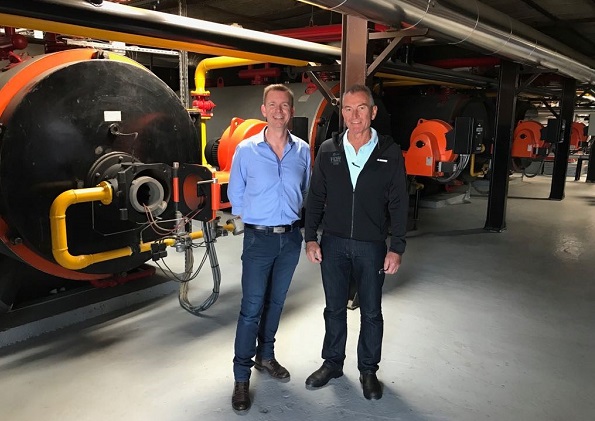
Xavier Labeille, export director for Odyssee Environnement and Adrian Estcourt, technical boiler specialist for G-Chem Aquacare.
A groundbreaking initiative called the FASEP ODYAFRICA Project, supported by the French government through the FASEP Programme (Fonds d'Études et d’Aide au Secteur Privé) and led by Odyssee Environnement, a French industrial water treatment company specialising in hydroethical, sustainable industrial water technology and chemistry solutions, is investing more than €500 000, approximately R9.6-million, to improve water treatment in Free State hospitals.
The project represents the first deployment of Odyssee Environnement’s monitoring technologies in South Africa, combining the company’s advanced water treatment solutions with strong local implementation partner G-Chem Aquacare, and institutional collaboration with the Free State public healthcare sector.
Local hospitals rely heavily on water-intensive systems, including cooling towers, steam boilers and heating infrastructure, which must be carefully managed. Without correct water treatment and monitoring, scale formation, corrosion and microbiological growth cause infrastructure failure: compromising hygiene, energy efficiency, water consumption, budgets and safety.
According to G-Chem Aquacare’s CEO Shaun Golding, South African hospitals traditionally use manual monitoring and water treatment: “The Odyssee project is data-driven and automated. Specialised monitoring equipment, sensors and smart metering will track key metrics such as water consumption, steam production and system performance in real-time,” Golding explains, adding that flow meters and other instrumentation feed data into a remote monitoring platform, allowing stakeholders to identify inefficiencies and optimise system operation.
After installation and commissioning, the project will begin with a six-month baseline period using traditional water-treatment chemistry. From December, this will transition to Odyssee film-forming amine (FFA) technology.
“FFA forms a protective molecular film on internal system surfaces, improving heat transfer efficiency while significantly reducing corrosion, scaling and energy losses. During the remaining 18 months, the project team will demonstrate the benefits of the French film-forming technology in day-to-day hospital environments,” Golding advises.
A partnership built on technical expertise
G-Chem Aquacare’s relationship with Odyssee Environnement dates back to 2018. “From the very beginning, they demonstrated strong technical expertise, a high level of operational discipline, and a clear alignment with our hydroethical approach to water treatment. Together with their local knowledge and reliability, this made G-Chem Aquacare an obvious choice for this project,” explains Xavier Labeille, Export Director of Odyssee Environnement.
Early groundwork for the current project began in 2023-2024, with a preliminary site survey at various Free State hospitals. A formal joint site visit by both the French and South African project teams followed in September 2025.
The choice of the healthcare sector was driven by Labeille: “This decision aligns with the FASEP programme requirements, which are dedicated to public sector projects. Hospitals represent a fully public, structured and accessible environment. In addition, Odyssee Environnement has strong operational experience within hospitals in France, making this sector both relevant and technically controlled for deploying advanced monitoring technologies and chemical solutions,” he advises.
Golding explains that the Free State healthcare environment also presents a diverse mix of infrastructure and operational conditions. Initially, five hospitals were identified as potential participants. Detailed site inspections finally shortlisted three, each representing a different operational scenario.
At the primary site, Universitas Academic Hospital in Bloemfontein, the full suite of monitoring and optimisation technologies will be installed across its boiler, cooling tower and closed-loop systems. This includes advanced sensors, specialised monitoring equipment and smart metering to demonstrate the technology's full capabilities.
The secondary site, Pelonomi hospital in Bloemfontein, will receive a streamlined version with fewer monitoring devices and a simplified equipment set-up. This will demonstrate that while advanced monitoring can enhance performance, significant improvements can still be achieved through the chemistry programme, particularly by applying the film-forming technology developed by Odyssee Environnement.
At the Central/Regional Laundry, the third site, the partners will focus on the laundry steam boiler system, which represents another important area of energy and water consumption within the healthcare sector.
G-Chem Aquacarem: the local partner
As the local implementation, technical and operational partner, G-Chem Aquacare will play a vital role in the long-term success of the project. Responsibilities include on-site technical implementation of treatment programmes, system optimisation and operational support, monitoring and performance validation, training of local maintenance teams and ongoing technical collaboration with Odyssee Environnement.
“We understand the operational realities within South African healthcare facilities. Through our local technical teams and service infrastructure, we can provide on-the-ground support, regular monitoring and rapid response,” Golding observes.
The project emphasises knowledge transfer and capacity-building, ensuring that local teams are equipped to sustain improvements. G-Chem Aquacare will therefore liaise with hospital technical teams, engineers, facility managers and maintenance staff.
Training will focus on the correct operation of the monitoring equipment, the interpretation of system data, and the management of the water treatment programme. In addition, G-Chem Aquacare will provide ongoing technical support through regular site visits, performance reviews and remote monitoring of system data.
Scalable and sustainable
Labeille points out that this project demonstrates water, energy and environmental performance: “Our objective is to establish a replicable model that can be deployed across Africa’s institutional and industrial infrastructure. The goal is to deliver measurable results and enable scalable, sustainable water management solutions,” he says.
For Golding, the project reflects G-Chem Aquacare’s ongoing commitment to partnering with global technology leaders: ”We are proud to contribute to a project which not only improves operational performance but also supports the broader goals of environmental stewardship and responsible resource management,” he notes.
Technical events and workshops hosted in collaboration with universities, energy management specialists and other industry stakeholders will share the project’s objectives, progress and successes.
“We already consider G-Chem Aquacare as our strategic partner in South Africa. This project strengthens our collaboration and creates a solid foundation for further joint development across the public and industrial sectors,” Labeille concludes.