
In a bid to decarbonise operations and reduce high energy costs, the mining industry is rapidly turning to renewable energy, particularly solar and wind, with over 18 000 MW of renewable projects planned or implemented, notably in Africa. For insight into the benefits of adopting micro-grid solutions, Modern Mining spoke to Joseph Yao, Vice President of digital power Business Unit, and the MD of Mining Micro-Grid and Renewable Business at Huawei.
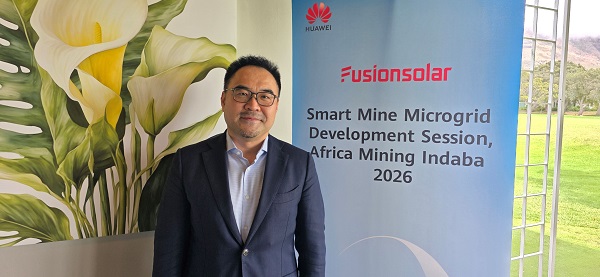
“For decades, the mining industry has relied heavily on fossil fuels to power mining – a sector that remains integral to the development of modern society. With the shift to clean green solutions, mining is increasingly adopting renewable energy options, which bodes well for Huawei digital power, as it focuses on renewable energy solutions for the industry.”
Remote mining operations, often located hundreds of kilometres from the grid, face prohibitive, up-front capital costs for infrastructure, making grid connection economically unviable.
As a result, many mining operations around the world rely on diesel generators for their power supply. However, diesel fuel is expensive, particularly in Africa.
“Energy supply is one of the most critical operational challenges for miners. In some African countries, the levelized cost of electricity (LCOE) from diesel generation can exceed 40 US cents per kilowatt-hour, which is extremely high. By comparison, in China, electricity costs can be as low as 3 US cents per kilowatt-hour. These high energy costs make it difficult to expand metal production and affect overall project economics.”
Another major challenge is meeting ESG (Environmental, Social, and Governance) requirements. Many projects must provide certification for green, low-carbon mining—especially when supplying European buyers. Continuing to rely on diesel generation not only increases operating costs but also makes it harder to meet decarbonisation targets.
“For example, in the Democratic Republic of Congo (DRC), copper exports to the European Union require proof of green mining certification. Without this certification, exporters may face substantial carbon taxes,” explains Yao.
The adoption of PV and the energy storage system (ESS) offer several benefits, including significantly reduced electricity costs, stable power supply, a lower carbon tax and ultimately, improved metal production.
Global Service System: Huawei has established a worldwide network of local spare parts warehouses and professional service teams across more than 170 countries, to deliver 24/7 rapid response, fully eliminating operational and maintenance (O&M) concerns for mining operations.
Integrated Fully In-House Developed Architecture: Featuring full-stack in-house development of end -to-end microgrid systems, our solution leverages a string-type modular design for easy installation, fast commissioning, simplified O&M, and ensured long-term stable operation of the system.
Core Innovative Technologies: Covering critical components including chips, IGBT models, advanced grid forming technologies, which continuously lead the industry’s cutting-edge innovation, with rigorous control over product performance and quality at the very source.
“Green grid-forming technology has advanced considerably, and costs have dropped substantially. This makes our solutions practical and ready for real-world deployment to support mining operations. It is now more cost-effective, more reliable, and far more efficient than before, making it a much more affordable solution overall,” says Yao.
Adopting Huawei solutions in Africa
Yao advises that the technology specialist has successfully deployed several PV and ESS projects worldwide, including in Central Asia, Africa, and South America.
Sharing two examples of successful adoption of micro-grid solutions, he explains that the first project is in the Democratic Republic of Congo (DRC) at the CNMC copper mine, operated by China Nonferrous Metal Mining Group.
“Before implementing our solution, the mine faced frequent power outages, which resulted in unstable copper production levels of between 60–68%. We deployed an 18 MW photovoltaic (PV) system together with a 10 MWh ESS. Since commissioning the project in May last year, production stability has improved dramatically, reaching 98%. In addition, the solution materially reduced diesel consumption, helping the customer save approximately $1 million in fuel costs. This has become a strong success story demonstrating the value of our solution.”
The second case is in Mongolia, where winter temperatures often fall below –40°C, creating considerable operational challenges. Running energy systems reliably under such extreme conditions required careful technical design and adaptation.
After extensive discussions with the customer in 2023, Huawei successfully deployed a project with a total capacity of 54 MW of PV and 140 MWh of energy storage. Since July 2025, the system has been operating with exceptional stability, substantially improving the customer’s production performance.
“This project has proven to be a major success, and we are currently in discussions regarding the next phase of expansion in Mongolia.”
To date, Huawei has deployed around 15 projects globally, including in Ghana, the DRC, Sierra Leone, Madagascar, and Mongolia. These successful implementations demonstrate Huawei’s strong capabilities and extensive experience in delivering reliable solutions worldwide.
“We believe that microgrid solutions will become the primary power supply model for the mining industry in the future.”
Huawei’s focus on R&D
The high-tech company places strong emphasis on research and development, investing heavily in this segment of business.
“Last year our revenue exceeded $130 billion, and we invested nearly $20 billion in R&D. This substantial investment enables us to develop advanced chipsets and IGP technologies that we integrate into our equipment. As a result, our solutions deliver enhanced performance and reliability in challenging environments, including low temperatures, high-latitude regions, and humid conditions,” concludes Yao.
Renewable energy – a driver for growth in commodities
Given that the PV industry relies on key commodities such as copper, aluminium and lithium for use in micro-grid solutions, demand for associated commodities is set to rise, with Yao estimating that demand for copper to increase “three times the current rate by 2030 with lithium set to grow by as much as five times current demand”.
Underpinning demand for these commodities is the push for clean energy solutions and massive growth in AI technologies.