The Gomes name has been associated with construction since 1936 when Gerardus Gomes started mining building sand, topsoil and river sand by hand. This fairly rudimentary business model eventually made way for the highly mechanised plant that has been operating since 2009 at its current quarry situated in Laezonia, where customers can collect sand and stone, or can order these.
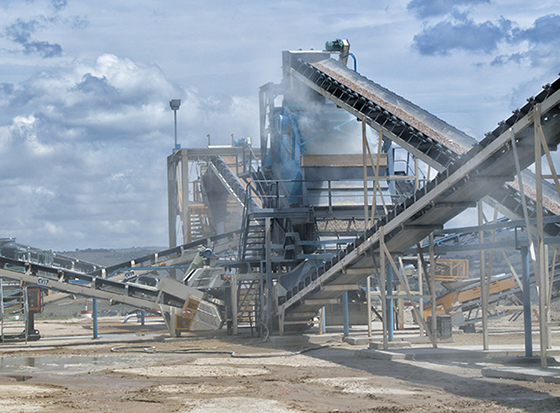
Modern Quarrying recently visited the 180 ha site and spoke to Mining Manager Gabriel Gomes and Pilot Crushtec’s Charl Marais (Sales Manager) and Ben Armitage (Sales Engineer). This company has had a relationship with Gomes Sand for over 30 years and has supplied it with several pieces of equipment ranging from mobile screens, cone crushers, jaw crushers, vertical shaft impact crushers and washing plants.
“We produce all sand products here - building, plaster and river sand in addition to aggregates,” says Gomes. “We only deliver in a 50 km radius to keep the price competitive.” Gomes Sand operates and owns a fleet of 35 trucks. “Owning our own fleet means that there is efficiency in delivery as we can control every aspect right until the product is delivered to the client,” says Gomes.
The quarry consists of four crushing plants and has the capacity to produce 150 000 tons of product a month. “In 2022 Gomes Sand produced an average of between 120 000 and 130 000 tons a month,” says Gomes. “We work from 7:00 to 17:00 weekdays and seldom work overtime as we try to get the maintenance and production done in normal working hours.”
Unique selling point
Gomes is quick to point out why Gomes Sand has been around for so long. “It is service, quality and availability of stock. If you go to Spar and there is no bread on the shelf, one does not go back there. The same applies with selling sand – when a client sends a truck to collect product, they do not want to wait. There has to be product availability to cater for their needs. They want to load and go as they have to manage their own risk,” says Gomes. The company aims to maintain a 24 hour turnaround time for deliveries.
He says that the quality of the building materials that it produces is a result of experience. “One eventually builds up enough experience to be able to tell the difference between good and bad sand. In addition to knowing what you are mining, you need to know the geology, what the end product must be and you need to put up the plant to achieve this.”
Gomes Sand has always had a good demand for sand. “We make what our clients need. If the demand is low, the plant is switched off and if demand increases, production in increased. There is always a demand for quality sand in South Africa. Many sand producers are producing building sand from recycled builder’s rubble, but this does not necessarily produce a good quality building sand.”
Gomes says there is a specific recipe to produce product. “This is combined with the know-how that Gomes Sand has accumulated over the years. The plant was mechanised and automated using the best combination of crushing, screening and washing equipment available.
“Over the years we have had hands-on experience with different types of equipment. The shortfalls of some and the benefits of others soon become apparent. It is through experience that you know what you want and you find the equipment to match this while understanding the geology and the mining process,” says Gomes.
“All the sand produced by Gomes Sand – including the river sand – is a manufactured sand. We produce a wide range of products to cater for required specifications ranging from G1, 19 mm and 13 mm stone and river sand.”
Gomes Sand mines granite. The quarry is situated on the edge of the Halfway House granite dome. “The sand we produce is quite consistent. We strip off the loose overburden and this is dug off by excavators. Whatever the excavators cannot dig out is drilled and blasted. The brown overburden is turned into river sand. Once the granite becomes more competent it is turned into aggregate,” explains Gomes.
“The plant is all aimed at achieving reduction ratios right up until the final product that is required. It there is a demand for aggregates, we can produce aggregates too,” says Gomes.
A partnership
“My dad started doing business with Pilot Crushtec in 1990. It has always been a one stop shop for us. The primary reason is the back-up service that we get from Pilot Crushtec. One can have the best machine in the world, but if there is no back up from the supplier, the machine is worthless. A crusher is an integral part of my plant – if it goes down, my entire operation comes to a standstill. I needed to decide to purchase a machine from a company that is going to support their product with after-market support such as parts holding and onsite technical support. When we need spares they must be able to deliver 24/7. That is why we bought from Pilot Crushtec and still do - it comes down to service, reliability, and stockholding.”
The plant to produce the required product
After initially attempting to recycle rubble, Gomes Sand quickly upgraded the recycling plant to a hard rock plant from Pilot Crushtec. “There is no sense of recycling in South Africa yet,” says Gomes.
“As the pit got bigger we added a second plant from Pilot Crushtec. The plant has been revamped as the demand changed,” says Gomes and adds that some 80% of the plant on site is from Pilot Crushtec.
It most recently supplied the Metso GP330 Cone crusher to Gomes Sand. “A machine was required to operate receiving feed from the primary jaw crusher on site and crush the material down to 40 mm in a closed circuit which can achieve 350 metric tonnes per hour,” explains Marais. It was important to consider a cone crusher that could handle the top size from the jaw crusher and provide enough fines in the crushing process to produce filling material. “Another consideration was that the cone crusher had to be simple to maintain and have few moving parts to reduce standing time due to periodical maintenance,” explains Marais.
This GP330 offers installed power up to 315 kW with a cavity feed opening of 238 mm which is able to accommodate feed sizes produced by the primary crusher. “With variable eccentric stroke the unit can be optimised to suit several types of processes. The cone crusher chamber can be configured to operate from a secondary position in the plant all the way to a final stage quaternary crusher,” explains Marais.
All operation data of the cone crusher is logged continuously and can be accessed by the standard on board Metrics monitoring system. This system has no monthly or yearly subscription and offers valuable data from the crusher from any device with internet access.
Ben Armitage indicates that Gomes Sand has adapted well to circumstances in the market that determines the type of machines installed in a plant. “Certain machines have certain outcomes and Gomes Sand selects its equipment based on reliability and the outcome that is required for the end product.”
Pilot Crushtec has been supplying and servicing the industry since 1990 offering unrivalled customer support, service and knowledge to keep customers operating competitively with a 100% commitment on stock holding from critical spares, wears and consumables. “We understand the frustration when spares are not available as well as the cost of standing time and lost revenue. Business works both ways and to be truly successful a partnership needs to be formed between supplier and customer,” says Marais.