The COVID-19 situation has created major challenges for the mining sector worldwide and has highlighted that digital production is more important than ever when it comes to gaining a competitive edge. Consequently, BME reports increased enquiries of its digital blasting tools as mines seek to take advantage of digital technologies to react to current and future challenges with the required degree of flexibility. By Munesu Shoko
The days of trying to convince mining executives of the imperative of a comprehensive digitalisation roadmap may well and truly be over. There doesn’t appear to be a mine owner or manager in the world who doesn’t appreciate the immense value, efficiencies and competitiveness that can be unlocked by fully harnessing the power of digital tools.
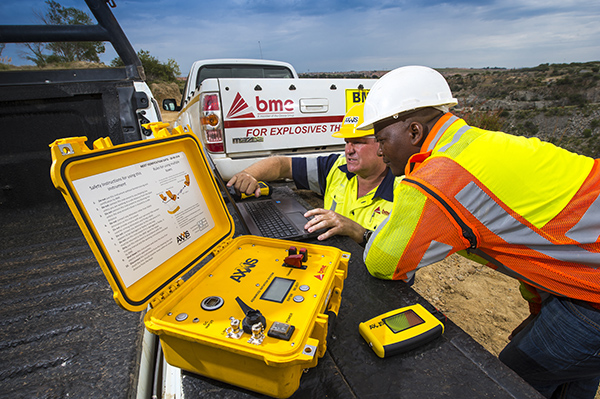
One area in the mining cycle where the power of digital is proving its worth is in blasting. Tinus Brits, global product manager – AXXIS at BME, says mines in the SADC region, and Africa at large, are looking for innovation and technology to promote sustainability.
“We have seen a big move towards electronic detonators in the African mining sector,” he says. “A big drive is the testability of the product. With electronic detonators you know immediately what is going on – you can detect possible misfiring in the range and can easily detect which detonators are not responding. We have therefore seen most mines moving over to electronic detonators.”
Brits also notes a big drive for data at mines. The data, he reasons, has always been available, but now more than ever, mines are realising the value that can be driven from the large amounts of data at their disposal. “Previously,” he says, “data was never really shared between the customer and the explosives supplier. There is now a big drive to make the data available to all parties for informed decisions when it comes to blasting patterns and blocks.”
- Scott Scovira, global manager Blasting Science at BME, agrees, saying that the behaviour and discipline of mining houses has changed in recent years. Previously, in the late 90s, he says, mines were very much paper driven, and operations personnel largely ran mines at the expense of engineering teams.
“Mines traditionally tend to be heavily driven by operations, and every time you introduce more work processes, they are often met with resistance. Fortunately, mine management has seen the value of big data and now it’s being driven from top-down, rather than from bottom-up,” says Scovira.
Scovira adds that traditionally the drill and blast function in most mines was regarded as an entry level position and was not considered a sophisticated role. “The viewpoint is changing,” he says “as people realise that the entire mining cycle, the physical part of it, starts with drill and blast, and has a huge impact on fragmentation, which has a big effect in downstream operations such as load and haul as well as crusher throughput.”
More experienced and knowledgeable people are thus being brought in to fill in these roles. To help facilitate that, leading blasting companies like BME are at the forefront of a digital revolution, offering digital tools to help optimise the full blasting cycle, from planning through to initiation and analysis.
Digital innovation
Over the years BME has developed a suite of digital technologies to help mines with improved blast planning, initiation and analysis. The company has always been synonymous with innovation. Formed in 1984 as a supplier of bulk emulsion explosives, BME was the first explosives company to introduce dual salt cold emulsion technology into South African opencast mines.
In 1987, the company became part of the JSE-listed Omnia Group, and today is a market leader in emulsions and initiating explosives in Africa. In addition to emulsion explosives, BME has developed cutting-edge products and services at every stage in the explosives supply chain. Its main innovations in recent years comprise the AXXIS electronic initiation system, its BLASTMAP blast planning software, its XPLOLOG blast recording system and, more recently, the Blasting Guide app.
Electronic initiation, says Brits, has become increasingly popular due to its reliability, accuracy and flexibility, making blasting more predictable and allowing for larger and more cost-effective blasts. BME’s AXXIS is a fully programmable, accurate and easy-to-use electronic delay detonator system. It is said to be one of the safest initiation systems available.
With safety in mind, AXXIS offers full two-way communication between the blasting box and detonators. During detonator logging, there is no direct communication with the detonators. Using the AXXIS system, you can programme AXXIS detonators to fire accurately at any time between 0 and 15 000 ms at one millisecond intervals. You can fire up to 600 detonators from one AXXIS Blasting Box.
BME’s AXXIS system – which has built a strong customer base in the mining sectors of Africa and even beyond, mainly Australia – has been behind the world’s largest surface blasts, measured by the number of electronic detonators fired in a single blast. At Zambia’s Kansanshi mine – the largest copper mine in Africa – 7401 electronic delay detonators were successfully initiated in one blast using AXXIS.
Recently, the company broke the South African record for the largest electronic detonator blast, initiating 3 780 detonators in a single blast at a manganese mine near Hotazel in the Northern Cape. The latest record was once again achieved using the company’s popular AXXIS GII electronic detonation system.
BME’s BLASTMAP, a software tool for designing blast timing for use with XPLOLOG and AXXIS, ushered in a new era in blast planning. It is a powerful and modern software that allows design of the blasts from hole layouts to charge quantities, deck charging and blast timing.
Christiaan Liebenberg, software product manager at BME, explains that the desktop application allows for importation of survey data of the block geometry, holes and surface, as well as virtually creating a blast and pattern of holes, adding explosive and rock types. With BLASTMAP, one can also view a blast design in 3D with full 360° rendering, create charge and timing designs based on actual hole positions and calculate costs and quantities based on actual drilling information.
“You can also create your blast designs and share the file with another user that has the BLASTMAP software installed, allowing them to view, make corrections and sign off the blast. “The blast design file exports directly from BLASTMAP into BME’s XPLOLOG system allowing users to view, edit and sync planned with actual data captured to a cloud solution for XPLOLOG users to access the date from anywhere. The integration of data allows you to use the powerful blasting simulation and prediction modules in BLASTMAP to further analyse and improve blast outcomes on real data.”
“Real-time data over local networks (GSM/WIFI) mean that the process can be monitored remotely and dipping, priming, charging and stemming procedures can be efficiently coordinated. This technology digitises the pre-blast process, reducing human error, increasing efficiency and ensuring reliable results,” adds Liebenberg.
Continuous development
Historically, says Liebenberg, BME’s software solutions were developed according to a specific customer request. Thus, these products – BLASTMAP, XPLOLOG and BME Blasting Guide – were previously developed in isolation.
In recent years, BME has continuously invested in its software development team and also adopted a development framework to streamline the development process and releasing of existing product features and new products in a shorter timeframe without jeopardising the quality of work.
“We continue to invest in our software team,” explains Liebenberg. “Our strategy in the medium term, in terms of technology development, is to improve the existing offerings. The aim is to improve on user experience, to add new innovative features in response to current customer needs, improve application performance to reach optimal productivity and also to use data to make informed decisions, monitor blast progress and react to alerts that need immediate attention.”
A case in point, as far as continued improvement of offerings is concerned, is the recent enhancement of the BLASTMAP blast planning tool with an added burden relief timing module. As an enabling tool for AXXIS electronic initiation system, BLASTMAP now has a powerful burden relief feature that gives the blaster better control over the shape and movement of the blasted rock muckpile. Burden relief, explains Scovira, is fundamental to good blast design, as the blaster needs to shape the muckpile to optimise the efficiency of the excavation fleet.
The new feature augments a range of BLASTMAP tools that have added value to BME’s customers for many years, integrating with BME’s AXXIS and XPLOLOG systems. AXXIS allows blast technicians to programme a detonator with the desired time delay, while XPLOLOG allows users to view, capture and sync drill and blast data to a cloud solution for real-time access to preparation progress on the blast block.
Another recent development from BME is the free Blasting Guide application for Android mobile devices, enabling users to rapidly calculate and check blast designs. Available for download from the Google Play Store, the new BME Blasting Guide mobile app replaces traditional paper booklets carried and referenced by in-field users. It includes a blast design calculator, quick calculators and prediction calculators. Other app features include surface blast design rules of thumb, environmental guidelines, a table of common rock properties and a BME contact directory per country.
The app runs both metric and imperial unit measurements, making it useful across the globe. “The new app is an integral part of BME’s pioneering approach to harnessing the power of digital technology in the blasting sector,” says Liebenberg. “The platform gives our Blasting Guide a mobility and ease of use that makes a blasting engineer’s job easier and more productive.”
In the near future, BME will also roll out its AXXIS TITANIUM, said to be the most advanced electronic blast initiation system in the world. The system, an upgrade of the current AXXIS GII, is undergoing final trials in South Africa, with a 100% success rate to date. A total of 60 blasts have been undertaken to date using this system. The system is expected to be launched later this year as a successor to the company’s GII version.
“The upgraded system has achieved trial certification from the first phase of testing, receiving a six-month trial period confirming that it is safe to use,” says Brits. “Trials are now proceeding under the control of BME, so that we can build up a history of performance data – which to date has been faultless.”
Data is king
The key improvements in BME’s digital offerings have been driven by the increased need for blasting data by mining management. “From an integration point of view, our products have traditionally been built in isolation. We are starting to integrate our technology offerings to allow these products to talk to one another. From stage one of the blast cycle to the very end, data needs to keep flowing,” says Liebenberg.
Brits says while data has always been there, the COVID-19 scenario has fast-tracked the mining sector’s need for digital systems to improve every part of the operations. “Data has always been there, but my view is that it was never properly understood by the mine,” he says.
Liebenberg says there is greater need for real-time data to drive short interval control in execution, reduce variability and shorten planning cycles. He also notes that there is an increased need for reporting and analysis of historical data and insight gained from analysing trends, patterns and opportunities for improvement learned from previous blasts. Future insight is also derived from historical analysis to improve planning and predict future outcomes using analytics.
While there has been plenty of data, interpretation has always been a concern. In its new re-development work for XPLOLOG, BME is offering the user a new customised reporting feature as the answer to the interpretation concern.
“As part of our new XPLOLOG re-development, we are giving the customer an option to select the data they want to see and how they want to see it; whether online, in pdf format, or email. The idea is to also integrate with the customer’s data, pushing the drill and blast data into their environment.”
Scovira says integrated data platforms support all processes at the mine. In that regard, BME is currently working with several third-party mining software providers. “We have been open-minded and so have our partners. This allows these products to communicate with each other. That has been a key focus in the past decade, to get everything to talk to each other so that there is a continuous flow of data from design through to review.”
Supporting mines during COVID-19
COVID-19 has further reiterated the significance of digital blasting systems in mines. “We have actually seen an increase in requests for quotations for our software-based tools. As many people work remotely, the need to transform to digital tools has never been this high,” says Liebenberg.
Scovira says the mining sector, like many other industries, is seeking to operate and function differently. Before COVID-19, many of the things were done face to face, not necessarily because they had to, but because that was the way work was done, says Scovira. “The methodology of working is now changing, becoming more data and analysis sharing driven. In the long term, I am sure some positive technology advances will come out of this. We are in a period of transformation.”
In conclusion, Brits believes the future of mining is digital, where electronic detonators and related digital tools will take centre stage. “I think electronic detonators will further develop. For instance, there is talk of wireless detonators already being developed in the market. BME is also exploring such tools. That’s where the future is heading,” says Brits.
Liebenberg is of the view that to support sustainable mining “semi-autonomous technology is the future,” he says. “Automation by its very nature takes people out of harm’s way, avoids human error and also facilitates the upskilling of people. It doesn’t necessarily have to replace people, but it creates new opportunities for people to grow.”
“This is a period of gap filling in mining. One of the gaps available, for example, is how do you load drill holes with explosives autonomously? That’s an area currently receiving greater attention,” concludes Scovira.