


“Medium voltage’ means voltages from 3300 V to 22 000 V. These occur generally in factories, on mines, in municipalities, sugar mills, paper and pulp factories, etc. In these venues, cables are used to distribute power at these voltages. Low voltage cables are normally wires/conductors (usually copper) which have PVC insulation per conductor. Three phase cables have four conductors (red/white/ blue phases and a neutral) and, in the cable make up, these are grouped together and the collective bunch is further sheathed with PVC, then, for armoured cables, sheathed in a galvanised steel wire armour (known as SWA) which is itself sheathed in PVC. These cables, normally referred to as ‘PVC armoured cables’ are more accurately described as PVCPVCSWAPVC or PVCAS cables. Medium voltage cables cannot be made from PVC since PVC breaks down for voltages above around 1000 V. For this reason, the cable make-up is different.
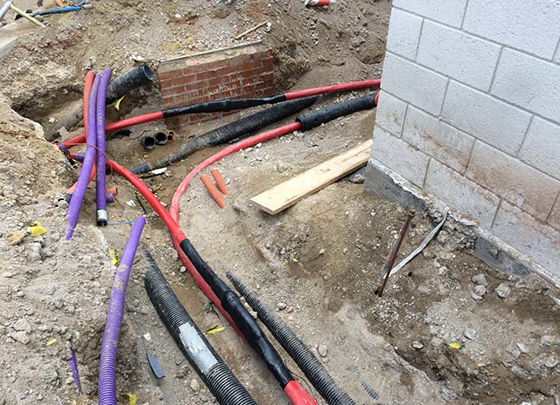 There are two types of medium voltage cable: PILC cables and XLPE cables. PILC cable have the conductors wrapped in oil impregnated paper and all three conductors sheathed in a thick lead foil sheath. This sheath is further sheathed in jute or PVC and then in steel wire armour (or double wrapped steel tape) and again sheathed in PVC or jute. Now, there is no need to remember this other than to note that a PILC cable is very different in construction to a PVC cable. An XLPE cable is different still: copper conductor/conductor screen/ XLPE insulation/insulation screen/copper wire screen/filler/binder tape/PVC bedding/SWA/ MDPE sheath.
The purpose of all of this is not to make anybody fluent in cable knowledge, it is simpler than that: all cables, at some stage, need to be terminated in a switchboard or at a transformer. Further, since cables are normally only made in 300 m lengths, all cables, if they are more than 300 m runs (as in a suburban environment) have to be jointed together. My advice is this: if the cables under consideration are medium voltage cables … then, unless you have been trained in jointing and terminating medium voltage cables, do not try and do this yourself. It is a fact that all termination and jointing kits come with a list of instructions on how to use the kit to joint or terminate the cable. Do not think, under any circumstances, that you will be able to make an effective and safe termination or cable joint by following the instructions any more than you will be able to fly a helicopter by following a book of instructions.
It is quite probable that you will be able to make a joint or termination which will not fail immediately but, joints and terminations have very long memories. If badly done they will fail, even if it takes years. Well, one imagines that the joint or termination will long be out of guarantee by then, so what? No problem if nobody is hurt. But if somebody is injured the liability does not end with the guarantee period and the person responsible (in this case you) will have to go to court where a forensic electrical engineer (such as myself) will make sure that the appropriate person gets blamed. You will not be able to claim that ‘normal wear and tear’ led to the failure since there is no movement in a termination or joint.
The result of this could be very costly indeed. I know out there is a person who is saying, well, I taught myself to do joints and termination and none of them have failed yet. I say, "well, lucky you". And finally, never, ever try joint an XLPE cable to a PILC cable unless you know exactly what you are doing. Such joints will fail. At a local refinery, a cable joint from an XLPE cable to a PILC cable was completed in 1966. In 1994 the joint blew up when a labourer dug a trench in the vicinity of the joint. The labourer died from his injuries. The failure of XPLE and PILC joints and terminations is not that common, but it does happen. Be well aware

