If you are planning the installation of lightning protection equipment on your property, the first step is conducting a lightning protection study. This does not need to be an intimidating or scary process, explains surge experts Lightning Protection Concepts (LPC). In fact, the study can be completed in just five steps…
1. Lightning risk assessment
This must be in accordance with the IEC 62305-2 standard set by the International Electrotechnical Commission, and it is used to establish the actual necessity for electrical protection on the property. The test takes numerous factors into consideration, including:
- Lightning strike density in the area
- The occupation coefficient of the building
- Fire risk
- Electrical power lines nearby
- Relative location of the site
- The information is input into computer software that then uses an algorithm to calculate the risk of a lightning strike to the property.
2. Soil resistivity testing
This information is necessary as it determines the grounding system that you will need. You need the space with the lowest possible resistance on your property, and the best method is the Wenner Four Point test. A four-pole digital ground resistance meter is used as four probes are inserted into the ground – they establish electrical contact with the ground and inject a constant current through the ground, and the resulting measurements give you the soil resistance.
3. Design
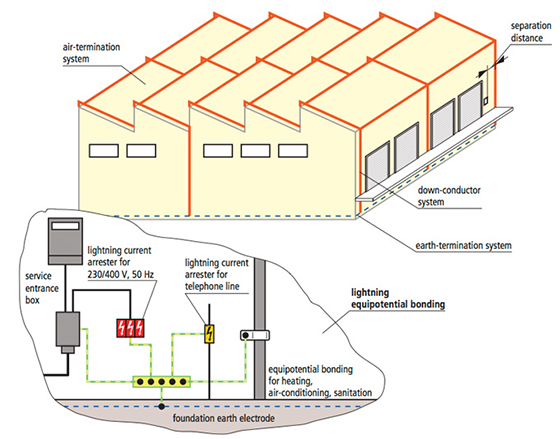
Your lightning protection system (LPS) design is an in-depth model that illustrates the system that is going to be used. Every component, cable, wire, nut and bolt is accounted for in this design, including the down-conductor system and earthing termination system.
4. Earth Termination System simulation
The Earth Termination System (ETS) must be designed in a way that lightning currents are safely diverted into the ground without fault. Once the ETS has been configured, computer software is used to run simulation tests that will calculate what the system can and cannot handle in terms of surges.
5. Insulation co-ordination study
This determines the correct mitigation against lightning electromagnetic impulses by using the risk assessment and lightning protection zoning data. It ensures that the system meets relevant industry standards and that users will be safe should an incident occur.
Enquiries: www.lpconcepts.com
Image: www.dehn.ua.com