From copper and aluminium to optical fibres – Helukabel discusses how the various conductor materials in cables and wires differ from one another.
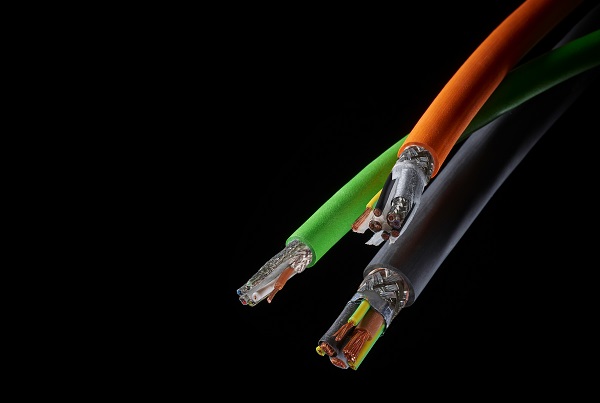
Various materials can be used as electric conductors to transmit energy, signals or data in cables and wires. The most well-known and commonly used one is copper (Cu), a very ductile metal with high conductivity. It is also flexible, high-tensile and comparatively cheap, making it the first choice for many applications.
The conductor comprises either a single wire or multiple wires twisted together to form a so-called strand. Copper can be tin-plated, for example, to make it more corrosion-resistant, or nickel-plated to improve its temperature range.
Copper, aluminium, or fibre optics?
Choosing the right conductor material is often difficult for cable and wire users.
Aluminium (Al) is another potential conductor material. Its major benefit over copper is a much lower density. But it has poorer conductivity, which means a greater cross section is required to transmit the same current. In addition, aluminium wires are less flexible and, hence, more likely to break. This makes them unsuitable for moving applications. As a result, aluminium is mainly used for energy distribution cables and medium-voltage cables where weight plays an important role.
The material with the best conductivity is silver (Ag) but it is many times more expensive than copper. For this reason, silver is normally only used in special applications where exceptional performance and efficiency are required – for example, in high-end audio.
Another possible conductor for audio cables is silver-plated copper wire which stands out for high conductivity and resistance to corrosion. The high price and poorer conductivity of gold (Au) compared to silver and copper rule this out as a conductor.
Another material that, at first glance, would also appear to be an unsuitable conductor is steel, which has a conductivity significantly worse than that of copper or aluminium. On the other hand, it is extremely strong and highly tensile. For this reason, steel is used in military and aerospace applications, often in combination with other materials such as aluminium.
Alongside all these metal conductors are optical fibres, or so-called optical waveguides. These are ideal for transmitting signals at high-speed using light. They consist of a quartz glass or plastic fibre core. The latter is more flexible and hence can be bent more easily. The core is surrounded by an optical jacket, known as the cladding. The light signals are reflected between the core and cladding and transmitted through the waveguide at high speed. Optical waveguides are used in a variety of applications, such as in telecommunications, medicine and aerospace. They cannot transmit current, though.
The best conductor material thus depends heavily on the application in question and the prevailing conditions. These must be known precisely to be able to consider the pros and cons of each material carefully. Of course, other characteristics of a cable, such as stranding, cross-section, insulation and sheathing material, also play an important role. For this reason, it is always best to seek expert advice when choosing cables and wires to ensure compliance with all the requirements of everyday use.