The latest Commodity Trade Observer report on low-voltage cable imports from March 2024 to February 2026 indicates that low-voltage cable imports have jumped 18% year-on-year to 19.27 million kilograms. Average prices have fallen sharply from R161/kg to R129/kg despite increases in raw material and logistics costs worldwide.
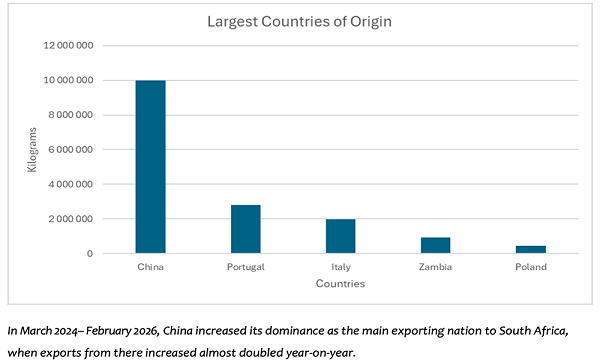
Countries of Origin for low voltage cables March 2025 – February 2026.
Andre Smith, CEO of South Ocean Electric Wire (SOEW), has warned that the continued influx of low-priced imports is accelerating the hollowing out of South Africa’s cable manufacturing sector and poses serious risks to infrastructure safety and job security.
SOEW, a subsidiary of the JSE-listed South Ocean Holdings, is one of the country’s largest manufacturers and distributors of low-voltage electrical wire, cable and accessories.
Smith said: “The data confirms what we have been seeing on the ground for some time. China has almost doubled its exports to South Africa, and we are now seeing individual shipments entering at prices as low as R3.00 per kilogram, which are simply not commercially viable for any legitimate, locally compliant manufacturer.”
“One trader alone brought in nearly 985 tonnes at R3/kg, a figure the report itself describes as a clear indication of illicit trade.”
South Africa imported a total of 35.57 million kilograms of low-voltage power cables over the two-year period, worth R5.12 billion.
- In the March 2024 to February 2025 period, 16.30 million kg were imported at a total value of R2.63 billion at an average of R161/kg.
- In the March 2025 to February 2026 period, imports rose to 19.27 million kg, an increase of nearly 3 million kilograms – valued at R2.49 billion at a significantly lower average of R129/kg.
Smith said the report indicates that China has dramatically strengthened its position as the dominant supplier of suspected inferior and non-compliant products. “While Chinese exports almost doubled year-on-year, Portugal, Italy, Zambia and Poland followed in terms of kg exported into SA. Durban remained the primary port of entry, handling the vast majority of these imports.”
He noted that the report highlights concerning patterns among individual traders. While the top 10 importers accounted for the bulk of the volume, one trader imported 984 877 kg at an average price of just R3/kg, well below the market average and flagged in the report as ‘a clear indication of illicit trade’ that ‘should be investigated in greater detail and reported to SARS for further review’. Another trader imported at R85/kg, approximately 50% below the overall average.
“These imports are not only undercutting local producers on price, but many are entering the market without proper SABS compliance, using inferior materials and failing critical local safety standards. We have already documented widespread failures in household installations, commercial buildings and critical mining infrastructure, amongst others, caused by non-compliant cables. The human and economic cost of these failures, from fires and downtime to lost productivity, is enormous.”
He emphasised the broader impact on employment and the local value chain. “South Africa’s electrical cable industry supports thousands of direct and indirect jobs, spanning raw material suppliers, drum manufacturers, and logistics service providers.”
“When factories are forced to scale back or close because they cannot compete with dumped products, the ripple effect is devastating. Local manufacturers in South Africa have the capacity to supply most of the country’s needs with safe, fully tested, SABS-compliant cables. What is missing is decisive government action to protect the local industry.”
Smith called on the government and SARS to act without delay: “We need urgent enforcement of existing standards, proper investigation of suspiciously low-priced shipments, and the implementation of targeted duties on dumped products – just as was successfully done in the automotive tyre manufacturing industry.”
“Without intervention, we risk losing the entire manufacturing sector and the jobs that go with it, while compromising the safety of our electricity infrastructure. The time for talk is over. South Africa must choose between protecting local industry and jobs or continuing to allow the unchecked importation of sub-standard, non-compliant products.”
He said SOEW remains committed to supplying the market with high-quality, fully compliant cables, supported by its accredited testing laboratory and a 35-year track record in the South African cable sector.