At 18 years old, rusted and thought beyond repair, the University of the Western Cape’s golf cart is now making headlines. A year after it was decommissioned, the cart was brought back to life as the university’s first shuttle powered entirely by renewable energy.
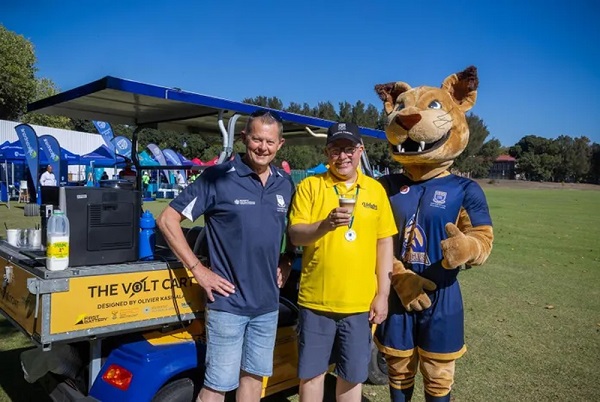
Revamped by skilled engineering graduates from UWC’s Energy Storage Innovation Lab (ESIL), the once-forgotten cart is now a bright yellow mobile powerhouse—capable of powering most household appliances. ESIL, part of the South African Institute for Advanced Materials Chemistry (SAIAMC), is a leader in South Africa’s renewable energy transition and specialises in advanced lithium-ion battery technology. It’s the only facility in Sub-Saharan Africa with its own battery cell assembly line, having developed these processes since 2011.
Nicknamed “The Volt Cart,” the vehicle still looks like a typical golf buggy at first glance. But look closer and you’ll spot its high-tech upgrades: a sleek lithium-based battery now sits at the rear, replacing the outdated and inefficient lead-acid battery.
This new battery technology extends the cart’s range to 140 km on a single charge, charges more quickly, and lasts far longer than conventional batteries. Standout features include an onboard inverter and solar roof panels for supplementary power.
The innovation lab, led by Prof Bernard Bladergroen, trains engineering graduates in renewable energy integration through a partnership with UWC, the Department of Science and Technology, and First Battery. The project began when Prof David Holgate, Dean of Natural Sciences, asked whether anything could be done with an abandoned golf cart.
Prof Bladergroen tasked his trainees—accustomed to hands-on innovation—with tackling the challenge. They dismantled the golf cart, studied its mechanics and energy requirements, then rebuilt it with modern components and a custom-assembled battery pack.
“The students needed to master integrating solar panels with the battery and inverter, making this an excellent training exercise,” said Prof Bladergroen, who highlighted the onboard inverter as a unique feature.
“What’s special is that wherever you take this golf cart, you have an AC outlet. So, if you want coffee in the middle of the cricket field, just plug in your machine and enjoy your drink on the go.”
Originally purchased in the early 2000s for UWC’s Postal Services, the golf cart once assisted the late Rudolph Christians, an employee with mobility challenges due to dialysis. Over the years, running costs soared.
“Battery replacement became unsustainable as load shedding worsened,” said Adrian Snell, Safety Officer in the Faculty of Natural Sciences.
Prof Bladergroen also noted surging global demand for lithium batteries. South Africa alone imported nearly $1 billion in 2023, underscoring the urgent need to develop local expertise.
Tragically, Olivier Kasikalaala—the lead engineer on the upgrade—passed away before the project’s completion. The team has added his name to the cart to honour his contributions.
After test-driving the revamped cart at the university’s staff Wellness Day, Rector and Vice-Chancellor Prof Robert Balfour expressed his delight.
“It was a wonderful ride. Driving a vehicle powered by clean energy means freedom from fuel price fluctuations and the worry about rising diesel or petrol costs,” he said.