Last month, the subject “Standards and Compliance” was the theme. I ended by informing you, the readers, that we will take a closer look at this subject in this edition.
You will recall that SANS 10114-1 is applicable for interior lighting, albeit a poor copy on EN 12464-1, the European standard on which the SANS is modelled.
What will you miss if you keep to SANS 10114-1?
- More detail.
- It specifies the requirements for good lighting solutions rather than giving design guidelines. With the experience of applying the standard the next steps were taken in the development of this new edition and human and user needs are given broader acknowledgement. Lighting requirements for task areas to fulfil visual tasks are given a close relation to the space in which they are carried out. Technologically LED has taking over as the light source from conventional lamps. The main changes with respect to the previous edition are:
-
- User needs are better reflected by adding an additional level of recommendations in the tables in Clause 6 next to the minimum requirements. This gives more emphasis to already existing requirements in 4.3.3.
- The impact of visual and non-image forming effects of light are elaborated in the new Annex C.
- Requirements for walls, ceilings and cylindrical illuminances are moved from the main text to the tables in Clause 6 for increased visibility and usability.
- A new chapter on design considerations (Clause 5) gives advice on how to apply the requirements when designing lighting for visual tasks and activities within a space.
- Relation between task area and its immediate surround and the background area is more detailed (4.3.3, 4.3.4, 4.3.5).
- Glare requirements have been clarified for improved usability including clarification for shielding in 4.5 and recommended practices for UGR in non-standard situations has been added in a new Annex B.
- Flicker and stroboscopic effect is updated (4.8).
- A new Annex D is introduced including examples on how to derive the requirements in different applications (office/industry) for designing lighting.
A very important section contained in EN 12464-1 is not covered whatsoever in SANS 10114-1. That is the section on Illuminances on the task or activity area, three pages of essential detail to provide professionals and lighting designers with critical information to add to their knowledge.
BHA School of Lighting has been teaching students, professionals who attend workshops and webinars the correct method to provide the correct illumination. It is wrong to provide the same illumination and thus the illuminance or lux levels throughout a space. It results in energy wastage, over illumination, boring lighting and in many cases is the cause of various workplace ailments for the occupants. Space in the article does not permit an in-depth discussion on the value of the contents of EN 12464-1.
Another important omission in SANS 10114-1, is the section that deals with “Mean cylindrical illuminance requirement in the activity space”. Good visual communication and recognition of objects within a space require that the volume of space in which people move or work shall be illuminated. This is satisfied by providing adequate mean cylindrical illuminance, Ēz, in the space.
EN 2464-1 includes the “Variability of Light” which address light that affects the mood, emotion, and mental alertness of people. It can also support and adjust the circadian rhythms and influence people’s physiological and psychological state. It addresses the general well-being of the occupants. More importantly, it complies with CIE S 026/E2018: CIE System for Metrology of Optical Radiation for ipRGC-Influenced Responses to Light. This is about the non-visual or Non-image forming illuminances and colour of light – responsible for adjusting our Circadian Rhythms and our hormone production and general body functioning.
By now I am sure that you will have gathered that there is so much more to lighting than simply installing a quantity of luminaires evenly spaced in all directions. The role of the lighting designer, particularly a lighting designer who is qualified and has a solid grounding in the theory of light and lighting, one who understands lighting for the well being of the occupants and one who understands the detail of every applicable standard for the specific area for which lighting is to be designed.
The last significant difference contained in EN 12464-1 is the tables of required maintained illuminance values. When you study the heading to the tables, you will immediately see that there are many more columns.
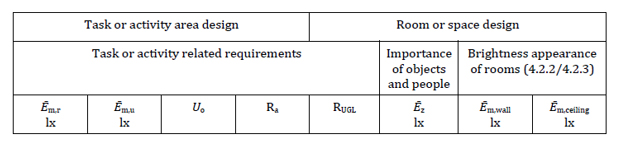
From left to right: Required lux, maximum lux, uniformity, CRI, cylindrical lux and the lux level on the room wall and ceiling surfaces.
Qualified Illumination Engineers and qualified lighting designers will have immense appreciation for the fact that all aspects of lighting to be measured are now reflected in the comprehensive tables. This makes it easy for the lighting designer to be fully compliant with Standards, Regulations and CIE Directives from the outset.
Finally, there is an entire appendix to EN 12464-1 that provides “Additional information on visual and non-visual (non-image forming) effects of light”, is provided. The contents provide one with a thorough understanding on a variety of topics, including the following:
- Perceived room brightness.
- Mean ambient illuminance.
- Mean surface exitance.
- Visual lightness and interest – 40 degree band illuminance.
- Adaptation illuminance within the normal field of view.
- The influence of spectral power distribution on non-image forming effects.
- Varying lighting conditions.
- Daylight penetration.
We have only scratched the surface of this fascinating subject. For those who are familiar with SANS 10114-1: Lighting for interiors, I hope that your interest has been stimulated and that you will purchase a copy of EN 12464-1. I always use the highest, most comprehensive, and latest standard that is available to me. Of course, I am familiar with the relevant and applicable standards from many different countries which apply to our students from those countries.
In September, we will continue this journey of discovery. I will address standards applicable to Emergency Lighting, particularly the most comprehensive and the best standard which is IS 3217. It is an eye-opener in terms of the detail. Unfortunately, SANS 10114-2 falls very far short of IS 3217.
Once again, I am always prepared to assist any of the readers and give basic advice about lighting to minimise their risk of non-compliance. Until the next episode in the fascinating journey into light and lighting next month, stay safe!
Enquiries: phil@bhalighting.co.za