In the world of lighting, two terms often surface when discussing brightness and performance: lumens and lux. While they sound similar and both relate to light, they measure very different things and understanding their distinction is essential for anyone specifying, designing, or installing lighting systems. Aurora Lighting Africa believes that informed choices lead to better, more efficient, and more sustainable lighting outcomes.
 Lumens: measuring the total light output
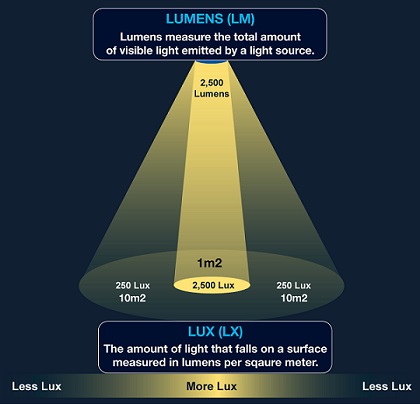
Lumens (lm) represent the total amount of visible light emitted by a source, regardless of direction. In simple terms, lumens quantify how much light a lamp or fixture produces in total. It’s the raw measure of brightness that comes straight from the source.
For example, a 10 W LED downlight might produce around 900 lumens, whereas a 60 W incandescent bulb emits about 800 lumens. Despite consuming less power, the LED produces more light, showcasing its superior energy efficiency. When consumers look at packaging or specifications, lumens indicate how bright the lamp or fitting will appear overall, a key factor in energy comparisons and product selection.
However, lumens don’t tell the whole story. A light source could have a high lumen output, but if that light is not directed or controlled effectively, much of it may never reach the intended area. That’s where lux becomes critical.
Lux: measuring light where it matters
Lux (lx) measures illuminance, or how much light falls on a given surface. One lux equals one lumen per square metre. In other words, lux quantifies the intensity of light on a surface, not the total light produced.
Consider two identical 1,000 lm fixtures: one mounted high above a warehouse floor and another positioned closer to a workbench. The first will spread its light over a wide area, resulting in fewer lux (lower brightness per square metre), while the second will concentrate its light on a smaller area, producing more lux (higher brightness where needed).
For lighting designers, architects, and engineers, lux is a far more practical measure than lumens. It determines whether a space is adequately illuminated for its purpose. For example:
- An office typically requires 300–500 lux for comfortable reading and computer work.
- Retail environments may aim for 750–1,000 lux to highlight merchandise.
- Warehouses might need around 200 lux, while detailed assembly work could demand 1,500 lux or more.
Why both matter
Understanding the difference between lumens and lux helps ensure that lighting installations deliver both efficiency and effectiveness. Lumens allow us to compare products and evaluate energy performance, while lux ensures that light is properly distributed for human comfort, safety, and productivity.
Aurora Lighting Africa designs lighting solutions that balance high-lumen efficiency and precise optical control to deliver the right lux levels exactly where they’re needed. Whether illuminating a corporate office, an industrial site, or a retail environment, our goal is to enhance visual comfort while maximising energy savings.
“At Aurora Lighting Africa, we don’t just measure how much light a product produces, we measure how effectively that light transforms a space. Understanding lumens and lux isn’t just technical knowledge; it’s the foundation of creating environments that feel brighter, safer, and more human,” says Scylagh Clunnie, managing director of Aurora Lighting Africa.
In essence, lumens measure light at the source, while lux measures light in use. By understanding and applying both, we can transform spaces not only with brightness but with purpose, precision, and sustainability.