10
CONSTRUCTION WORLD
JUNE
2014
>
MARKETPLACE
At the prestigious annual event
which was held at The Maslow,
Sandton in April, Van Eeden took
home a prize of R50 000. This is in
addition to the R8 000 prize that she earned
on winning the regional final in September
last year. The Corobrik Architectural Student
of the Year Awards were created to promote
quality design and to acknowledge talent
among architectural students.
Edna Perez, who supervised Van Eeden’s
entry said that the awards were important
as they motivated students to think about
their roles as architects in a fast-changing
world by rewarding them to become the best
designers they could be.
“I believe winning an award like this is
beneficial to the recipient's career in that it
demonstrates a level of competency, inge-
nuity and also communication that is neces-
sary in practice.
“In addition, I think these awards are also
important for the profession as they offer
an opportunity for reflection and forward
thinking,” she said.
Van Eeden’s dissertation alludes to
new ways of architectural place-making in
a rapidly changing, 21
st
-century world. The
project investigates the potential of industry
as urban catalyst – a mechanism with which
to regenerate urban environments and re-in-
tegrate fragmented socio-ecological systems.
In an attempt to redefine modern
concepts of waste and mitigate the flood of
pollution emanating from 20
th
century indus-
trialisation, the investigation is focused on
the re-structuring of the textile industry and
is contextually based in an ‘urban waste-
land’ – the Daspoort Wastewater and Sewage
Treatment Works.
“The site is re-programmed as part of
a new industrial ecology, an architectural
system which re-uses waste water and other
untapped resources on site to produce textiles
and algae-based dye. By integrating local
urban communities and natural eco-systems
with this industrial space, this 21
st
-century
textile mill is designed as a holistic environ-
ment which blurs present-day distinctions
between social, productive and natural space
and proves that there is productive value in
the resources we discard as waste,” she said
in the abstract to her dissertation.
Perez pointed out that, in a world where
architecture's ability to navigate an uncertain
future was increasingly being questioned,
Van Eeden explored one of the biggest chal-
lenges of our time – how to transform wasted
sites, wasted structures and wasted land into
sites that can regenerate conditions within
which life can flourish and evolve.
Corobrik managing director Dirk Meyer
Architecture of
THE FUTURE
University of Pretoria student, Heidi van Eeden, has taken first
place in Corobrik’s 27
th
Architectural Student of the Year Award
with her dissertation ‘Machinarium: Architecture as a living
machine, a 21
st
century textile mill’.
said that in recent years, there had been an
exciting evolution in the architectural debate
surrounding issues related to sustainability
which was clearly manifesting in the work
and thinking of the architects of tomorrow.
This new urban architecture not only
concentrated on top-of-mind environmental
issues but on more deep routed social issues
associated with the creation of a built envi-
ronment that addressed the needs of its
users and created a sense of place. Through
rejuvenating tired or dilapidated structures
and spaces rather than completely rebuilding
them, precious resources were conserved.
At the same time, the history of the site was
integrated with modern lifestyles, becoming
an exciting part of South Africa’s reality.
Judging
In their critique the judges commented: “The
reinterpretation of architecture as a living
machine, this project reconnects a commu-
nity with its history and with a nearby river
as well as re-looking at the idea of waste as a
resource. It achieves a well-considered urban
design resolution. The author demonstrates
a great maturity and professionalism.
The depth of research is astounding. The
completeness and thorough examination
of the design of a complex building type is
exemplary. This level of research and reso-
lution could be applied to address similar
urban problems. The imaginative reuse of
obsolete infrastructure is resourceful. Ideas
were well presented, verbally and graphically
demonstrating a high degree of competence.
The judges are confident that this
building is buildable. It provides an uplift-
ment to the immediate community it benefits
by acknowledging an inherent industry and
supporting its growth. It will be an asset to
the city of Tshwane”.
This year’s judges were president of the
South African Institute of Architects (SAIA)
Sindile Ngonyama and professional archi-
tects, Ruben Reddy and Amanda Katz.
From left: Peter Kidger – Corobrik; Heidi van Eeden – University of Pretoria and winner of the 27
th
Corobrik Architect Student of the Year Award; Peter du Trevou
– Corobrik; Tarryn Michael – University of Witwatersrand; Talia Orli Gild – University of Cape Town; Mongezi Ncube – University of KwaZulu-Natal; Dylan Watkins
– University of Johannesburg, Thilo Sidambaram – Corobrik; Wynand Viljoen –University of the Free State; Marco du Plessis – Tshwane University of Technology;
Mientjie van Niekerk – Nelson Mandela Metropolitan University and Dirk Meyer – Corobrik.
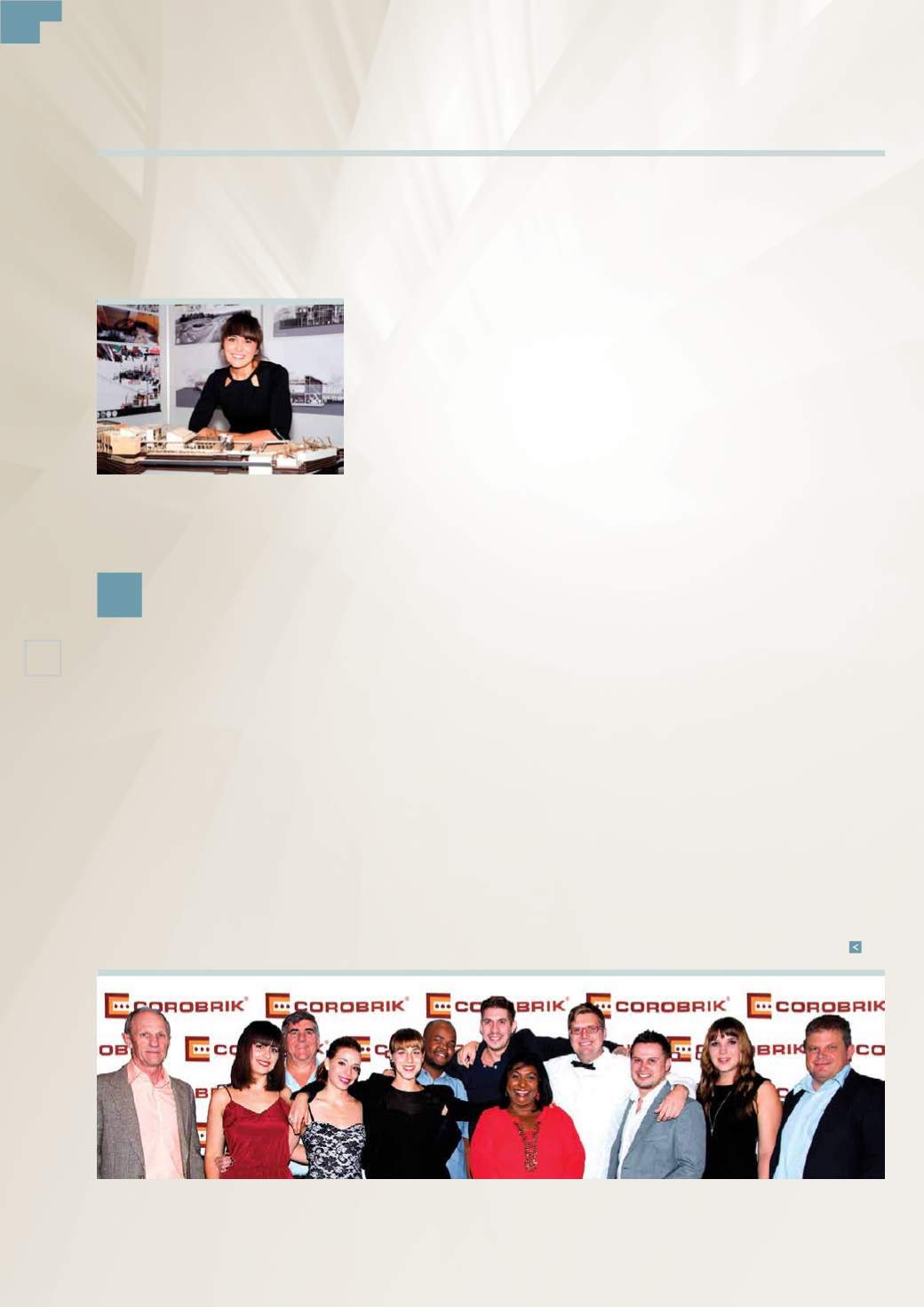
Heidi van Eeden is pictured with the model of her
winning entry entitled ‘Machinarium’. She has
won the 27
th
Corobrik Architectural Student of the
Year Award held at The Maslow on 9 April 2014.
>


