34
CONSTRUCTION WORLD
MARCH
2014
PROJECTS AND CONTRACTS
become the world’s first fully enclosed
grassed stadium.
Aurecon used advanced modelling
and simulation techniques to verify that
the adequate air ventilation and sunlight
exposure can be maintained for grass
health within the fully covered stadium.
The solution was subsequently recognised
with a Merit Award in the 2013 Association
of Consulting Engineers New Zealand Inno-
vate NZ Awards of Excellence.
Melbourne’s
55
000-seat
Etihad
Stadium is one of Australia’s leading
multi-purpose venues catering for major
sport and entertainment events.
Its natural turf is maintained in a
healthy condition through the stadi-
um’s fully retractable roof that takes only
eight minutes to close. As part of the turf
management process localised grow lights
are utilised particularly on the higher
wear areas over the pitch. This combined
strategy has delivered high quality grass
despite the busy event schedule of this
world class stadium over many years.
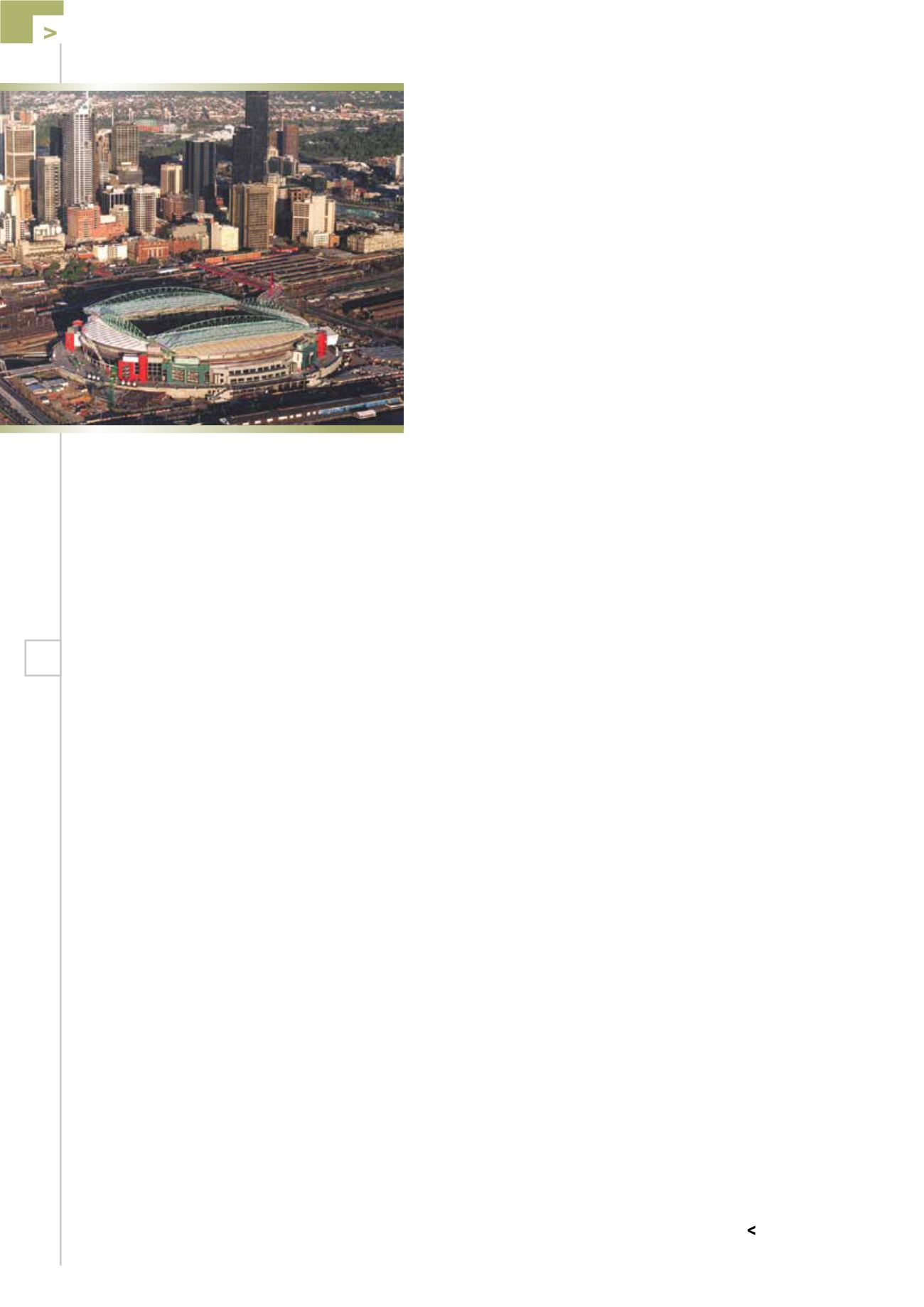
Etihad Stadium, Melbourne features a
fully retractable roof with ample ventila-
tion, which helps to maintain its natural
turf in peak condition.
Aurecon was responsible for the
stadium’s full structural and MEP design
including performance-based fire engi-
neering as well as the sophisticated, multi-
mode sports lighting design, public address
systems and scoreboards.
Ensuring multi-use
functionality
Increasingly, stadiums must
be adaptable, high performing
buildings that achieve multi
-use functionality.
The trend is for physical flex-
ibility, which means designing
to be able to shrink capacity
using modular and demount-
able construction.
Upper tiers and even upper
structures can be removable.
While this appears straight-
forward structurally, one of
the challenges is that building
services also need to be modular
and demountable. An elegantly
simple solution in some arena
type venues, such as the Perth
Arena in Australia, is to have curtains that
can close off the back tiers seating to create
a cosier ambience during smaller events.
The vibrations induced by crowds’
synchronised motions need to be carefully
studied in the design of the seating tiers.
These days we use sophisticated analytical
tools to predict the expected level of accel-
erations at every seat on the tier to ensure
the acceptable thresholds are not breached
in lively sports and concert events.
High-tech thinking
Technology and fan engagement will be
the key in the future. Whether it is through
additional in-game augmented reality
content, delivered direct to spectators’
smart phone applications, enhanced pre-
and post-match family orientated enter-
tainment produced by in-house production
teams, or unique rewards for attending
matches such as special food and beverage
incentives, the final end game is to draw
fans away from their living rooms and into
the stadium.
A key trend in leading stadiums is high-
tech with WiFi that will allow fans to use
their own smart phones. Technology is
racing ahead and soon the use of multiple
cameras and more sophisticated broad-
casting technology will enable fans to
select and track the activities of their sports
idols on their smart phones.
In addition, advances in computer
technology are quite literally breath-taking
and will mean modelling techniques such
as Building Information Modelling (BIM),
Finite Element Analysis (FEA) and Computa-
tional Fluid Dynamics (CFD) are becoming
‘business-as-usual’, extending the bound-
aries of structural form and architectural
expression ever more rapidly. These tech-
niques are, at the same time, ensuring safety
and promote time and cost savings.
Increasing attention is being given
to sustainability aided by the strength of
our modelling capabilities. This will be
reflected in stadiums consuming less area
and tonnage of material, onsite power
generation with photovoltaic arrays on the
roof, grey water reuse, thermal storage, and
a stronger focus on carbon neutrality.
Meeting tight time and
budget constraints
We are always very aware of the need to
deliver on time, on budget and manage
the risks to the client in doing so. The fact
that a stadium is an unusual building and
an increasingly complex form with many
components means the risk of exceeding
time and budget is often very significant.
Effective management of the plan-
ning of design and construction is vital. A
project team is required to have an in-depth
understanding of how the decisions they
make impact on cost and programme and
how factors such as supply chain and the
need for any specialist skills impact on
project delivery.
Creating fan comfort
The current stadium design buzzword is
‘Fan First’. We have a role to play in deliv-
ering stadium projects that encourage
fans to leave their comfortable couch
and big screen TV, and look forward
to having a great time in the stadium.
This means considering what makes the
experience at the stadium as good as it can
be for the fans.
The key word here is ‘comfort’:
today not only is shading a given, but
increasingly air conditioning and cooling
has to be provided.
We have been developing concepts
such as the installation of cooling pipes
in the concourse slabs and displacement
air-conditioning delivered via plenums
under seating platforms throughout the
stadium as a sustainable way of achieving
a comfortable environment.
Even the layout of the premium seats is
influenced by the need to facilitate delivery
of food and refreshments, so that well-
heeled fans do not to miss any action by
having to leave their seats for refreshments.
We are also seeing a big push in parts
of the world for localised produce and
gourmet food to be sold in and around the
venues, rather than your standard pie and
chips. These creature comforts, integrated
with an in-seat food and beverage service
smart phone application, provide a unique
stadium only experience that cannot be
replicated at home.
Etihad Stadium, Melbourne: Etihad Stadium
features a fully retractable roof with ample
ventilation, which helps to maintain its
natural turf in peak condition. Aurecon was
responsible for the stadium’s full structural
and MEP design including performance-based
fire engineering as well as the sophisticated,
multi-mode sports lighting design, public
address systems and scoreboards


