A
bout the author
Luiz Rzezak is the regional sales manager for Elspec in
South America. He has 25 years’ experience in sales, mar-
keting, and market development in various electrical and
electrical software support systems. Luis is responsible
for securing a significant market presence for Elspec in
South America. Enquiries: Impact Energy. Email Wayne@
Impactenergy.co.za.
T
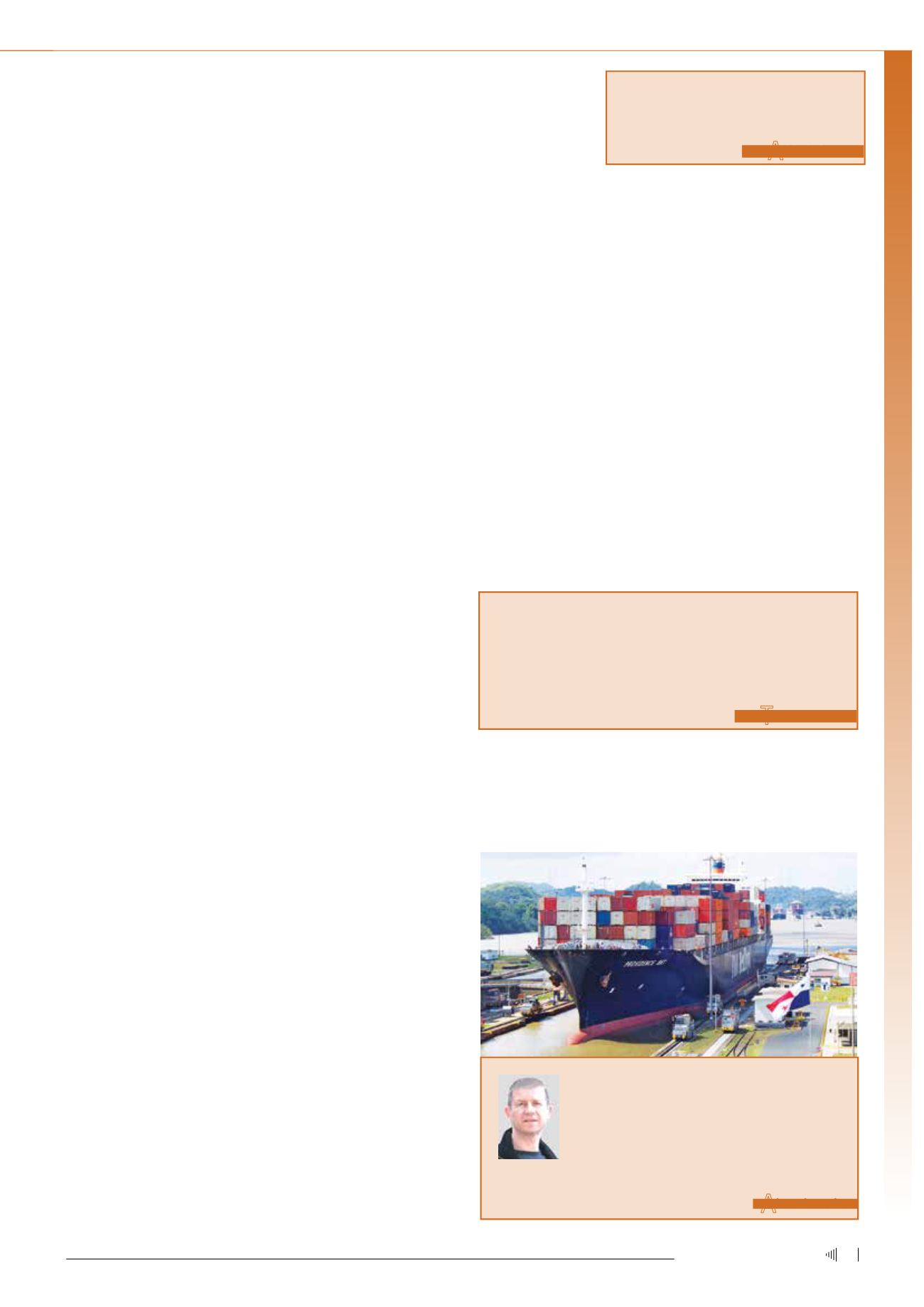
he Panama Canal, the waterway between the Atlantic and Pa-
cific Oceans, provides transit service to vessels of all nations,
some 13 – 14 000 per year. This number accounts for approxi-
mately 5% of the commercial world trade. The canal uses a series
of locks, as well as a tow track with a fleet of locomotives to transit
vessels through the canal. The Panama Canal had problems due to
a 90-year old weak grid. The locomotives that pull the ships through
the canal had extremely heavy and fast changing loads caused by
the many starts and stops, thus creating power quality and voltage
stability issues. The locomotives require delivered power to be free
of transients, over and- under voltage, unbalanced voltage and cur-
rent and must maintain a stable frequency to ensure a safe transit.
The hilly terrain added to the complications. Locomotives would
cease to function on uphill climbs; they often plummeted backwards,
crashing into oncoming locomotives. The canal hadmany technicians
and maintenance crew on duty 24 hours a day. The Panama Canal
Authority (ACP) searched for a solution to their PQ problems with
the following objectives:
• Improving the electrical quality in the Panama Canal locks
• Reducing the impact of the fluctuations and disturbances of
voltage on the equipment and machinery in both the locks and
locomotives
• Implementing a monitoring system in a local and remote meth-
odology
• Reducing or avoiding delays at the locks due to electrical distur-
bances.
Panama Canal locks dynamic VAr
compensation project
Initially, four prototype Equalizer systems were installed by ACP per-
sonnel in the Miraflores Lock central east wall in the four transformers
that feed the locomotives. The Equalizers were then monitored for
three months before the entire project was realised. An additional 44
Equalizer systems were then installed by ACP personnel on both the
Pacific and Atlantic sides of the canal with a final inspection made by
the ACP with system start-up performed by Elspec. Immediately upon
installation, the three locks (Miraflores, Pedro Miguel and Gatun) saw
an almost complete mitigation of voltage disturbance. Machinery,
which may have gone off-line because of the disturbances, continued
running smoothly, eliminating the costly delays in traffic flow.
T
ake note
In addition, harmonic distortion, especially the 5
th
and 7
th
was drasti-
cally reduced. All 48 ‘Equalizer’ systems were also equipped with the
G4K BLACKBOX and connected to the ACP’s SCADA system, enabling
the ACP to continuously monitor the electrical network of the locks.
The G4K has many advantages in relation to the competition, one of
the most important being the capacity to record all of the electrical pa-
rameters cycle-by-cycle with no need to establish limits (thresholds).
Conclusion
The installation of the Equalizer systems have eliminated costly transit
delays in the Panama Canal locks by improving power quality and
reducing harmonic distortion.
Transformers and substations
Panama Canal
locks – dynamic VAr
compensation project
By L Rzezak, Elspec
Compensation of reactive energy, voltage control, harmonic filtering and power monitoring solve a serious problem in the locks of the Panama Canal.
A
bbreviations
ACP – Panama Canal Authority
SCADA – Supervisory Control and Data Acquisition
PQ – Power Quality
• The Panama Canal had serious problems due to a 90-year old weak
grid.
• Improving the electrical power quality in the Panama Canal locks was
necessary for the safe transit of vessels.
• The systems installed improved power quality and reduced harmonic
distortion - eliminating costly delays.
31
December ‘13
Electricity+Control


