Mechanical Technology — May 2013
17
⎪
Proactive maintenance, lubrication and contamination management
⎪
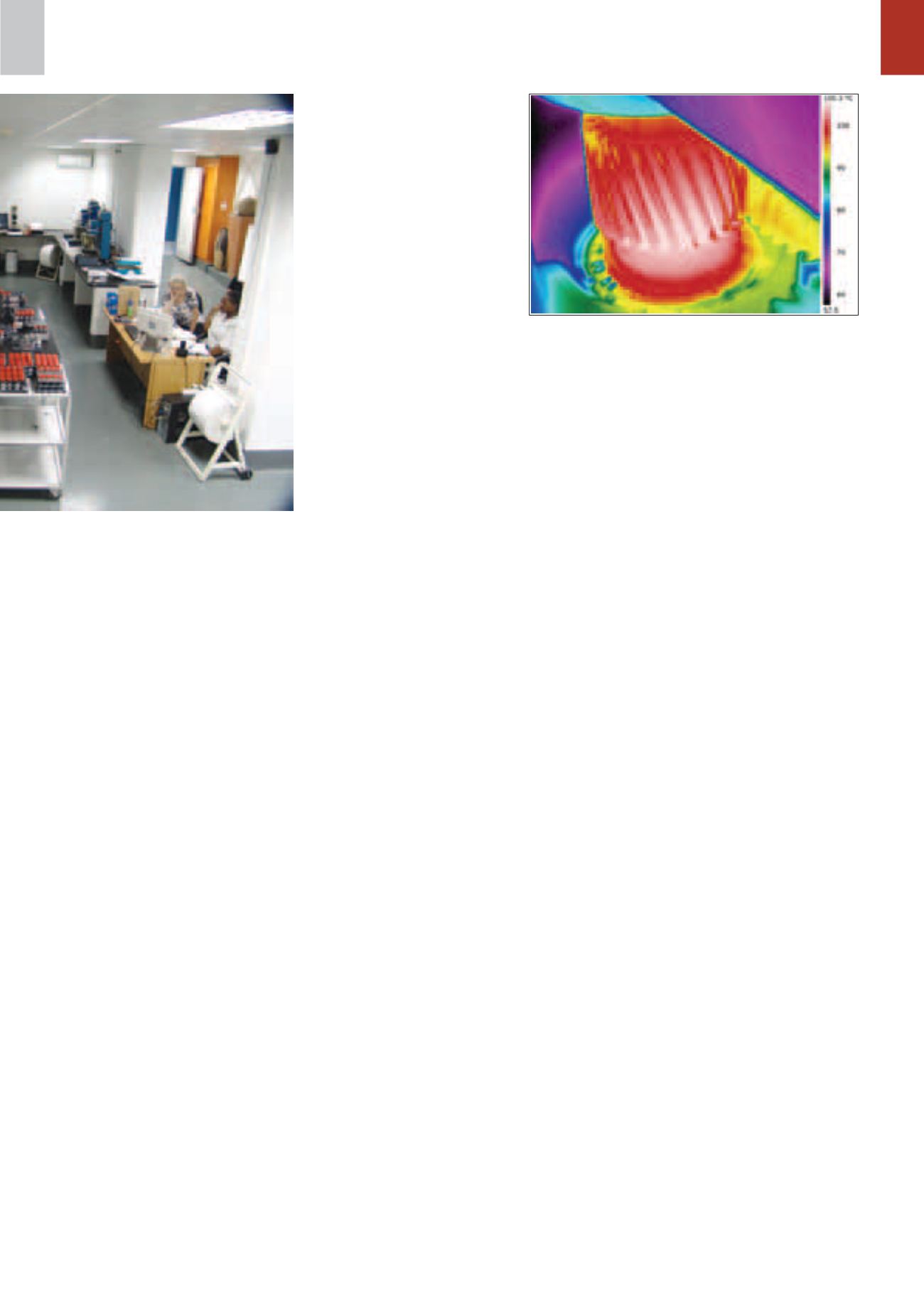
Thermography gives an indication of a component’s surface
temperature once the machine problem has started to gener-
ate friction and heat.
on every corner, but you can never be
sure that the one you catch is going to
arrive. If you look at a plant, availability
is about the plant being able to produce
at some level, while reliability relates
to the probability that an individual
machine will break down.
“Increasingly, modern operators
today are focusing on plant health,
to improve the reliability of individual
machines and, more importantly to
maximise availability and production
efficiency,” Schutte argues. “And condi-
tion monitoring is the fundamental tool
to help people to assess plant health,”
he advises.
Describing WearCheck’s Reliability
Solutions’ offering, Schutte says that
if you look at condition-based mainte-
nance for rotating equipment, the cen-
tral pillars are oil analysis, vibration and
thermography. Then, if you look at the
proactive maintenance side, alignment,
balancing, oil filtration and purification
are the cornerstones. “Basically it is all
about extending the productive life of
machines,” he adds.
Turning his attention to the different
condition monitoring methods, he says
that every machine has a specific life
expectancy that can be summarised on
a graph. Initially, while the machine is
new, it might be 100% reliable. But it
immediately begins to wear and you
can track this wear by counting the
fine particles that accumulate in the oil
samples. “If the machine is monitored,
the first indication of an impending fail-
ure will be vibration, and as soon
as a problem has been detected,
you no longer have 100% reli-
ability. You have a defect that you
know about, so from then on, it’s
all about prolonging the life of the
machine and minimising the risk
of a catastrophic breakdown,” he
maintains.
The second indication of an
impending failure will be the oil
analysis results. “Normal wear
appears as fine particles, but as
soon as components begin to fail,
larger ‘chunks’ begin to appear in
the oil. In a gearbox, for example, you
see natural wear as a number of parts
per million of fine particulate. But as
soon as you see larger particle sizes,
you know that pieces are being knocked
off teeth or off the ball bearings,” he
explains. “Sometimes, from the com-
position of the particles, you can tell
which component is going to fail, but
it is vibration analysis that will tell you
exactly which component is failing and
where it is in the gearbox,” he explains.
Thermography, which uses the infra-
red (IR) spectrum to give an indication
of a component’s surface temperature,
can only detect defects later, once the
machine problem has started to gener-
ate additional friction and heat. “And
the last indications of an imminent
failure are physical, ie, we can see, hear
or feel the machine shaking, knocking
or vibrating. You then know that a
breakdown is about to happen or that
the machine is nearing the end of its
life,” Schutte informs
MechTech
.
And the approach applied to ma-
chines can also be used to proactively
maintain the condition of oil. “Oil has
two functions, it controls temperature
and it lubricates. On a large turbine you
might have 20 000
ℓ
of oil, so you want
to keep the oil in good condition for as
long as possible.
“So you analyse the condition of
the oil itself, its lubrication properties,
viscosity, contamination levels, the to-
tal acid and total base numbers (TAN
and TBN), for example, and instead of
simply replacing the oil, you use better
filtration and blend in additive packages
to change the chemistry and get the oil
back to its ideal condition. So the life of
the oil is extended without any risk to
the machine,” Schutte says.
WearCheck Reliability Services offers
three levels of service. “At large plants
we have people permanently on site, at
several power stations, for example, and
they have daily routes to monitor critical
equipment and to collect oil samples.
Typically, vibration and oil analysis of
a machine is done every month, with
thermography readings being done
quarterly or bi-annually, depending
on the machine’s mean time to failure
(MTTF) statistics. At these plants, the
idea is always to identify problems well
in advance so that they can be rectified
during a planned maintenance outage
at a non-critical time,” Schutte says.
At the second service level, Wear-
Check specialists go to a plant on a
monthly basis to capture the data.
This is then analysed at the WearCheck
laboratories and a comprehensive report
is sent to clients. “The third option is
for the plant maintenance personnel to
collect their own oil samples and to use
their own condition monitoring equip-
ment to collect the data. But we have
the analysis expertise and laboratories,
so we will do the analysis, report back
and recommend proactive action,” he
notes.
“At the end of the day, no matter
what equipment or methods you are
using or how expensive, well-designed
or critical the machine, you need people
who can diagnose problems accurately
so that they can be rectified properly.
It is the expertise of our people that
enables accurate diagnoses, and it
is this accuracy that is at the heart
of proactive maintenance,” Schutte
believes. “With our oil expertise, along
with the expanded condition monitor-
ing abilities, we have now become a
one-stop shop for any industry needing
to improve plant health. We are now
able to offer the most comprehensive
range of reliability services available,”
he concludes.
q


