Mechanical Technology — February 2014
19
⎪
Materials handling and logistics
⎪
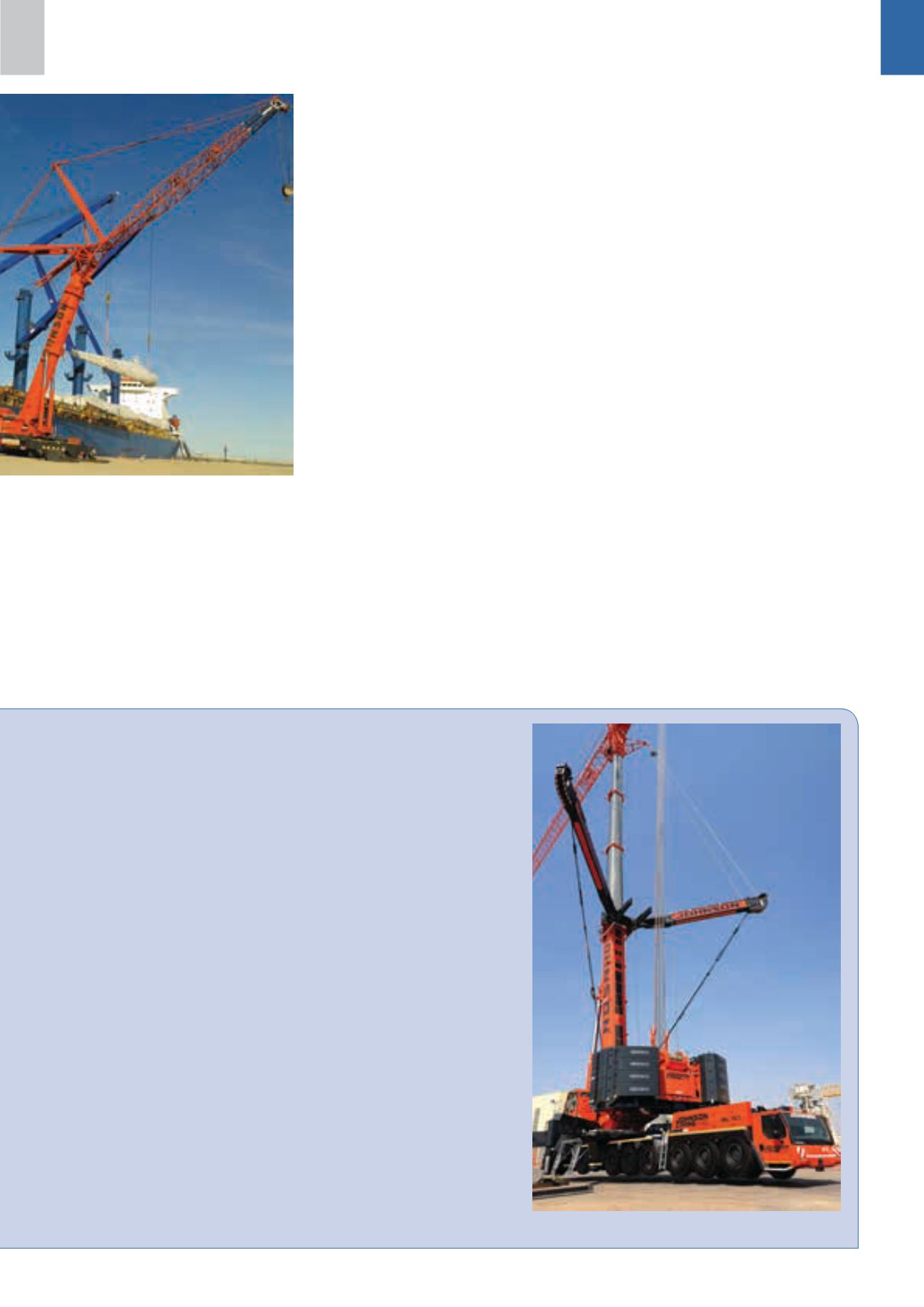
The new Liebherr LTM 1750, ready to lift.
commitment is to provide a value
added solution to customers’ lifting
requirements that includes the latest
technology, as well as all the neces-
sary risk assessments and rigging
studies, with lifts carried out by fully
qualified operators.
“Safety is a key driver in our in-
dustry and the new 750 tonner has
several important safety features.
For example, as an alternative to
lifting smaller pieces of equipment
up to a height and then assembling
them in the air, this crane makes it
possible to pre-assemble a bigger
component on the ground before
lifting it in its entirety. This goes a
long way to eliminating delays and
improving safety.”
Other safety features include
a guy line that runs all the way
along the top of the crane, to which
safety harnesses can be attached,
as well as hand railings in strategic
positions. In a major technological
advancement, all functions of the
crane can be remotely controlled via
a Bluetooth controller. This allows
the operator to stand alongside the
crane during the installation of the
outriggers, to enable him to observe
the operation from ground level.
The Liebherr LTM 1750-9.1 also
features improved roadability, owing
to removable rear outriggers. The unit
has a fifth outrigger positioned at the
back of the crane that enables it to
lift these rear outriggers off a truck,
place them into position and pin
them back onto the crane, effectively
eliminating the need for a smaller
crane to assist with this procedure.
This nine-axle crane also makes
it possible to keep the complete
telescopic boom attached during
transportation on public roads.
The longest combination of the
new unit is its 52 m telescopic
boom, which can be lengthened by
adding another 19 m of main boom
extension. The crane has 91 m
of luffing fly jib and in full con-
figuration it reaches approximately
160 m high. In addition, where
conventional cranes only allow jib
offsets at fixed angles, the new crane
incorporates hydraulic cylinders that
allow for rapid offset adjustments
at any angle between 0 and 38°,
under load.
q
the ship was turned around and we
repeated the process of moving up and
down the quayside to lift and offload
the remainder of the components.
Concurrently with Johnson Crane Hire’s
lifting exercise, a third party was busy
offloading the large turbine blades from
the ship, so the area was extremely
congested,” Simmons continues.
Prior to the actual lifts, the Johnson
Crane Hire engineers carefully planned
the exact positioning of the crane to
ensure that the loading on the quayside
was within acceptable limits. “The total
loading on the quay comprised 165 t of
counterweight, 96 t of crane and up to
86 t of cargo. The edge of the quayside
is concrete, with an inner gravel por-
tion, which the crane traversed on each
horizontal movement along the length of
the ship. Once the crane was again in
position for a lift, we strategically placed
the outriggers on the quay’s concrete
load bearing beam, which was a mere
300 mm wide,” he says.
The components lifted and offloaded
included 18 freestanding nacelles each
weighing 86 t and 28 tower sections,
each weighing 62 t and with a length of
22 m. “And the docking fees are high,
so we were forced to mobilise our team
very quickly in order to reduce the ship’s
time in port,” adds Simmons.
“Unfortunately, due to the high
winds common in the area, we were
forced to schedule our lifting time to pe-
riods when wind speeds would be lower.
Using long-range forecasts through
Windguru, together with handheld wind
speed devices and the crane’s own wind
speed meter, we discovered that this
was generally at times between 18:00
and 21:00. We were fortunately granted
permission by the Port authorities to
operate a 12-hour shift and we used
the ship’s bulk to partially shelter us
from the wind,” Simmons says.
“Other aggravating factors that the
Johnson Crane Hire team had to con-
tend with were the movement of the
ship due to tidal activity and the shifting
of the ship as weight transfer occurred.
We took great care to ensure that the
outer fibreglass shell on the components
was retained in pristine condition,” he
points out.
“I can truly say that these lifts have
been precedent setting in terms of the
challenges faced, how we overcame
them and the sheer weight of the lifts.
The fact that we were able to accom-
plish these lifts in such a short space of
time and coordinate our movement with
the other quayside activities, underlines
JCH’s commitment to customer-centric,
quality service.
“As testament to our company’s ex-
perienced and skilled teams, we used a
different crane and crew on each of the
April and June lifts. Extensive training
of our operators and rigging crews en-
sures that they are able to leverage their
knowledge on other heavy lifts to provide
customers with a quick, yet safe lifting
experience,” Simmons concludes.
q


