Mechanical Technology — February 2014
23
⎪
Materials handling and logistics
⎪
Condra enters Class 4 market
C
ondra, a leading Johannesburg
crane manufacturer, is to expand
production at its Germiston fac-
tory to include very heavy duty Class 4
machines, allowing the company to ag-
gressively target the market for this type
of crane throughout Africa.
Condra, announced during December
the extension of its existing agreement
with Russian partner Vniiptmash to pro-
vide for two-way import and export crane
component flow between the two entities,
comprising hoists, crabs, end-carriages
and bottom-blocks manufactured by both
companies. Class 4 components made by
Vniiptmash in Russia will be imported by
Condra and married to crane girders and
other structural elements fabricated in
South Africa, while Condra will continue
to manufacture components for Class 1,
Class 2 and Class 3 cranes for export and
incorporation into Vniiptmash structures
manufactured in Europe.
Condra has full GOST certification, the
Russian Federation’s equivalent of ISO
9001, and has actually possessed proven
Class 4 manufacturing capability for some
years. However, it had preferred to focus
on Class 3 machines, venturing into the
Class 4 arena only once, for a 50 t crane
for Zimbabwe’s iron and steel company,
ZISCO, in 2001, a machine that is still
operating today.
Other very large cranes such as
Condra’s 140 t double-girder maintenance
crane for Tati Nickel and the 150 t main-
tenance cranes for the primary crusher
plant at Sishen, have always been to Class
3 specification.
The company’s orders from Russia,
typified by the 38-metre span 70/12/5½-
ton cabin-controlled, double-girder ma-
chine installed in a power generation plant
in Russia’s Ural Mountains, have similarly
all been Class 3 machines.
AISE Technical Report Number 6,
Specifications for Electric Overhead
Travelling Cranes for Steel Mill Service
,
defines a Class 4 crane as one designed
for severe material handling duty over two
million cycles, applications typically found
in foundries (lifting and moving hot metal
ladles), ports (ship to shore loading and
offloading), and in nuclear power plants,
for example. Recently, there has been
increasing pressure on Condra to extend
its robust and reliable line of Class 1, 2
and 3 cranes into this classification so
that the company can respond to enquiry
documents spanning all four classes.
At ArcelorMittal’s greenfield iron ore
mining project in Liberia, for example,
a Class 4 capability would have allowed
Condra to tender for the ladle cranes as
well as the workshop crane, maintenance
crane and service crane contracts that
it won.
Condra’s partner in Russia, Vniiptmash,
has also, for some time, been moving
Condra towards Class 4 manufacture for
the African market as a logical extension
of its European focus on cranes with very
heavy lifts and duties. Vniiptmash is one
of eastern Europe’s preferred manufactur-
ers of Class 4 cranes for nuclear power
stations.
Implementation of the Class 4 capabil-
ity will extend Condra’s product offering
in Africa all the way from 500 kg chain
hoists to the multi-hundred ton double-
girder Class 4 overhead travelling cranes
needed for Africa’s nuclear power plants
of the future.
q
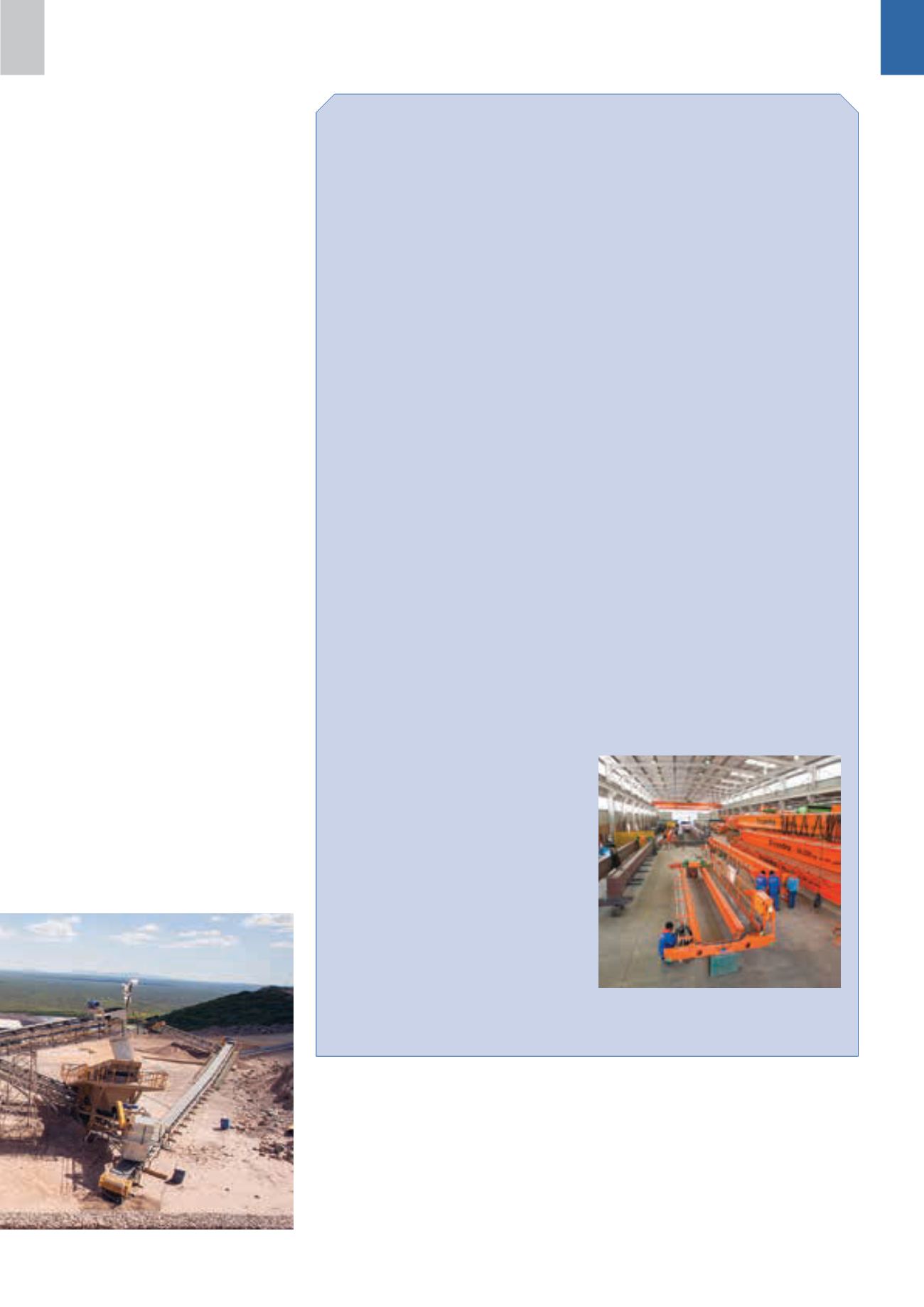
Condra’s factory at Raceway Industrial Park,
Germiston, which is being upgraded to
enable the manufacture of Class 4 machines.
success
from China are being shipped to mines
around Africa. It’s a reflection of the
exceptional quality of Osborn’s equip-
ment,” he says.
Osborn won the R20-million export
order from a Chinese iron ore operation
amid stiff competition from leading
global players.
The Osborn modular plant – which
Botha says will replace a “locally-made
kit” at the Chinese operation – com-
prises a primary Osborn jaw crusher,
secondary cone crusher, screen and
tertiary cone crusher. With a capacity of
300 tph, the Osborn plant will produce
a nominal -12 mm product.
Osborn has partnered with a China-
based company that will undertake the
manufacture of the plant’s conveyors.
“This order is the latest in a series of
sales that Osborn has netted – locally
and further afield – for its SA-designed
and built modular crushing and screen-
ing plants. The company has recently
supplied modular plants to several
South African mines, as well as opera-
tions in Lesotho, Mozambique, Zambia,
Burkina Faso, Guinea and Namibia,”
Botha reveals.
“New and existing customers are
recognising the value of Osborn’s ex-
ceptional modular plants. They are easy
to build and are mounted on skids, so
they are easier to set up. They are also
easy to transport and re-erect on a new
site. These plants are designed to fit into
containers when they are dismantled,
which makes transportation easier
and cheaper. There is less ‘civils’ work
involved and they can be transported,
assembled and dismantled easily and
quickly. Customers also recognise that
Osborn’s machines are robust and wear
resistant, having dead-box areas to
improve liner wear and machine wear.
It is proving to be a recipe for success.”
Three plants are available, in differ-
ent sizes: A modular jaw crushing plant
(sizes 2540, 3042, 3055, 3648); a
modular cone crushing plant (sizes 38,
44, 52, 57); and a modular screening
plant (sizes 6’, 7’ and 8’ double and
triple decks). With the addition of its
KPI-JCI vertical shaft and horizontal
shaft impactors to the modular set-up,
Osborn also offers full quarry processing
plant solutions.
q


