16
Mechanical Technology — February 2014
⎪
Materials handling and logistics
⎪
M
&J has a longstanding re-
lationship with Black Rock
Mine, having previously
designed and manufac-
tured 29 of the mine’s chute systems.
“We receive repeat business from our
customer base for a number of reasons.
Before any project is undertaken, we
carefully and extensively consult with
the customer regarding their specific
needs,” says Mark Baller, managing
director of M&J Engineering.
“It is important to factor in the
direction of flow and velocity of the
calculated volume and type of material
in each application, while taking into
account belt width, belt speed, mate-
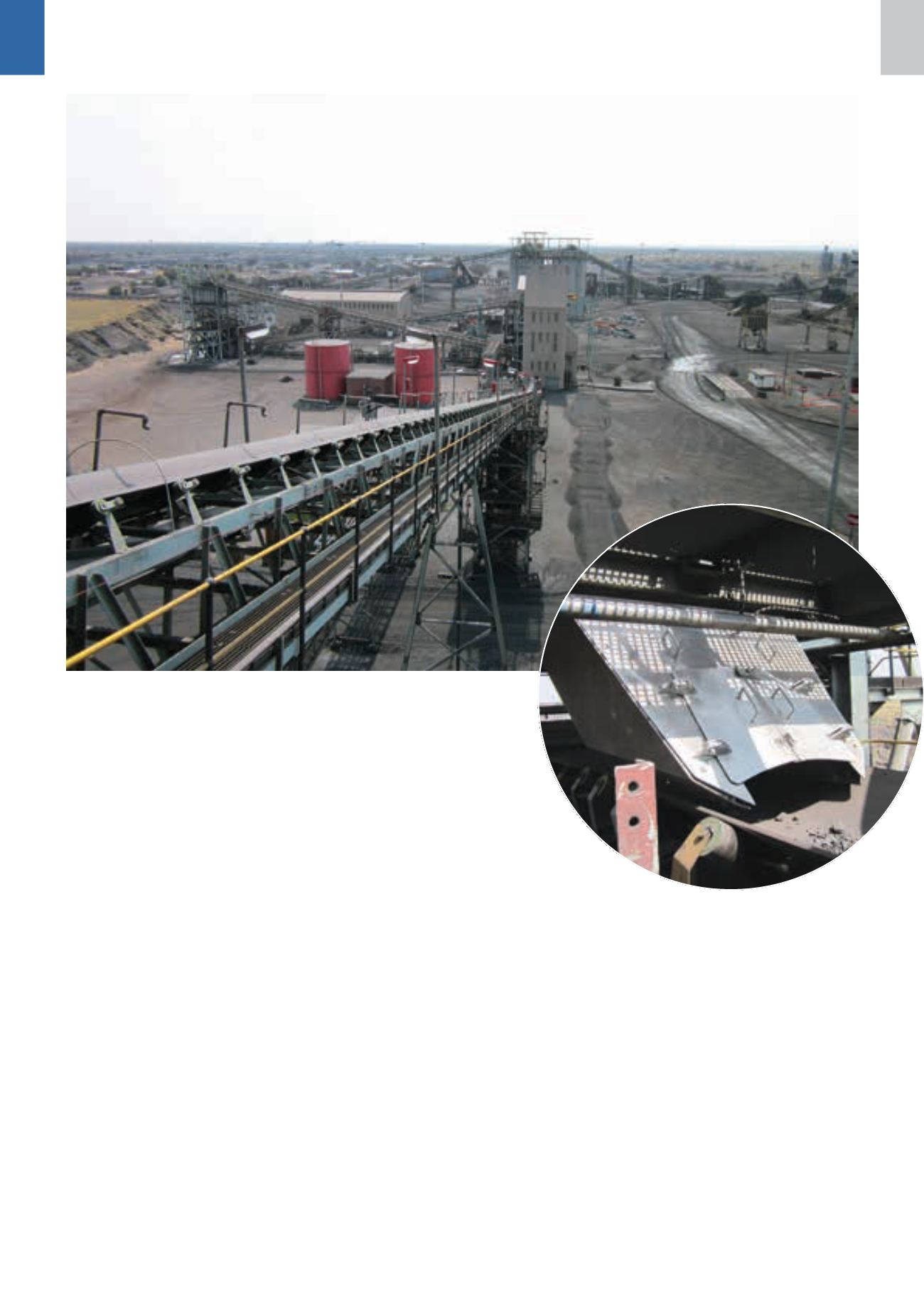
The vibrating feeder discharge onto a
conveyor.
Above:
The Nchwaneng II Plant at Black
Rock Mine in the Northern Cape.
Complex design of chute systems
at Assmang’s Black Rock Mine
Using its proprietary Weba Chute systems, M&J Engineering has
completed the complex design for ten chute systems comprising
two for the tilt conveyors, four for the silo discharge and four
for the crushing circuit at Assmang’s Black Rock Mine, about
80 kilometres north-west of Kuruman in the Northern Cape. The
challenging design on an additional contract for four diverting chutes
on top of the silos has also been completed. The tilt conveyor and silo
discharge chutes have been approved for manufacture and will be delivered
to the mine by the end of the third quarter of 2013.
rial sizes, shape and throughput,” he
continues.
“M&J Engineering provides designs
and solutions that meet these needs
and furthermore ensures that the fin-
ished product is of the highest possible
quality to provide decreased downtime
and wear, increased productivity and a
favourable return on investment. Our
team of highly experienced engineers is
available at any stage, before and after
installations, to discuss any issues or
queries with the customer,” he adds.
Ted Cruickshank, projects manager
of M&J Engineering, points out that
the second contract required a unique
design, as the transfer point had to cater
for a tilting conveyor. Material is trans-
ferred from the tilting conveyors that
feed the silo and the crushing circuits.
These two chutes are required for
the material feed, which comes from
different sources.
One chute handles lump sizes of
up to (minus) 450 mm. These materi-
als are conveyed and then transferred
through the chute system. The capacity
is 1 100 tph on an incoming 1 050 mm
wide belt running at 1,85 m/s. The
outgoing belt, which feeds the crushing


