18
Mechanical Technology — February 2014
⎪
Materials handling and logistics
⎪
D
uring two visits to the Port
of Ngqura, Johnson Crane
Hire completed a number of
complex lifts for the first two
batches of giant turbine components
for the Cookhouse wind farm near Port
Elizabeth. The first lift took place in
early April 2013 and the second one
was completed in early June.
The cargo lifted by Johnson Crane
Hire is bound for the Cookhouse wind
farm, situated on 9 000 ha about
150 km north-east of Port Elizabeth.
This wind farm will be the largest one
on the continent and is being under-
taken by Indian wind turbine manu-
facturer, Suzlon Energy and its South
T
he new Liebherr LTM 1750‑9.1
750 t mobile hydraulic crane is part
of a multi-million Rand expansion
programme that has seen new, state-of-
the-art cranes being purchased and older
units within the company’s crane fleet
being replaced and upgraded over the past
few years. Today Johnson Crane Hire offers
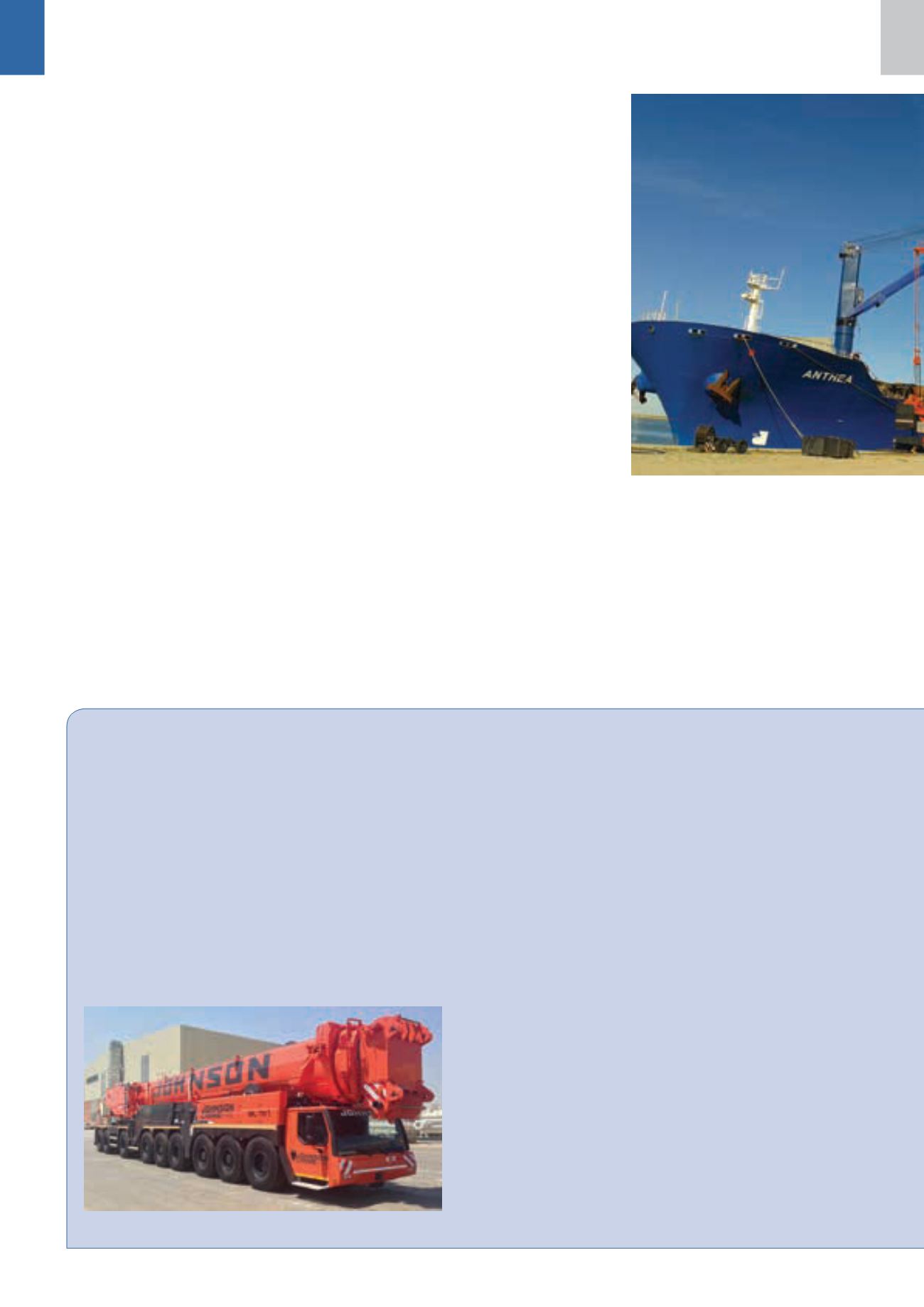
The new Liebherr LTM 1750 mobile crane.
Once the Johnson Crane Hire crane
was in position for a lift, the outriggers
were strategically placed on the quay’s
concrete load bearing beam, which was a
mere 300 mm wide.
Giant turbine components for wind farms are “extremely challenging” and,
prior to lifting massive components from a 100 m long ship, Johnson Crane
Hire engineers carefully planned the exact positioning of the crane to ensure
that the loading on the quayside was within acceptable limits. The successful
lifts were precedent setting…
Complex heavy lifts at
Port of Ngqura
New giant crane comes to SA
a full range of crane equipment: 8,0 t to
750 t hydraulic capacity; crawler cranes
from 110 to 750 t; as well as mobile tower
and compact city cranes. Other recent ad-
ditions to the heavy lift fleet include two
275 tonners to boost capacity in the coun-
try’s more outlying areas and a new 220
tonner deployed to Rustenburg to replace
an older 275 tonner.
Several 140 tonners
have been purchased
to replace older 120 t
cranes as well as a
whole range of 100,
70 and 60 tonners,
totalling about 60 new
units.
“The substantial in-
vestment being made
into our expansion
programme aims to
ensure that our fleet
African partner, African Clean Energy
Developments. A total of 66 turbines,
with a combined installed capacity of
138,6 MW, will be required.
Richard Simmons, branch manager
at Johnson Crane Hire, explains that the
lift in June was extremely challenging.
“Johnson Crane Hire was required to
lift components from both the hold and
the deck of the 100 m long ship. This
meant that the 550 t Liebherr crane
should, idealy, have been strategi-
cally placed in the centre of the ship.
However, this positioning would mean
that the crane would not have sufficient
reach to the fore and aft extremes of
the ship.
“To overcome this challenge, we had
to repeatedly move the fully configured
crane, with its 165 t counterweight and
luffing fly jib, to facilitate the lifting and
offloading of the components. Once one
half of the ship had been offloaded,
Mobile crane hire company, Johnson Crane Hire, has taken delivery of a Liebherr
LTM 1750-9.1 750 t mobile hydraulic crane – the biggest mobile hydraulic
crane in its fleet and one of only two cranes of this size to be put into operation
in South Africa to date.
remains fit for purpose, reliable and safe
in order to meet our customers’ high safety
standards and required turnaround times,”
says Peter Yaman, general manager of
Johnson Crane Hire’s Heavy Lift Division.
“We’re also investing in the bigger
equipment to meet the requirements of
the fast growing local wind energy industry.
Typically, a 550 t hydraulic crane is limited
in terms of the types of turbines that are
likely to be erected in South Africa. The
new 750 tonner will allow us to handle
certain wind turbine generators and meet
the requirement to move relatively quickly
between hard stands, as it can be stripped
and reassembled fairly quickly.
“However, there’s also a continuous
demand for bigger cranes right across the
industrial market and we’re increasingly
finding that access within industrial plants
is getting tighter, making it a challenge to
bring a crane close to the elements that
need to be lifted. A crawler crane needs
more space for assembly compared to a
hydraulic crane of same size, so we expect
to achieve increased efficiencies with the
new unit in these instances,” he explains.
In today’s crane industry, the cheapest
solution does not necessarily deliver the
best value for money, says Yaman. “Our


