⎪
Heating, cooling, ventilation and air conditioning
⎪
Mechanical Technology — February 2014
25
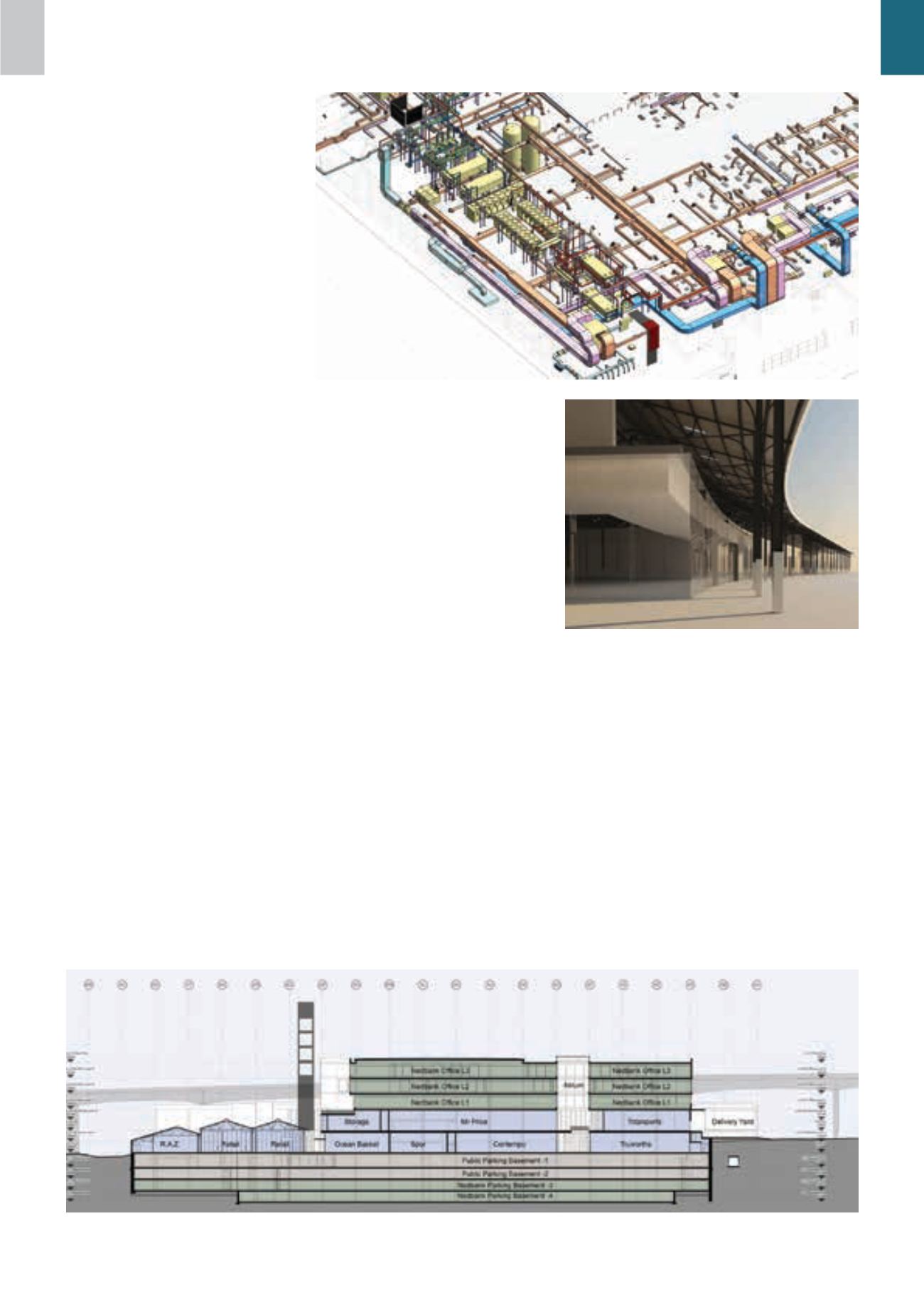
A 3D Autodesk
Revit MEP (Mechanical,
Electrical, Piping) model
showing Newtown Junction’s
chiller plant room with its ice
storage tanks (1) and the two 750 kW
CIAT chillers (2) that supply the green
star-designed Nedbank offices.
A model showing the link between the Nedbanks
Majestic building and Museum Africa.
A cross secion of Newtown Juncton showing the parking, mall and Nedbank office space.
green building
After extensive research of tri-gener-
ation, microturbine technology, polyva-
lent chillers and four pipe system op-
tions, it was decided to install two pipe
chilled water systems, with completely
independent systems and circuits for
the Nedbank offices to meet the 4-star
Green Star rating requirements.
For the Nedbank system, two
750 kW CIAT chillers serve the office
levels, each one supplying approximate-
ly 750 kW of cooling, with a Cristopia
TES ice storage system, located in the
basements, being used to reduce peak
demand. Two 76 m
3
tanks filled with
Cristopia balls and glycol infused chilled
water make up the encapsulated ice
storage system. “At the start of the day,
the tanks are filled with balls of solid
ice, which are slowly melted during
the day to reduce the cooling required
from the chillers. At the end of the day,
the ice will be completely melted, but
the demand from the chillers is low at
night, so the flow of glycol through the
storage tanks is reversed to refreeze the
encapsulated ice balls. We use glycol in
the primary circuits to reach very low
temperatures, down to -7,0°, so that
the ice can be made in an eight hour
period,” explains Lund.
“And while the total energy use will
not be reduced by using the ice storage
solution, there are huge advantages
because of peak demand,” adds Berry,
pointing to a 24-hour cooling demand
chart. “The electricity profile from the
grid is lowered, which significantly
reduces maximum demand charges
from the utility.”
Lund adds that the chiller sizes, in
terms of footprint and required power,
are also reduced. “Without storage,
we would have had to install two
1 400 kW chillers, at a proportion-
ally higher capital cost,” he adds. The
key benefit, though, is flexibility. The
chillers operate at variable speed to
meet demand and one or both can be
completely shut off. Demand can be
supplied by melting ice, a combination
of melting ice and chilling or directly
from the chillers, while making ice. Six
different permutations are possible,
making the system very accurate to
demand, and hence efficient, as well
as flexible should conditions change.
Adding to the flexibility of the chiller
solution is the Cristopia encapsulated
ball system, which according to Lund,
is an engineered solution. “The en-
capsulated phase change fluid can be
manipulated to optimise melting and
freezing temperatures and rates. This
allows the ice storage system to be
engineered to match different ambient
conditions and requirements in different
locations,” he explains.
The chilled glycol in this primary cir-
cuit is passed through a heat exchanger
to make chilled water, which is pumped
to plant rooms and air handling units
through Nedbank’s office block. “This
ensures that glycol, which is poisonous,
is only used in the basement plant room
and only pure water is circulated though
the building,” Lund adds.
Servicing the public mall area is a
completely independent system that
uses three large (1 100 kW) and two
small (600 kW) chillers. “These sys-
tems are all air-cooled, so there are no
water losses in the condensation cycles
– and you get green building credits for
saving the water,” he continues. The
chillers are located in the chiller plant
room on the roof, which allows for heat


