safety on mines
feature
49
06.13
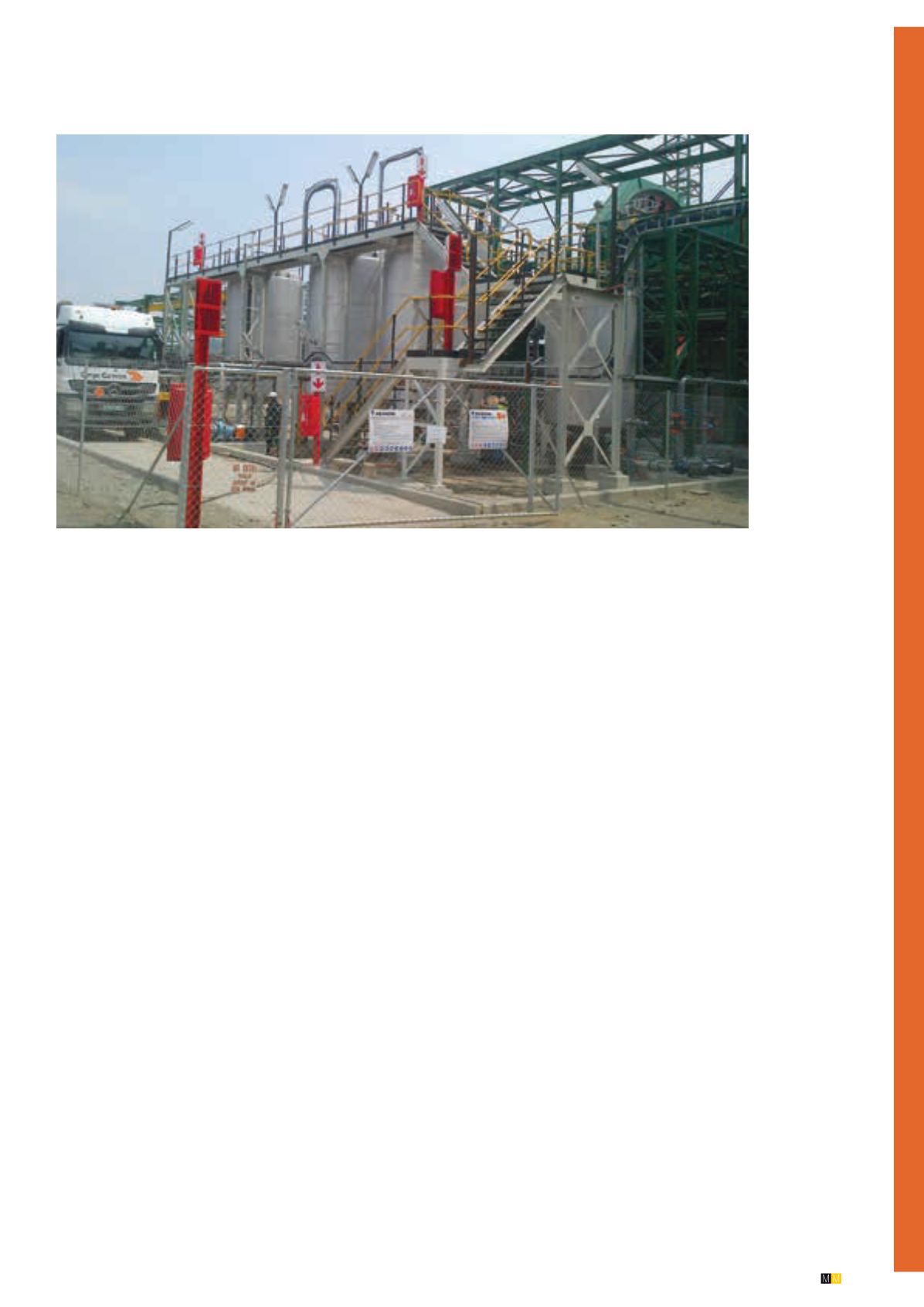
A typical Senmin installation at a chrome mine.
ton of CS2 compared with the old charcoal-based pro-
cess. As for the bioacrylamide technology, this also
reduces energy requirements and produces virtually
no effluent compared to traditional copper catalytic
processes.
Standards in Senmin’s facilities are high and ac-
creditation includes ISO 9001: 2008 for quality man-
agement and ISO 14001: 2004 for environmental man-
agement. Senmin is also NOSA 5 Star (Safety) certified
and received a NOSCAR award for safety in 2011.
Senmin’s products are widely used by the South
African – and indeed African – mining industry and
its clients include many ‘blue chip’ mining houses.
Says Dicks: “Our products are applicable to a wide
range of metals and minerals, including base metals,
platinum, gold, uranium and coal.”
While mines will often simply purchase chemicals
from Senmin and thereafter take all responsibility for
their handling and usage, Senmin’s full service model
is rapidly growing in popularity with in excess of 20
sites active in South Africa, the majority of them in
the Rustenburg area. In terms of this model, Senmin
takes total responsibility for inventory management
of reagents, for quality control and dosing of the re-
agents and for all SHE issues relating to the handling
of hazardous chemicals.
As part of the service, Senmin provides equipment
to optimise reagent make-up, remove the handling of
chemicals on site, negate the requirement for ware-
housing and remove the disposal costs associated
with packaging material such as bulk bags, shrink
wrapping and pallets.
Dicks says the full service model frees up plant
personnel to concentrate their efforts on production-
related issues while Senmin is held accountable
for the safe handling and quality control of the re-
agents up to the point of dosage. “Basically, we offer
a seamless process which maximises safety, at the
same time ensuring that the chemicals are applied
correctly without over-dosing or under-dosing based
on the concentrator’s specifications,” he says. “The
service also includes ore sampling and metallurgical
evaluations, bench scale and pilot plant evaluations
and statistical evaluation. Generally, we will work to
Key Performance Indicators (KPIs) agree with mine
management, so the benefits are measurable.”
In charge of the safety aspect of Senmin’s full service
teams is Lindiwe Mamabolo, Safety Manager. She has
a BSc in Safety Management and prior to joining Sen-
min two years ago was employed by Rand Water. “Our
teams are each led by a qualified metallurgist and be-
come closely integrated with the mine’s own work-
force,” she says. “They identify totally with the cli-
ent’s operation and its objectives and will, apart from
meeting Senmin’s own exacting standards, fully com-
ply with the mine’s own standards and procedures.”
As part of her responsibilities, Mamabolo under-
takes audits of mine reagent plants or sites to assess
whether there are problems in the handling and ap-
plication of chemicals. “When we are initially negoti-
ating with a mine on the possible signing of a full-ser-
vice contract, an audit will invariably be our starting
point and we will also continue our audits once we
are in place on a mine to ensure that standards are
maintained and that the client is getting real value,”
she explains.
She adds that she also performs audits on mines
where there is no full service contract in place. “For
example, I regularly audit some mines outside South
Africa’s borders, who use our chemicals but who
choose to manage the whole process of reagent stor-
age and application in house.”
According to Mamabolo, the benefits of the full
service model are very apparent. “I’m visiting sites
constantly and there’s no doubt that full service man-
agement of chemicals results in a better safety perfor-
mance and a more efficient usage of chemicals. We do,
however, recognise that not all clients prefer full ser-
vice management and in these cases we will obvious-
ly provide mine management with every assistance –
including training – to ensure that they use our prod-
ucts in a safe and optimal manner,” she concludes.


