safety on mines
39
06.13
feature
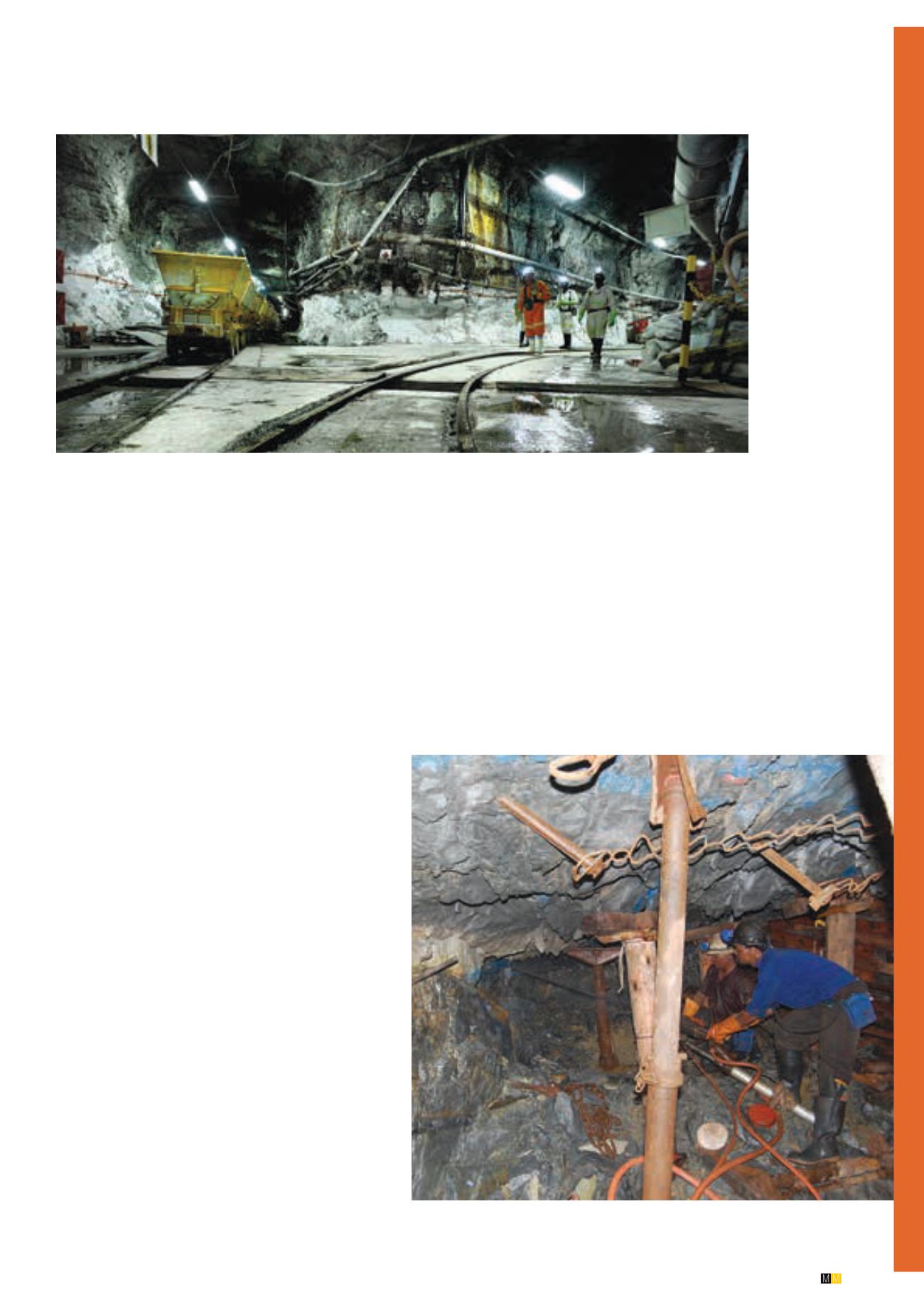
A stope at a deep-level gold mine on the West Rand. The seismic-
ity of the Wits Basin gold mines presents major safety challenges
to mining houses (photo: Arthur Tassell).
The layouts of mines bring employees and locos together to achieve the goal of mining but there are inevitably attendant risks which
need to be addressed.
was the mining house’s “safest year ever” with a lost
time injury frequency (LTIF) rate of 1,15 (1 329 in-
juries in 2012 from 2 746 injuries in 2011) and six
fatality-free months. He expressed condolences to the
families of the seven employees who died in the 12
month reporting period to December 2012. Five of the
deaths occurred underground, one of which resulted
from a fall of ground.
Quoted in Amplats’ recently published Sustain-
ability Report, Griffith – who is leading the Amplats
restructuring initiative – says the lost time injury rate
has declined steadily year on year from 2,03 in 2007.
Six company locations achieved LTIF milestones
with the Mototolo concentrator achieving 13 months
of operation without an LTI. Five mines recorded
high totals of fatality-free shifts led by Dishaba with
2,6 million shifts. Of the three plants mentioned,
Union concentrators topped the list with 6,5 million
fatality-free shifts.
Wellsted says Sibanye Gold’s fatal injury frequency
rate for 2012 was 0,17 compared with 0,15 for the
previous year. Sixteen miners lost their lives in 2012
in mining accidents compared to 18 in the previous
year. The rate for the first five months of 2013 is 0,06.
The lost day injury frequency rate (LDIFR) for 2012
was 6,90 compared with 5,79 for 2011. The LDIFR
for the first five months of 2013 is 6,34. The rates are
calculated at one million man hours.
“The safety department has been increased by 100
employees over the last two years to ensure compli-
ance to standards. The other two critical departments
for technical support are the occupational engineering
and rock engineer departments, which provide plan-
ning and control guidance and support. The medical
services are world class and cover all the basic needs
of staff, with a service level agreement with leading
hospitals to provide specialised care and treatment.”
Wellsted attributes safety improvements to the suc-
cess of Sibanye Gold’s integrated health and safety
strategy comprising five pillars: culture – hearts and
minds, stakeholder engagement, wellbeing, engineer-
ing out risk, and compliance.
“All of these pillars have a part to play in the over-
all improvement in safety and no one can stand on
its own or be credited with being the reason for the
success. This is part of the reason for the success as
every element and every person on Sibanye Gold has
a part to play. If anyone falls over the whole wellbeing
of Sibanye Gold is at risk.
“The application and management of safety re-
quires continual focus on all elements on the mine.
Sibanye will continue to focus on and expand the
five pillars of the health and safety strategy. Addi-
tional focus will be placed on ensuring that all lev-
els of leadership behave in line with the values and
the principles that underpin Sibanye Gold in order to
create an environment that is engaging and assists all
employees to perform their tasks safely.”
He identifies depth and distance from surface in the
South African gold and platinum sectors of the min-


