safety on mines
feature
40
06.13
ing industry as being a challenge to safety, especially
when coupled with the layouts of local mines.
“It is difficult for leadership to travel around mines
to interface with large numbers of employees,” he
says. “The upshot is that influencing employees is
more difficult and therefore employee self-discipline
becomes even more important. Depth of mine makes
extraction of the orebody more critical and thus de-
tailed planning and controls are required to ensure
delivery of the mining plan. Travelling times to get
employees to their work places underground has a
double risk factor in that they use large amounts of
energy to get there and back, thus reducing available
time on the face. This can lead to the taking of short
cuts with a resulting increase in safety risks.”
According to the 2011/2012 DMR annual report
covering the 12-month period to the end of March
2012, deaths/injuries arising from transport remain
high by comparison with other sectors in the mining
environment. While the mining industry had record-
ed a year-on-year reduction in mining fatalities “the
safety track record...continues to be a matter of great
concern.” While there has been a decrease in fatali-
ties from fall of ground incidents, a 3 % increase in
transport and mining fatalities requires attention, the
report indicates.
The DMR’s concern is highlighted by a scan of me-
dia reports in April and May this year, which showed
that two miners had died as a result of rail-bound ac-
cidents – at AngloGold Ashanti’s Mponeng mine and
at Harmony Gold’s Kusasalethu mine.
Wellsted says that any activity that takes place “in
close proximity to a high energy source will always
have a high risk profile. Locomotives are extensively
used on the mines to move labour, material and ore
and the layouts of the mines bring employees and
locos together to achieve the goal of mining. The
way to reduce the risk is to ensure that all employees
know the risks and the correct procedures to be fol-
lowed, and that effective discipline is maintained on
the mine.
“Risk must be engineered out as far as possible.
To this end, Sibanye is equipping all its locos with
a communication system that will ensure that both
the driver and guard must agree on the direction and
speed of travel and that both have the ability to stop
the train in an emergency.” He adds that, in addition,
a new system is being implemented to have auto cou-
pling done to ensure that employees can stay out of
the risk area when locos and cars are coupled.
The Amplats Sustainability Report indicates that a
major drive has been launched internally to improve
its mine haulage transport system – an operational
area in which several employees were killed or seri-
ously injured in past years.
A new local management system (LMS) has been
designed to improve the safe operation of locomo-
tives through engineered solutions, the key features
of which include proximity warning and speed zon-
ing. All aspects of locomotive operation are automati-
cally stored for viewing as operational reports. The
system will provide the mines with an integrated
system capable of addressing all their underground
locomotive transport requirements.
The aims of the system are to monitor the move-
ment and other behaviour of underground locos and
to help Amplats enforce controlled interventions in
cases where a driver does not respond to warnings
and violation alarms.
Dorian Emmett, Chairman of the Safety and Sus-
tainability Development Committee at Amplats, says
that the significant improvements in safety in Am-
plats result from strong efforts to work with a range
of stakeholders, in particular labour and the Govern-
ment. He says that Amplats will “continue to focus
unrelentingly on visibly improving the company’s
safety record” and reiterates the company’s commit-
ment to its objective of zero harm which “will not be
achieved without leadership”.
Fatalities from fall of ground incidents had been
reduced to one during the year and the severity of
injuries from these incidents had also been reduced.
Transport remains the company’s biggest concern.
He ascribes the overall improvement partially to
additional attention placed on people and behav-
iour following a review at the end of 2011 of the four
thrusts of the company’s safety, health and environ-
mental strategy. A ‘Zero Harm in Action’ project was
launched to correct the imbalance while maintaining
the remaining three thrusts comprising management
systems, engineering and engineering solutions, and
wellness in the workplace. Non-compliance with sys-
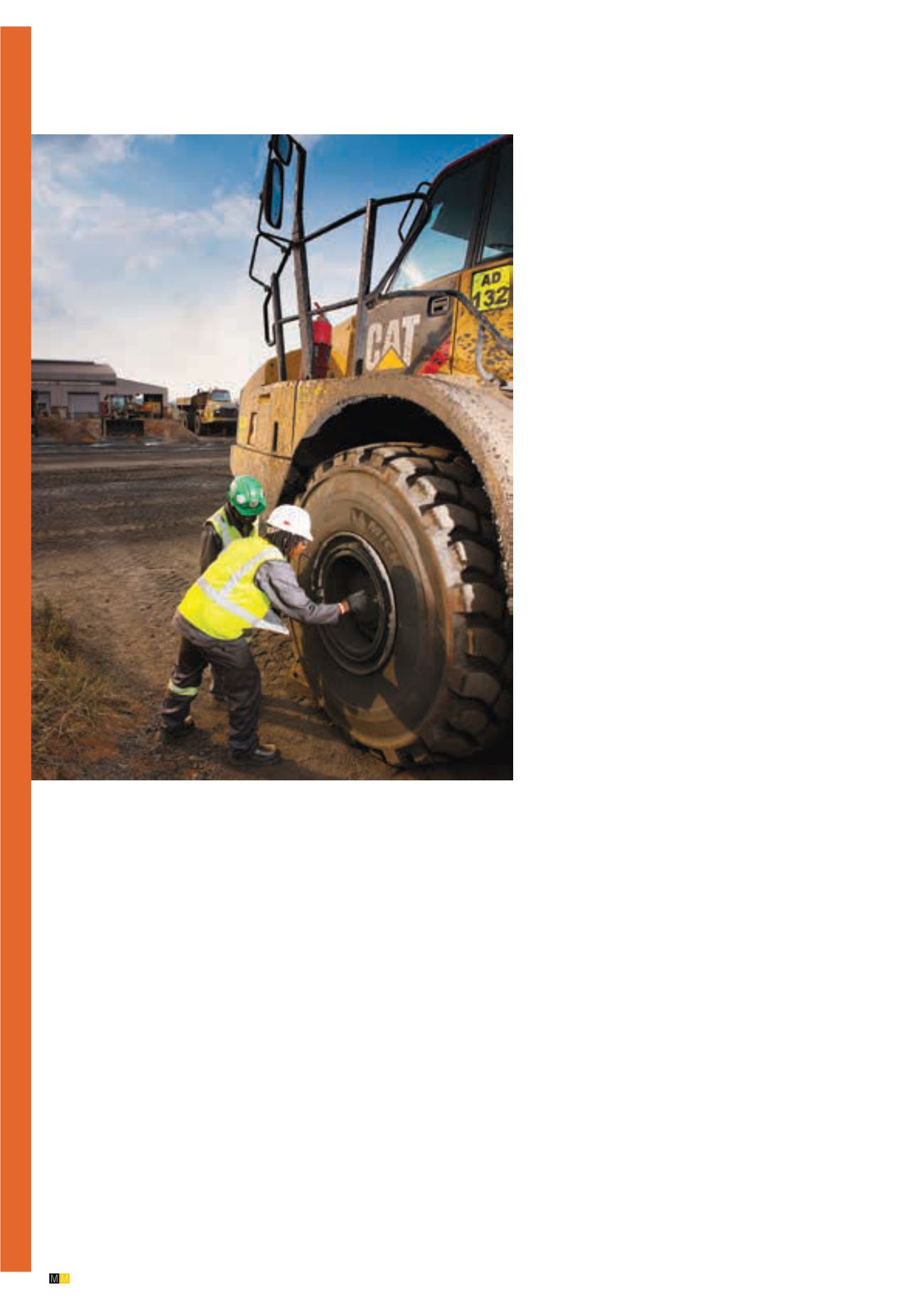
Safety officers inspecting a truck at Zibulo (photo: AAC).


