safety on mines
feature
48
06.13
S
enmin’s products are used in froth flotation and
tailings treatment and are manufactured at its
modern facilities in Sasolburg, in which it has
invested heavily to improve production capacity and
Senmin
service enhances
safety in process plants
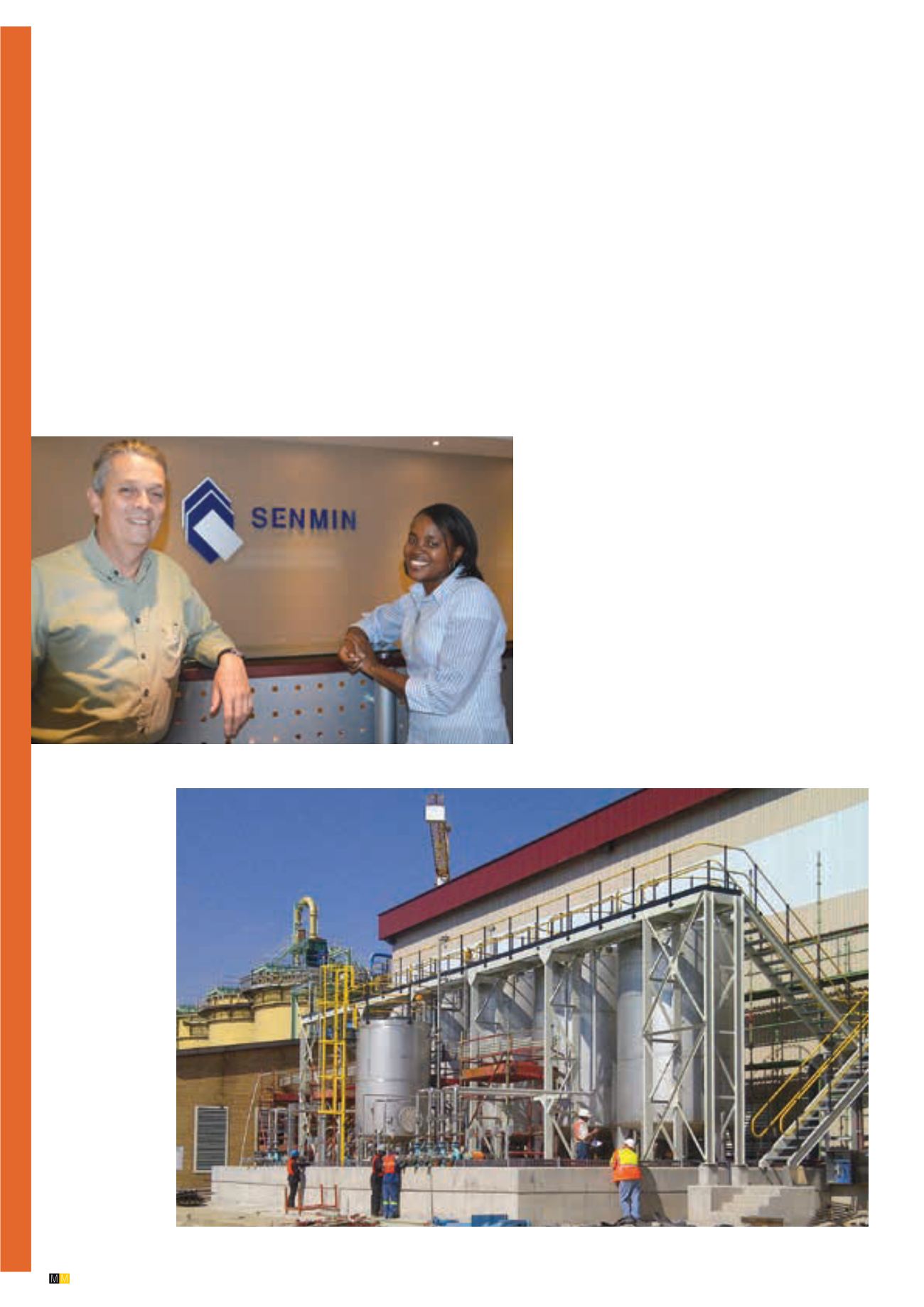
Tanks for bulk distribution of reagents at a gold plant on the Witwatersrand.
Senmin’s Dr Patrick Dicks, Director, Business Line and Technical,
with Lindiwe Mamabolo, Safety Manager.
One of the greatest potential safety risks on mines lies in the handling and application of the chemicals – some
of them hazardous – used in the beneficiation process. One way to reduce this risk is to allow professionals to
take over this function. Senmin, for example, which supplies a range of mining chemicals, offers a full 24/7
service model to mining clients which not only addresses safety but also ensures that chemicals are used in an
optimal manner, potentially reducing costs and enhancing process plant efficiency.
to reduce dependence on raw material imports. The
company’s product line includes a comprehensive
range of xanthates in powder, pellet or liquid form,
Senkol collectors, which are formulated flotation
collectors for improved metallurgical performance,
Senfroth frothers, Sendep depressants, and Senfloc
flocculants, which are polyacrylamide flocculants for
tailings settling and water clarification.
According to its Director, Business Line and Tech-
nical, Dr Patrick Dicks, Senmin, which is part of the
AECI Group, is the biggest manufacturer in its field
in the Southern Hemisphere. “Some of our competi-
tors may be bigger in terms of individual products
but, based on a basket of products typically used in
beneficiation, we are the largest producer. We can
also claim to be one of the ‘greenest’ manufacturers
even though some of our end products are not ‘green’
– over the past several years we’ve commissioned a
new methane-based CS2 plant, which has a much
smaller environmental ‘footprint’ than our old plant,
and we’ve also introduced a bioprocess for polyacryl-
amide production which is a world first – at least on
an industrial scale.”
The CS2 plant, which has a capacity of 20 000
tonnes per annum, uses a tenth of the electricity per


