safety on mines
44
06.13
N
ormet, best-known for its concrete spray-
ers, scalers, lifting and charging equipment,
as well as underground transport vehicles,
added the D-Bolt technology to its product line-up
earlier this year when it acquired Norwegian start-
up Dynamic Rock Support (DRS), a company estab-
lished in 2009 – with the backing of venture capi-
talists and the Norwegian University of Science and
Technology (NTNU) – to commercialise the D-Bolt.
Commenting on the acquisition at the time, Tom
Melbye, President of the Normet Group, said, “This
acquisition is a good strategic fit to Normet. It broad-
ens our offering to underground customers and re-
inforces our aim to be a total solution provider, es-
pecially in ground support and rock reinforcement.
With our sprayed concrete, grouting and injection
technologies and products, the D-Bolt system adds to
how we can help our customers make underground
construction safer, even in difficult strata under high
stresses and experiencing excessive deformations.”
Explaining the background to the D-Bolt, Skogseth
says it was invented by Swedish Professor Charlie C
Li, Professor of Rock Mechanics at NTNU, who earlier
in his career worked in the mining industry, primar-
ily with Swedish mining company Boliden. “His goal
was to develop the ideal mining rock bolt – one cater-
ing for high static loads but with the ability to accom-
modate the deformations, either gradual or sudden,
associated with squeezing rock conditions or high
energy events such as rock bursts,” says Skogseth.
“The concept he came up with is so robust and
simple that one wonders why no one came up with
the idea before him. In essence, the ingenious bolt Li
devised consists of a smooth steel bar into which an-
chor points have been pressed along its length. The
bolt is only fixed with cement grout or resin at the an-
chor points, leaving the smooth sections between the
anchors to freely deform when subjected to rock dila-
tion, hence absorbing energy released by the rock.”
In a paper on the D-Bolt, Professor Li writes: “The
D-bolt is similar to a rebar bolt in the sense that both
are bound mechanically to the grout through their
‘anchors’. The difference is that rebar is interlocked
in the grout through tightly spaced and weak ribs
along its length, while the D-bolt is integrated with
the grout/rock only at the anchor positions. This dif-
ference in structure determines that they behave dif-
ferently when subjected to rock dilation or fracture
opening.”
He continues: “A D-bolt has the same tensile
strength as a rebar bolt. It reacts in the rock mass in
a similar way as a rebar bolt until yield. Every entire
section of the D-bolt can elongate at yield/hardening
until the ultimate strain of the bolt steel is reached.
The plastic deformation capacity of the D-bolt is sig-
nificantly larger than rebar.”
Static pull tests and dynamic drop tests have shown
that the bolt length typically elongates by 14 to 20 %
at a load level equal to the strength of the bolt mate-
rial, thereby absorbing a large amount of energy. The
impact average load of a 20 mm bolt is 200-230 kN,
with the design causing only a small portion of the
load transferred to the bolt plate. The dynamic energy
Innovative safety bolt
to be launched locally
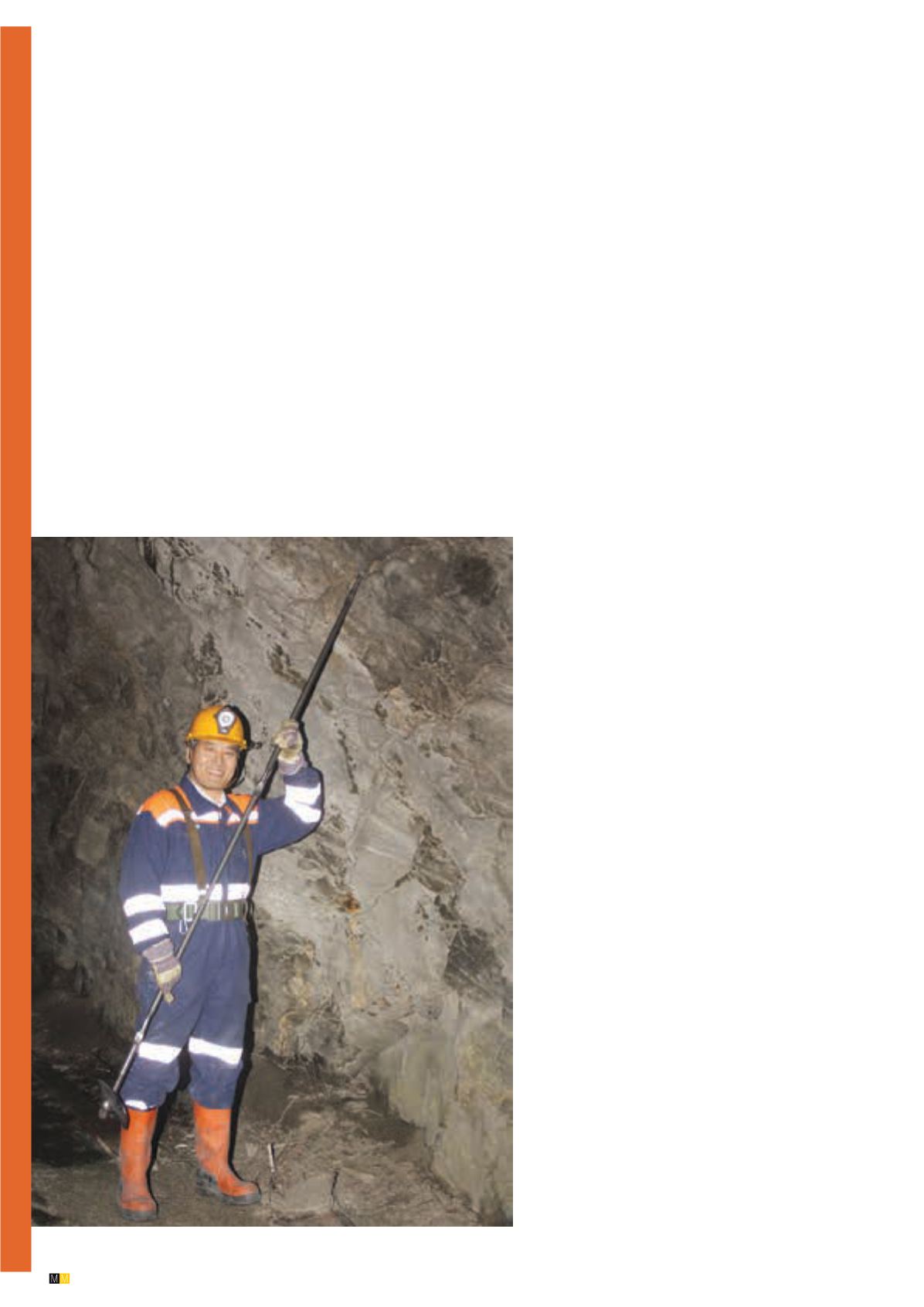
Professor Charlie C Li, inventor of the D-Bolt.
A new generation energy-absorbing rock bolt, specially designed for reliable rock reinforcement in both
squeezing and burst-prone strata conditions, is being launched in South Africa by Jet Park-based Normet
Africa, the local subsidiary of Normet, the Finnish underground equipment manufacturer.
Modern Mining
recently spoke to Trond Skogseth, Normet’s Director, Rock Reinforcement, and Gary Clench, GM of Normet
Africa, to learn more about the system – known as D-Bolt – and its applicability to the local market.
feature


