June 2014
MODERN MINING
29
COPPER
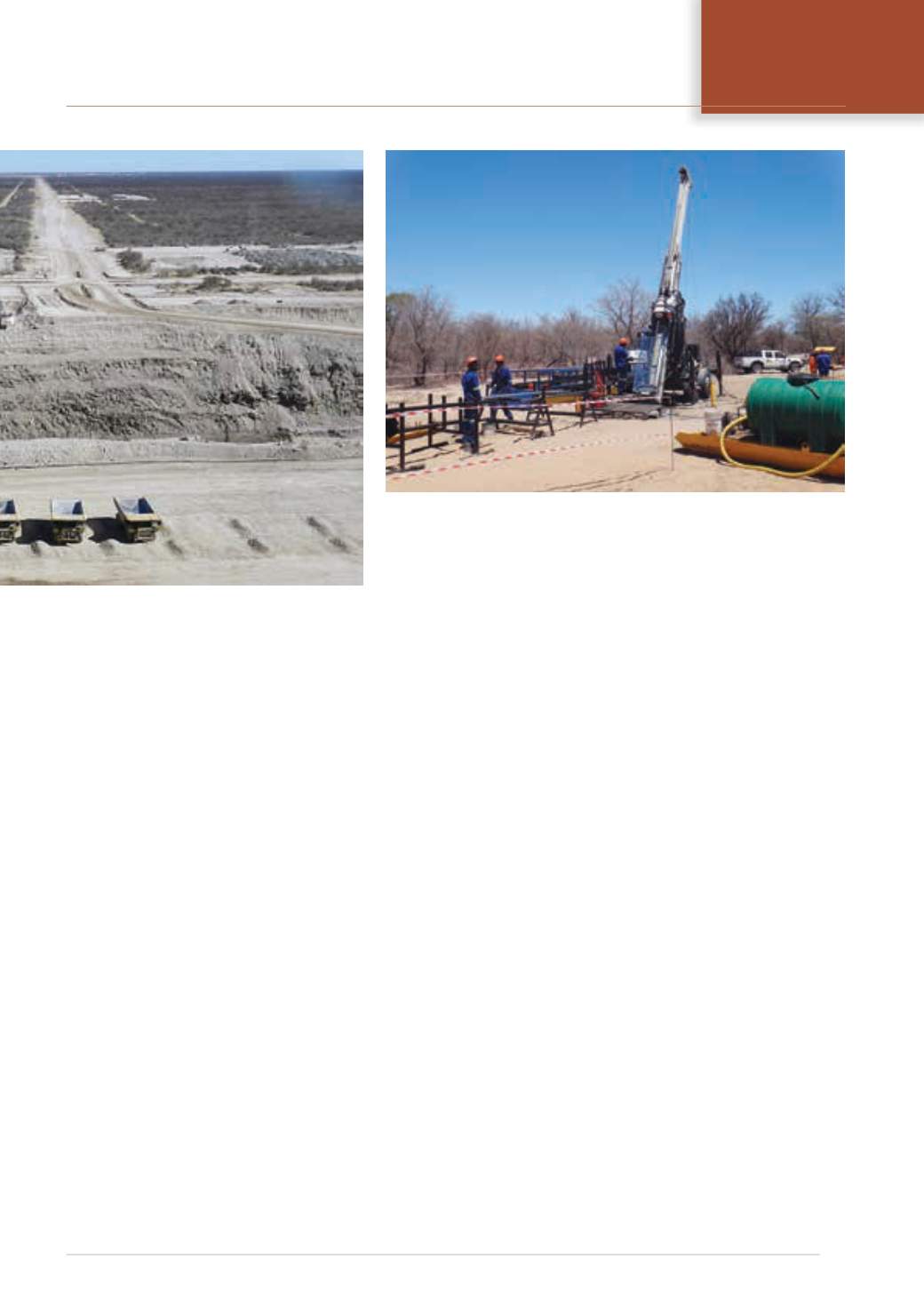
Above:
Titan diamond
drill rig drilling deep
stratigraphic holes for First
Quantum in north-west
Botswana (photo: Tsodilo
Resources).
Centre:
Discovery’s
Boseto mine is an open-pit
operation but the company
is now also planning an
underground mine at
its Zeta deposit (photo:
Discovery Metals).
targeting the Zeta deposit, would run concur-
rently with open-pit operations at Zeta and
Plutus.
Although Morulane did not go into detail on
the Zeta underground mine (which has an ore
reserve of 7,3 Mt at 1,3 % copper and 23 g/t
silver), DML announced in April this year
that the Botswana Government had approved
its application to amend the Boseto mining
licence to incorporate the underground oper-
ation into the Boseto project. It also said the
planned underground mine would produce
1,5 Mt/a at 1,3 % Cu at steady-state produc-
tion levels. This forecast is based on the use
of a sub-level caving underground mining
method with 20-25 m spaced sub-levels, con-
ventional trackless mining techniques, twin
decline access, and mine development rates of
between 600 and 850 m/month (including ore
drive development).
It is not yet clear when development of the
underground mine will start. DML, however, is
currently – as Morulane explained – in the pro-
cess of refinancing its debt and is also planning
equity raisings. If these initiatives are success-
ful, it seems likely that work will start within
months as DML clearly regards the new opera-
tion as being an essential part – indeed the key
element – of its turnaround programme.
Mowana and Thakadu
Apart from DML, Botswana’s only other dedi-
cated producer of copper at the moment is
AIM-listed African Copper, which owns the
Mowana open-pit mine and its associated
1 Mt/a concentrator (located 130 km north-
west of Francistown in the north-east of the
country on the Matsitama Schist Belt or MSB)
and which also has rights to the high-grade
copper-silver Thakadu/Makala deposits, 70 km
from Mowana. Developed from the Dukwe
project, Mowana – the Setswana word for ‘bao-
bab’ – was commissioned in 2008 but soon
became a victim of the global financial crisis,
being forced into care and maintenance in
early 2009. It reopened later in the year but
has never lived up to its potential, falling far
short of its originally planned full production
level of 29 000 t/a of copper in concentrate.
Management and ownership has also changed
over the years and African Copper’s main
investor now is ZCI (with a 74 % stake) and its
Acting CEO Jordan Soko.
Sulphide ore is currently being mined at
Thakadu and treated at the Mowana plant but
it is planned to restart mining operations at
Mowana later this year. The mining is being
undertaken by South African mining contrac-
tor Diesel Power (a subsidiary of JSE-listed
Buildmax), which earlier this year was awarded
a 52-month contract worth approximately 1 bil-
lion Pula (US$112,7 million) to provide mining
services to African Copper.
Just at the moment African Copper is a
fairly small producer of copper, reporting a
production of just over 2 500 tonnes in the first
quarter of this year. This was derived from the
processing of 163 391 tonnes of ore at an aver-
age grade of 1,71 % Cu. Commenting on the
quarter, Soko said, “We are pleased with the
mobilisation efforts of our new mining part-
ner Diesel Power and are looking forward to
progressive increases in mining tonnages at


