

The refurbishment of the Hegel Street apartment in Polanco, Mexico City, started with the idea that interior design should faithfully reflect the user's lifestyle. In this way, an elderly lady's apartment was adapted to suit the requirements of its heir, a young, single graphic designer and the client of the project.
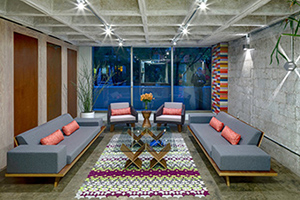
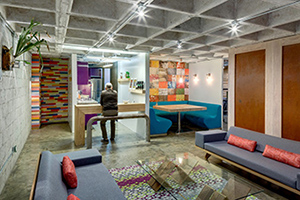
From left to right: Hegel_Living room (photo credit: Rafael Gamo); and Hegel_Kitchen and dining room (photo credit: Rafael Gamo)
The removal of old carpets, wall finishes and drop ceilings uncovered perfectly polished concrete floors, which were sealed and left exposed in the common areas. Similarly, the exposure of the existing waffle slab added 30 cm to the height of the rooms, plus the depth of the coffers themselves. This slab was prepared so as to remain exposed, and the new electrical wiring was left visible on the underside of the concrete grid.
Efficient re-distribution of the space through carefully planned design turned a traditional apartment into a functional studio/living space. Old service areas were converted into new bathrooms, a breakfast nook and storage space. A polycarbonate-roofed conservatory was built in what it had been an unused, dusty room prior to the refurbishment. An extra bedroom and an open kitchen complete the programme.
The recycling of construction materials was of paramount importance, and several strategies were employed to effect this. Discarded materials from demolition sites were collected; for instance, wooden floorboards were selected from an old building in the Colonia Condesa, painted different colours and used to dress columns whose condition required a new finish.
For the wooden floors of the main bedroom three batches of planks of different widths purchased at auction were cut to make a tongue and groove floor of own design. This premium quality wood contrasts with the raw finishes of the slab and the block walls and matches a separate piece of wooden furniture.
Visual contrasts were intrinsic to the concept and helped combine modern, colourful elements. For example, synthetic materials, such as aubergine-purple polyester for the kitchen cabinetry, are alongside the raw materials used in the breakfast bench (a recycled timber beam) and the metallic tube in the style of a bus stop which forms the seating.
The proposal for the breakfast nook was an enclosure of grey blockwork, in stark contrast with the colourful mural. The table design uses a steel base with a table top made from planks recycled from construction props.
The kitchen and bathrooms were fitted with proprietary products: Veracruz marble, Thasos stone, Byzantine glass and granite and polyester finishes. The lighting designs used Quasar luminaries (from Prisma). Custom-made metal wall lamps were designed for the breakfast area and fitted with Bulbrite bulbs. These details and the option of diming the light in each room, create a variety of space types.
The project succeeds in finding a solution to the client's brief: ‘I want a place where I can live and enjoy my lifestyle, a space that can revert to a conventional apartment should I ever want to sell it’.
Arqmov Workshop: www.arqmov.com