

The commercial rollout of the Cat trolley assist system comes after the conclusion of a nearly two-year pilot project at Boliden’s Aitik mine in Sweden.
Following a successful two-year pilot project at Boliden’s Aitik opencast mine in Sweden, Caterpillar has commercially rolled out its Cat trolley assist system for Cat electric drive mining trucks to the global market, writes Munesu Shoko.
Thanks to Boliden and Caterpillar’s recent trial at the Aitik open-pit mine in Sweden, the subject of trolley assist systems is back on the mining industry’s agenda. Offering significant productivity benefits, trolley assist technologies have been considered for decades. At the peak of the oil crisis of the 1970s, numerous studies investigating applications were completed and miners made preparations accordingly to reduce their reliance on diesel.
Despite this, widespread industry uptake of the technology has not happened. While there have been a couple of installations in the world, with southern Africa being one of the mining markets that has operated trolley assist systems for more 20 years, the technology has not caught on to the extent many expected.
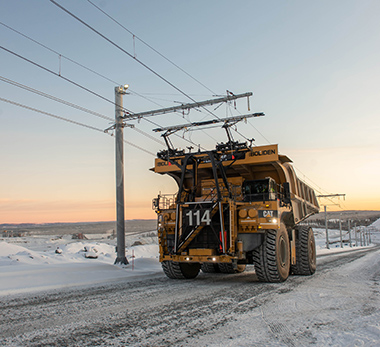
At a time when mines are continuously seeking for measures to stay on top of the cost control battle, Caterpillar is commercially introducing its Cat trolley assist system to the global market. This comes after the conclusion of a nearly two-year pilot project conducted with four 795F AC trucks using 700 m of electric trolley line at Boliden’s Aitik mine.
Joe Rottman, product performance manager, large mining trucks at Caterpillar, says the new Cat trolley assist system for Cat electric drive will help mines reduce their carbon emissions, lower fuel and engine costs, and boost speed-on-grade for greater productivity. The Cat trolley assist retrofit is currently available for the 795F AC truck, and the trolley design is compatible with three other Cat electric-drive mining trucks – 794 AC, 796 AC and 798 AC.
Rottman says the trolley assist system for the 795F AC is now available for the African market, adding that Caterpillar and its dealers are open to discussions regarding collaborating on trolley assist for the 794 AC, 796 AC and 798 AC in Africa. “Given the engine and drivetrain commonality of the 794 AC, 796 AC and 798 AC with the 795F AC, the Cat trolley assist system is readily deployable to all three models,” says Rottman.
“We are currently in discussions with customers regarding collaborating on the next implementation of trolley assist. When an agreement is reached, we will work with the customer to develop trolley assist for the selected truck model and to optimise the installation for their region and application,” he says.
Explaining trolley assist technology
Trolley assist is a system whereby a diesel-electric mining truck powers itself with electricity from overhead power lines instead of the diesel engine turning a generator onboard the truck. The system functions more like an electric passenger train.
Diesel electric haul trucks utilise electric motors to provide tractive effort, or rimpull. The speed of the trucks, on grade, is limited by the quantity of electricity which the truck’s diesel engine can generate. Trucks with trolley assist collect electricity from overhead conductors, so the speed of the truck on grade is no longer limited by the size of its engine – it is limited only by the capabilities of its motors and electrical drive system.
Rottman explains that the installation of trolley assist first requires identifying one or more haul road segments for trolley assist. Then two catenary DC electrical lines, supported by a series of support poles, are run overhead the identified haul road segments. Various AC and DC electrical substations are configured to provide power to the trolley assist haul segments.
“Capable mining trucks are fitted with trolley assist iron, which includes a support structure, pantographs and various electrical and hydraulic lines to connect the trolley assist system to appropriate base truck systems,” he says.
When one of the mining trucks with the trolley assist iron enters a trolley assist segment, the operator raises the pantographs, connecting carbon brushes on the pantographs to the overhead catenaries. While connected to the catenaries, the mining truck fully powers its electric traction motors from the catenaries and reduces the speed of the diesel engine.
When the mining truck is close to exiting the trolley assist segment, the operator lowers the pantographs, disconnecting from the catenaries, and returns to using the engine for propulsion power.
Key benefits
The benefits of the trolley system abound and include increased productivity (due to increased speed on grade), energy cost savings (by substituting cheaper grid electricity for expensive diesel) and extended engine overhaul intervals (due to the reduced load factor).
“The trolley system boosts productivity significantly. Operating with trolley assist, speed-on-grade increases as much as 100% versus diesel-only mode. Using trolley, a laden 795F can run at 28 kph on a 10% physical grade with solid haul road conditions,” explains Rottman.
The trolley system significantly reduces diesel engine emissions at the mine via substitution of electricity during the most demanding part of the truck work cycle. Powering a 337-tonne (t) payload 795F AC via trolley on a 10% grade as it climbs the ramp out of the pit saves up to 40 litres of diesel fuel per kilometre of trolley line. Fuel and engine costs are reduced by more than 90% while the truck is on trolley.
The Cat trolley system is fully machine integrated, bringing the benefits of optimised performance and system serviceability to the 795F AC. Caterpillar’s higher voltage truck and trolley system is designed to bring advantages through lower infrastructure capital costs and lower power distribution maintenance costs.
Other advantages come from the rugged Cat pantograph, designed to deliver superior uptime and reduced repair costs. A quick-drop feature helps protect the overhead trolley lines.
Success story
The Cat trolley assist system programme at Aitik has been a real success. Jonas Ranggård, programme manager at Boliden, explains that availability has been high despite the arctic conditions, and the company has had good support from Caterpillar and all other partners involved.
“There are few projects that can show both environmental and productivity improvements of this magnitude. This is why Boliden has decided to expand the trolley infrastructure at Aitik and equip its entire 795F AC truck fleet with trolley assist systems,” says Ranggård.
“We thank Boliden for its work in demonstrating the capabilities of the Cat trolley assist attachment. The benefits of trolley can be significant in the right conditions, and we would be pleased to discuss site-specific scenarios with customers,” says Eric Ruth, electrical senior product team leader at Caterpillar. “We feel that trolley assist can play a role in achieving mining companies’ greenhouse gas reduction goals. Simultaneously, trolley assist boosts productivity by increasing speed-on-grade. In fact, testing at Aitik mine has shown that a 795F AC equipped with trolley assist is the most powerful mining truck in the world!”
Commenting on some of the key lessons from the pilot project at Aitik, Rottman says trolley assist requires additional truck hardware and site infrastructure, and its implementation brings a host of new challenges to a mining operation. To successfully navigate these challenges, a strong change management plan among mine engineering, planning, maintenance and operations is required.
Application tuning is required to ensure successful trolley performance, as every mine site is different and has unique challenges. Good communication and strong collaboration between OEM, dealer and customer help eliminate roadblocks.
“The team leveraged Caterpillar’s position as the only 100% vertically-integrated manufacturer of ultra-class diesel-electric mining trucks and world-leading dealer network to help introduce the trolley assist system. Caterpillar’s vertical integration and testing allowed us to design, validate and iterate in the lab and at our proving grounds to detect and resolve problems before they got to the customer site,” concludes Rottman.