Mid-States Concrete Industries in Illinois, USA, saves up to USD20 000 a week (approximately ZAR244 000) at its hollow-core production plant. The new adjustable extruder of E9 series from Elematic enabled simultaneous manufacturing of non-standard narrow hollow-core slabs on the same production line. No more saw-cutting, dust, noise and injury risks.
 Mid-States Concrete Industries was faced with a problem, which is actually very common all over the United States. Besides the fact that the design of the hollow-core slabs has its own specifics in the United States, the erection of slabs on the construction site is done in different way too than, for example, in Europe. It is very common that some narrow space is left at the end of the floor slab system, when finishing the slab run with standard pieces. In Europe longitudinally cut slabs are used too but not very narrow pieces as cast-in-situ is used to close such gaps. In the USA, the contractor expects a precast manufacturer to rip standard slabs into narrow pieces and deliver them for erection to the site. That is why Mid-States needs constantly a huge number of narrow slabs or, how they call them, filler pieces of non-standard width.
There is also another place, where narrow filler slabs are in high demand. Narrow slabs are especially useful on small residential housing sites and in such tight areas of the hollow-core construction site like mezzanine. The largest cost for the hollow-core contractor on the site is the crane cost. Downgrading the size of the crane and narrow smaller slabs for smaller jobs, save the contractor’s and customer’s money.
Traditionally, manufacturing of non-standard widths of hollow-core concrete slabs means a ton of rip-saw cutting, which is a time-consuming, noisy, and dusty operation. The result is a slab with saw-cut edges that do not look as good as machine-finished edges. Furthermore, noise and dust cause workplace safety and health issues.
“It is very common, and I would definitely call it a problem. When you cut a piece off of the four-feet section, that creates a lot of scrap, because you need to throw the other piece away. A company carries the costs from this operation of approximately USD10 000- USD20,000 (approximately ZAR122 000.00 to ZAR244 000.00) per week”, said Mike Wolff, Vice President of Safety and Plant Operations of Mid-States.
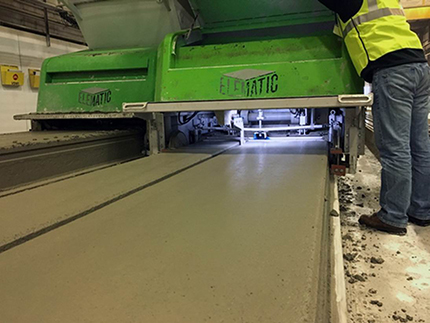
Elematic’s new filler machine, the modified version of E9 series extruder, solves this problem perfectly. A special nozzle and few more parts, added to the standard E9 Extruder, make it possible to cast two slabs of different width simultaneously on the same production line. It is possible to divide the standard slab in two identical or two asymmetric slabs. Hollow-core slabs of various dimensions can be profitably produced with less time and effort. With a basic setup, one can produce slabs with widths between 1.9 and 7.8 feet (600–2,400 millimeters), thicknesses between 6.2 and 19.6 inches (160–500 millimeters), and lengths up to 78 feet (24 meters).
Mid-States received the adjustable extruder in June 2017 and started production right away. “The filler machine not only responded to the specific needs of Mid-States, but also to specific needs that every hollow-core producer has in the United States,” summarizes Wolff
South African context
A regular visitor to South Africa, Elematic Area Sales Director, Mika Reunanen commented “Whilst our extruders are already operational in South Africa, the benefits, in addition to solving the problems experienced by Mid-States Concrete Industries, have enabled the hollow-core factories to cast at a faster speed and across two lanes, thereby increasing production and output. Feedback verifies that Elematic extruders exceed expectations both regarding the quantity of meters of slabs produced per minute and their quality”.