Comtest, Fluke’s local channel partner, has available the new IRR1-SOL Irradiance Meter, designed to simplify the installation, commissioning and trouble-shooting of photovoltaic arrays. As a single handheld tool, it serves to measure irradiance, temperature, inclination and direction of the solar array.
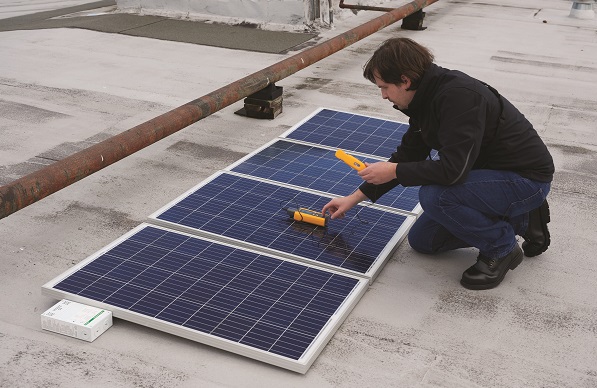
The new IRR1-SOL Irradiance Meter measures irradiance, temperature, inclination and orientation of the solar array.
With a rugged, compact design, a protective carrying case and an easy-to-read, high-contrast LCD screen to read measurements in direct sunlight, the IRR1-SOL can go anywhere users go. The simple user interface, instantaneous solar irradiation measurements and built-in temperature sensor make it easy to meet the IEC 62446-1 requirements for testing, documenting, and maintaining photovoltaic systems. Additionally, the integrated compass and inclination sensor allow users to measure and document roof and site orientation, pitch, and panel tilt while surveying, installing, or adjusting an installation.
Features
- Irradiance measurement: the high precision mono-crystalline solar sensor allows for instantaneous irradiation measurements up to 1 400 W/m2.
- Temperature measurement: using either the built-in temperature sensor or the external suction mount temperature probe to measure ambient and panel temperature.
- Integrated compass: measure and document roof or site orientation.
- Inclination sensor: measure roof and PV panel tilt when surveying, installing, or adjusting the installation.
- Carry it everywhere: equipped with a practical shoulder strapped case to allow safe scaling of climbing equipment, keeping users’ hands free.
Whether on a roof-mounted system or a large field installation, the IRR1-SOL is a single-handed solution that every solar installer and technician can use.
Applications
- Photovoltaic system design and surveying
The Fluke IRR1-SOL Irradiance Meter can be used to find the expected production levels at a site, determining the solar resource while taking shading into account. The solar resource is measured in peak sun hours: the number of hours per day with 1 000 watts generated per square metre of solar array. Location, time of day, season, and weather conditions all influence peak sun hours. The IRR1-SOL serves to determine the actual solar irradiance (Watts/m2) and shading at the site to develop a baseline.
- Measuring
Once the system is installed, the irradiance meter can be used to make sure it is operating as designed by measuring its electrical characteristics and the actual power output of the array. The performance of a photovoltaic array is based on its current-voltage (IV) curve. The IRR1-SOL can be used to obtain the amount of solar irradiance necessary to calculate the IV curve of the power output.
- Comparing and diagnosing
Even when installed correctly, a PV system may not be producing the expected electrical output. In order to do this the system needs to receive the correct amount of irradiance energy to generate the dc voltage that is fed into the inverter.
For more information visit: www.comtest.co.za