Jordan Marsh, managing director of Integrated Pump Technology, highlights the rapid rise of the company from its founding in 2014 to its official recognition as the world's largest Grindex distributor and a growing force in mine dewatering across sub-Saharan Africa.
Click to download and read pdf
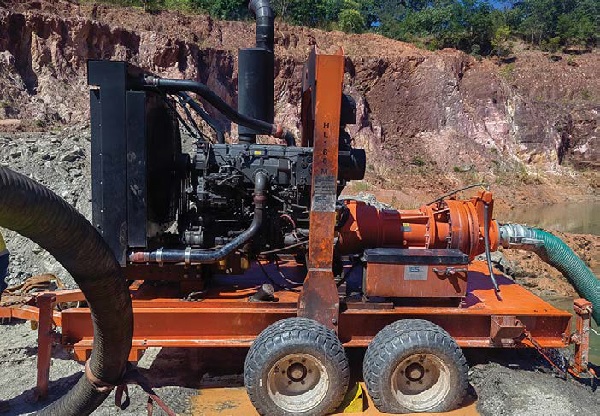
With Godwin diesel-driven units proven in remote and high-head applications, Integrated Pump Technology ensures that mines maintain reliable dewatering even when electrical supply is unstable or unavailable.
As African mines push deeper and face ever-harsher conditions, one challenge remains constant: water. Whether it is groundwater seepage, seasonal flooding or slurry-laden sumps, reliable dewatering is non-negotiable. Rising to meet this need is South Africa-based Integrated Pump Technology, now officially recognised as the world's largest Grindex distributor and a growing force in mine dewatering across sub-Saharan Africa.
Founded in 2014, Integrated Pump Technology has achieved what few could in just over a decade: building a continent-wide reputation for reliability, speed and technical depth. Managing Director Jordan Marsh attributes this success to an unrelenting focus on customer realities.
“From the start, our goal was simple: to provide fit-for-purpose dewatering pump solutions that actually work in African mining environments,” Marsh says. “We have built our business around understanding the conditions our customers face, whether that is a deep underground copper mine in Zambia or an open pit in Senegal.”
This hands-on philosophy has underpinned Integrated Pump Technology’s remarkable rise. Its longstanding partnership with Grindex, the Swedish manufacturer of robust electric submersible pumps, has enabled the company to deliver consistent performance where other solutions falter.
A pump built for Africa
The Grindex range is engineered for the world’s most demanding jobs, and Africa’s mining sector has put that claim to the test. Known for their rugged construction, high efficiency and ease of service, these submersible pumps handle flow rates up to 100 litres per second and heads of 200 metres. Mines across the Democratic Republic of Congo (DRC) and Zambia have come to rely on them as groundwater levels rise with deepening operations.
At one major DRC copper mine, a fleet of Grindex submersibles ranging from
5.5 kW to 90 kW has been running continuously since 2022, providing critical water control with minimal downtime. “When you are hundreds of metres underground, reliability is everything,” Marsh explains. “These pumps have proven their ability to perform under extreme conditions, ensuring both productivity and safety.”
To maintain that reliability, Integrated
Pump Technology’s teams work closely with mine operators and its in-country partners to assess dewatering applications, recommend the right solutions and provide spare parts and technical support. “You can’t sell pumps into Africa from a distance,” Marsh adds. “You need people on the ground who understand what customers are facing every day.”
Dual Strength: Electric and Diesel Solutions
Integrated Pump Technology’s strength lies not only in its products but also in its versatility. The company represents two of the world’s most respected brands, Grindex and Godwin, offering both electric submersible and diesel-driven dewatering solutions.
“In some regions, grid power is simply unavailable or unreliable,” Marsh notes. “That is where our Godwin range comes in. With these diesel-driven pumps, we can support high head, high volume or remote applications where mobility and endurance are critical.”
The Godwin HL160, for example, is already in operation in Zambia, delivering dependable high-head dewatering performance in open-pit operations. Higher up the range, the HL160 and HL270 deliver heads up to 300 metres and flows of around 300 m³/h for deep-pit or long-distance pumping applications.
Together, Grindex and Godwin provide Integrated Pump Technology with a full-spectrum dewatering capability unmatched in the African market, from underground sumps to open pits, for permanent installations or emergency flood control.
West Africa: the next frontier
The company’s latest milestone came in July 2025, when it was officially appointed as a Grindex distributor for West Africa. The move reflects Integrated Pump Technology’s sustained growth and the trust it has earned within the global Grindex network. “We see significant opportunity in West Africa,” Marsh says. “The region experiences high rainfall and hosts numerous wet mining operations. Reliable energy-efficient dewatering isn’t optional – it is essential.”
To support this expanded footprint, Integrated Pump Technology has established a bonded warehouse in Ghana, stocked with a range of Grindex units, including the 37 kW Maxi and 90 kW Mega models. The facility drastically reduces lead times and ensures customers can access critical equipment and spares quickly, a decisive advantage in a sector where every hour of downtime counts.
“This isn’t just about logistics,” Marsh emphasises. “It is about service continuity. We have replicated the same support model that has worked so well in Southern and Central Africa: local stockholding, technical backup and training for our distributors.”
Engineering trust across the continent
In markets such as the DRC and Zambia, Integrated Pump Technology’s customer-centric model has already proven its value. Mines operating at greater depths require not only high head pumping capacity but also assurance that systems will continue to operate despite voltage fluctuations, abrasive materials and limited maintenance windows.
At the same time, Integrated Pump Technology’s technical teams regularly travel to site to conduct audits and optimise pump configurations. “A properly specified pump saves money and prevents failure,” Marsh says. “It is not just about selling a pump but about ensuring the whole dewatering system performs as it should.”
What also makes Integrated Pump Technology’s success noteworthy is its consistency. The company has steadily extended its footprint from South Africa into Central, East and now West Africa without losing its agility or customer focus. Its strategy is built on three pillars: technical expertise, local presence and rapid response.
“Each market has unique challenges, but the fundamentals remain the same for our team: understand the application, deliver the right technology and back it up with support,” Marsh concludes.
https://www.pump-technology.com/