The ongoing evolution of the Venetia diamond mine from a surface to an underground operation is preserving one of the country’s most prominent sites while setting new benchmarks for sustainable mining. MCA talks to Russell Hattingh, MD of BBE Consulting, about the role of advanced ventilation-on-demand in helping Venetia to deliver the mine’s enhanced air quality and operational efficiency.
Click to download and read pdf
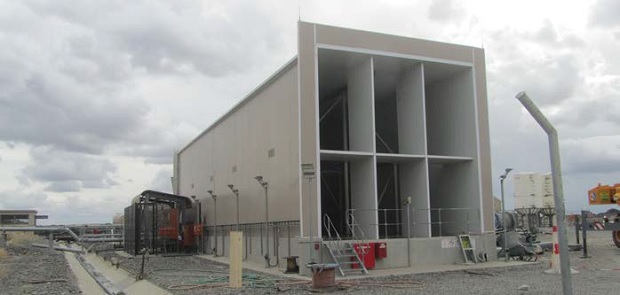
For the Venetia diamond mine, BBE designed and commissioned a new primary air-cooling (BAC) and ventilation system comprising two water-chilling refrigeration machines and multiple air coolers in August 2022.
“Ventilation-on-demand (VoD) is more about air-flow management than instantaneous optimisation of the ventilation system’s performance. That does not diminish the role of real-time control. Rather, effective VoD relies on a well-designed ventilation system that can be dynamically adjusted within safe and efficient operating limits. First and foremost, it's about right-sizing and ensuring proper airflow distribution. Ventilation systems need to be properly integrated into each mine's specific infrastructure, with the capability to meet immediate needs, with built-in expansion plans to meet the needs of the mine's future progress,” begins Russell Hattingh, managing director of BBE Consulting.
For the development of the new underground mine at Venetia, BBE was involved from the initial pre-feasibility phase. A new primary air-cooling and ventilation system comprising two water-chilling refrigeration machines and multiple air coolers was designed and commissioned by BBE in August 2022. “Venetia is now looking at incorporating a ventilation-on-demand capability to manage air quality for all underground workers, ventilating specific working areas according to their needs,” notes Hattingh.
VoD isn’t usual in a conventional mine, he says, but ventilation always needs to be managed. “It’s a bit of a buzzword that always comes down to ventilation management. You might call saving money optimisation, but the whole purpose behind a VoD-type system is to manage the mines' ventilation system properly,” he argues.
Ventilation-on-demand, he continues, can be as simple as opening and closing dampers and manually switching fans on and off. “But its purpose must be ventilation management so that the air is being sent to where it is needed and not to dormant areas that don’t need it,” he continues.
To manage a ventilation system properly, however, one needs to know what to do and what the effects will be. There are two aspects of this knowledge: the first is safety, which is the most important, as the underground ventilation system exists to keep miners safe and working in conditions that promote productivity.
Also important is knowing the required air volumes in each area and how opening a damper serving one area will affect the supply to another. “This is where a more complex control system sets itself apart. Modern digital control systems ensure the specified airflow reaches its destination, such as the new ore drive. Manual adjustments can’t deliver the certainty that a control system can. Over-supplying one production drive might mean under-delivering to another,” he points out, adding that proper ventilation management means getting the right amounts of air to wherever people are working.
Primary and secondary ventilation
Regarding ventilation design, he notes two critical aspects: primary and secondary ventilation. Secondary ventilation is where it starts. Mining occurs at multiple levels and across different time periods. Before mining begins, a level needs to be developed. And depending on the chosen method, one level could be mined while the level below is prepared.
At each level, secondary fans channel air from the primary ventilation system into the level being developed or mined. The secondary ventilation system also returns the ‘stale’ air to the primary return system, says Hattingh.
“So, the primary system needs to get enough air down to the level in question, while the secondary system distributes the air on each working level,” he adds.
When designing a system, because there isn’t an infinite supply of primary air, a fixed quantity is allocated to each level. With ventilation-on-demand, there is a perception that the primary fan is continuously adjusting up and down to match demand. “That's not true. It may be necessary during a brief period if the mine needs to enforce load clipping, for example. In general, however, any disruption in the primary air supply means that mining must stop in some areas because not enough air is available,” Russell Hattingh points out.
“So, we design each level for a fixed amount of available flow, using ventilation-on-demand to make sure that each drive, be it a rim drive, an ore drive or just an inspection, receives the necessary pre-allocated air. Ventilation-on-demand must start with mine design, typically with a minimum supply in mind to avoid oversizing the primary fans. We right-size the secondary ventilation systems to match the mine planning sequence, so that the primary can always meet the secondary demand of all active drives,” he explains.
Ventilation-on-demand at Venetia
This managed approach is well-suited to mining applications with multiple levels that are not all being worked simultaneously. “We are currently implementing a ventilation-on-demand system at Venetia and going through the process of putting the design together, finalising the control philosophy and how the ventilation system will fit into the way the mine is going to operate,” Hattingh says.
The mine is using a progressive sublevel caving operation, where multiple drives will be developed, but only a few will be mined at any one time. “The new on-demand system we are implementing will help them manage the air they are already using by applying a more effective ventilation control system to secondary circuits being fed by the existing primary system installed a few years back,” he explains.
The new ventilation strategy aims to support Venetia’s health, safety, and sustainability objectives, so a fully automated, digitised approach has been chosen.
“Instrumentation is key. It is the backbone of any successful control solution. Dampers or duty-controlled fans are used to regulate flow, and sensors monitor the impact of each adjustment. The instrumentation collects flow, temperature and air quality data from each area to ensure that any change to the system achieves expectations, without over- or undersupply of air, and without causing an unintentional undersupply elsewhere,” he says.
“As you can imagine, the infrastructure required to achieve this across a working mine is substantial. Every fan and every area of the mine needs sensors to collect the necessary data. All that data needs to be collected and sent to a central controller via a reliable communication network for real-time analysis, and the controller must then continually manage each fan speed and/or damper position.
“It’s an idea that's spoken about a lot, but it's seldom fully automated. At the end of the day, we see it as a way to ensure miners receive the airflow they need, where and when they need it.
“Ventilation-on-demand is about giving mine operators peace of mind that the correct quantity of air is going to the right places, which will result in a healthier workforce, better productivity and fewer unplanned work stoppages due to heat exhaustion, overheating equipment or poor air quality,” says Russell Hattingh.
“We are in the early phases of implementing this strategy at the Venetia diamond mine. We are starting on one level, and once we have proved its functionality in one working environment, we will roll it out level by level as mining progresses.
“We are very excited. In South Africa, this will be the first automated ventilation-on-demand system at this level of complexity,” he concludes.