Where the ground is accessible in the area of interest, the exercise of measuring the resistance of an earth electrode to ground is, seemingly, an uneventful exercise, explains Richard Evert, National Director of the Earthing and Lightning Protection Association (ELPA). “Soil is not a good conductor of electricity. By nature, poor conductors introduce resistance to any electrical circuit and an earth electrode will therefore have some form of resistance.” He adds that “an optimal lightning protection system (LPS) earth electrode has a low enough resistance to conduct the anticipated lightning current to ground without introducing dangerous voltages at the earth-termination system (ETS) or on any part of the down-conductor system (DCS).”
 Things to remember
- The value of earth resistance must be less than the value prescribed by the designer.
- The value of earth resistance will increase with increasing soil resistivity.
- Soil resistivity will increase with a decreasing moisture content.
- Measure the earth resistance when the soil has the least amount of moisture present as that is when the highest value of earth resistance will be recorded.
- The resistance of an earth electrode should be measured when it is installed. “If the value of resistance exceeds the maximum design value, the subject of soil conditions are irrelevant,” says Evert. “But if the value of resistance is close to the limits, soil conditions need to be taken into consideration. Where an uncertainty exists, subsequent measurements must be imposed as part of the asset management programs. Should the tested results be close to the limits and the soil has a high moisture content, the designer has failed to adopt the correct earth electrode for the conditions and most likely did not consider the correct soil conditions and soil resistivity values.
- Limited space can often be a problem, says Evert. “The site of an earth electrode within a congested civil works structure can render it impossible to isolate and determine the resistance of an earth electrode. The LPS designer and the vested property stakeholder must determine an alternate strategy to assess the actual ground potential rise behaviour of the structures when the LPS is conducting lightning current.” He adds that “it is the responsibility of the LPS designer to manage ground potential rise under all circumstances”.
Putting equipment to the test
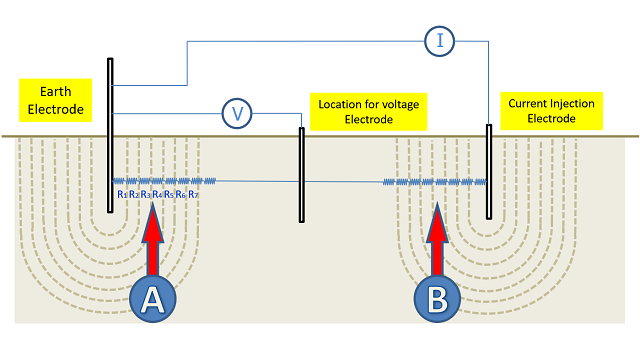
An earth resistance test is simplistic in its basic form, adopting Ohm’s Law as a fundamental consideration. “You introduce current through the component being tested, then you measure the voltage produced across that component. Resistance is equal to the measured voltage divided by the injected current,” explains Evert.
The equipment required for these tests is known as an earth resistance tester. More advanced products will typically include measurements of soil resistivity as a feature. “The test equipment must have an adequate power generating source to inject adequate current into the test circuit to detect a measurable and matching voltage independent of the length of the current injecting test leads,” explains Evert. “The recognised method of measuring the earth electrode resistance is by direct measurement of the earth electrode. This does not include measures of indirect measurements and adoption of assumptions and estimations. You must inject a test current with known parameters, measure the associated and matching voltage, then calculate the resistance.
The position of the current injection electrode is critical to the success of the test. “If the distance between the earth electrode and the current injection electrode is too short, the influences from the two electrodes will overlap and the total resistance of the earth electrode cannot be measured,” says the ELPA director. “The position of the voltage electrode must be used to verify that the position of the current injection electrode is appropriate.” The voltage produced from the earth electrode resistance can only be measured when the influence from the earth electrode and the current injection electrode are adequately isolated by distance. “If the distance between the earth electrode and the current injection electrode is too short, the voltage measured will either be too low and only measuring a portion of the earth electrode resistance, or too high and including the resistance of the current injection electrode.”
When conducting tests, strict protocols need to be adhered to in order to achieve accurate results that are then translated into usable information. There is another benefit of conducting correct tests: Any modification that needs to be done to the building structure can take place immediately. This means business operations can resume as soon as possible, everyone on site is safe, and equipment is given correct power supply.
Enquiries: www.elpasa.org.za