2002). Similar structures have been observed in other
sulphidic aquatic environments such as brackish and
salt marshes and these biofilms may be an important
component in total energy flow pathways in these
systems (Whitcomb, 1989). While it has been sug-
gested that they are simple accumulations of micro-
bial growth, we have found that these floating sulphur
biofilms are composed of both obligate aerobic and
anaerobic populations, including sulphide oxidizing
bacteria, which suggests rather that they are complex
well-differentiated structures that are comparable
to stratified biofilm growth found on solid substrates
(Monds and O’Toole, 2009).
While scanning electron microscopy of the floating
sulphur biofilm (Figure 2) clearly shows that the micro-
bial population is embedded in an exopolysaccharide
matrix that includes the production of ortho-rhombic
crystals of elemental sulphur (Bowker, 2002), the
possible functional differentiation of the population
structure within the biofilm has remained undescribed
up to the present.
Figure 2: Scanning electron micrograph showing large amorphous
structures which accumulate on the underside of the floating
sulphur biofilm. These were shown elsewhere to be composed
largely of sulphur, possibly in the long chain polysulphide form.
The possible application of the floating sulphur biofilm
system for sulphur recovery in the biological treatment
of acid mine drainage wastewaters has been proposed
and bioprocess development studies have been re-
ported by Gilfillan (2000), Bowker (2002), Bowker
et al
(2002), Molwantwa
et al
(2007), Molwantwa (2008),
Rose and Rein (2007), Molwantwa
et al
(2009), Mack
et al
(2009) and Van Hille
et al
(2011). However,
uncertainty about a biological role, if any, for sulphur
formation in these films, the possible presence of
differentiation within the microbial population struc-
ture and, importantly, the possibility of physiological
functional differentiation within this type of system,
has remained unresolved. The main reasons for this
are methodological constraints related to sampling
and experimental manipulation of these thin and
fragile structures. More clarity on the structural/func-
tional attributes of these floating biofilm systems could
be important to the future engineering of their use in
wastewater treatment applications.
We report here the development of a gradient tube
method for expanding the spatial distribution of the
various physiologically functional microbial groups
that grow actively within these biofilms. This approach
allows the effective sampling of the different compo-
nents found within the biofilm population structure.
Materials and methods
Actively growing floating sulphur biofilm was sampled
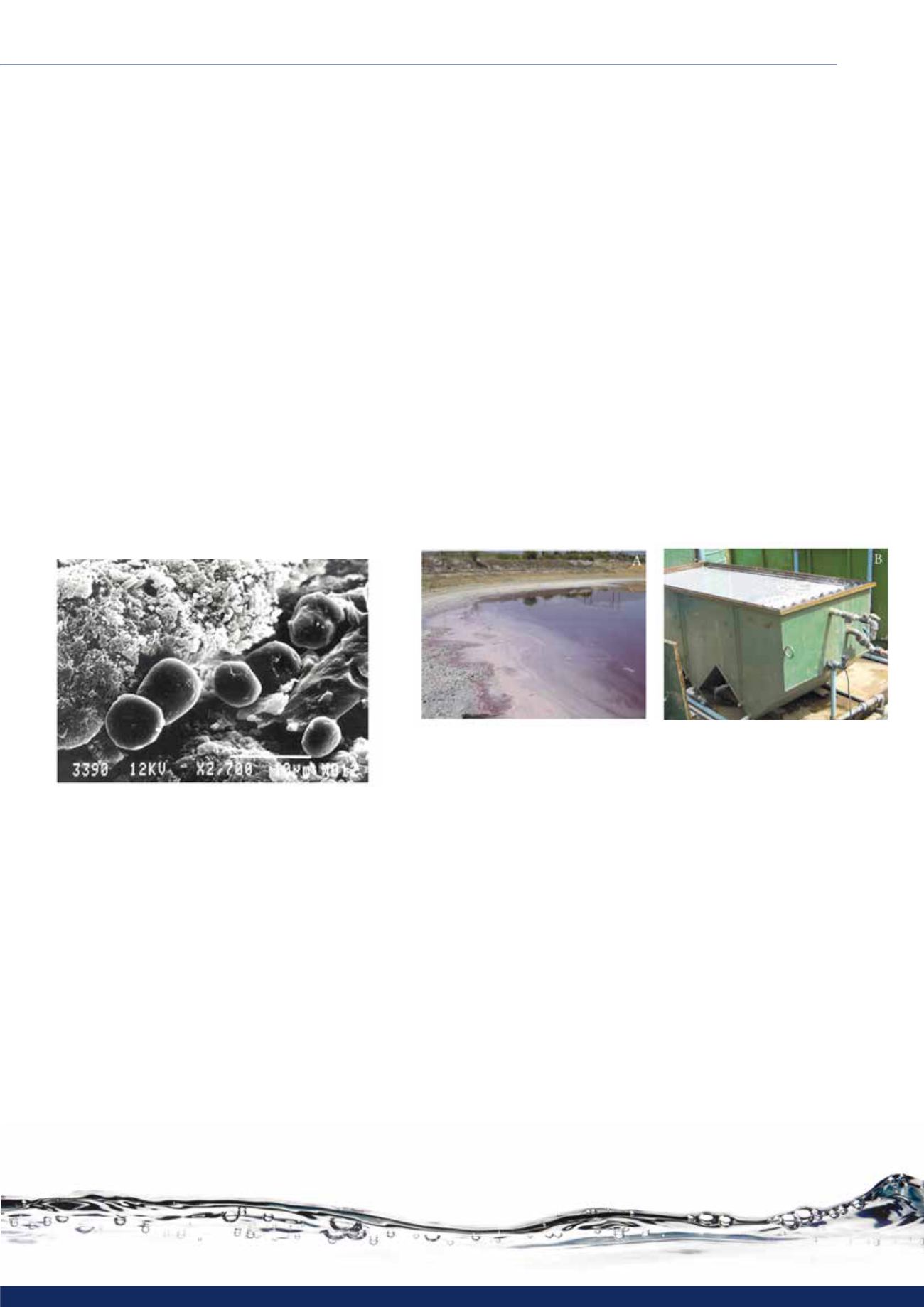
from both tannery ponding systems (Figure 1A), and
a laboratory reactor (Figure 1B) that was fed organic
sulphide-enriched water generated in a degrading
packed bed reactor as described by Molwantwa
et al
(2007). Aliquots of these biofilms (500 μl) were mixed
with 500 μl of glycerol and frozen at -70
°
C until used.
Figure 1: A. Photograph of a tannery wastewater evaporation
pond, an example of a high-sulphide organic-enriched aquatic
environment, and showing formation of the white sulphur biofilm
floating on the water surface. Sulphur produced in this system
is blown into thick windrows on the sides of the levies but may
also be deposited as a sediment within the pond. B. Field-scale
floating sulphur biofilm reactor developed to enable the simula-
tion of floating sulphur biofilm formation under experimental
conditions.
Gradient tubes were prepared by aseptically plac-
ing, at the bottom of a sterile 15 ml glass test tube,
a 5 ml molten agarose plug containing 1% low-melt
agarose, 0,5 g/l sodium sulphide in lactate medium
(1,75 ml 60% sodium lactate, 1 g MgSO
4
·
7H
2
O, 0,5g
yeast extract, 0,25g K
2
HPO
4
, 0,05 g CaCl
2
·
6H
2
O, 0,5 g
NH
4
Cl; made up in 250 ml with ddd H
2
O and steril-
ized). After the sulphide plug had set, an overlay of the
same lactate medium, but without sodium sulphide,
was prepared, to which the biofilm sample was added
and thoroughly mixed; the biofilm inoculum was added
while the medium was still liquid but as cool as pos-
sible. Then 10 ml of the mixture was pipetted asepti-
cally onto the surface of the solid agarose sulphide
plug while avoiding the introduction of air bubbles.
21
Chemical Technology • September 2013
water treatment


