33
CONSTRUCTION WORLD
MARCH
2014
PROJECTS AND CONTRACTS
sports stadia
“From a place to see your favourite
athletes pitting their skills against
competitors, to a modern Roman
Colosseum where the public gather,
clutching smart phones, for a multimedia
and multi-sensorial experience.”
example, the decision on the variations
in height, depth and profile of the roof is
as much about achieving structural effi-
ciency as is about architectural expression
and aesthetic proportions, and also main-
taining the view of the field and scoreboard
from the upper tiers.
These days we design stadium roofs
in an excitingly diverse array of structural
forms: ranging from the rather conven-
tional cantilevered and long-span systems
to the more exotic shells, cable nets, and
‘tensegrity’ roofs.
The choice of appropriate construc-
tion materials and its correct application
is particularly important. Long-span struc-
tures are generally fabricated from steel
because of the high strength-to-weight
ratio, ease of use and cost effectiveness of
this material.
The search for lightweight, durable
cladding materials has resulted in the
increasing use of high-tech tensile
membrane systems.
The decision on whether to incorpo-
rate a fixed or a retractable roof requires
the holistic evaluation of the value in
weather protection versus turf health, and
the impact of shadow effects on spectator
viewing and TV broadcast quality – all
factors that have implications on cost,
risk, functionality and potential return on
investment for the project.
Elaborate roof designs need careful
assessment of wind loads on the struc-
ture, while the overall design has to ensure
that spectators are comfortably shielded
from wind.
Aurecon’s capabilities in building and
analysing simulated models enable us
to overcome the unknowns in an uncon-
ventional design and ensure that project
objectives are fully met.
In essence, we can test the building and
de-risk it before it is built, without compro-
mising its technical integrity.
Answering the natural
turf trend
To sustain healthy, natural grass means
designing for lengthy periods of exposure to
sunlight, which creates a roof opening opti-
misation conflict. Too small an opening,
while shadier for the spectators, leads to
a significant expenditure for annual turf
repairs. Too small a roof, results in disgrun-
tled wet spectators during rainy spells.
One form of a solution is the roof of
the Forsyth Barr stadium in Dunedin, New
Zealand. Membranes of Ethylene tetrafluo-
roethylene (ETFE), a fluorine-based plastic,
were used to create air-inflated pillows
as the roof cladding material in what has
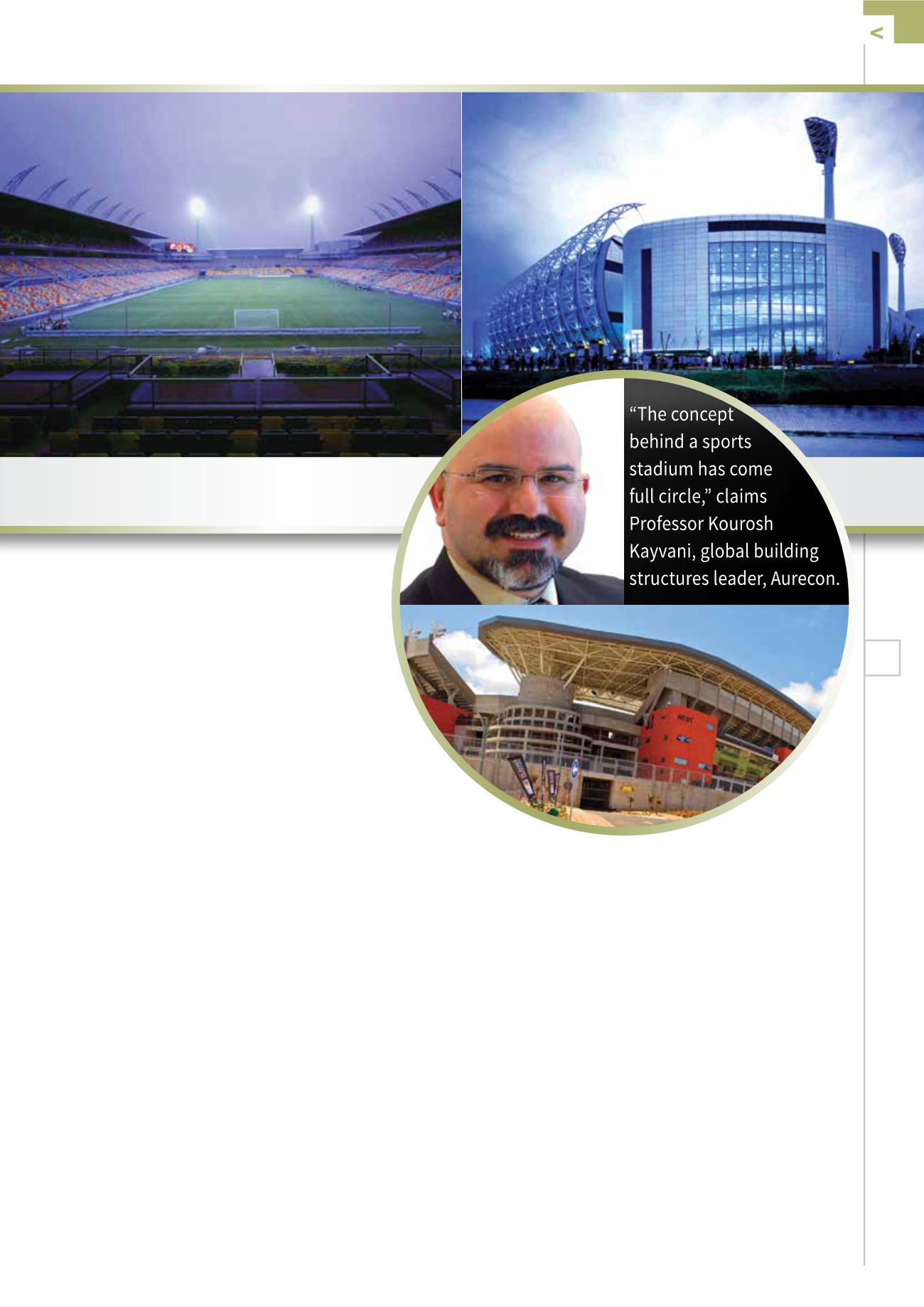
Peter Mokaba Stadium,
South Africa: This brand new,
45 000 seat soccer stadium acted
as one of the ten host venues for the
2010 FIFA World Cup™ and saw
Aurecon provide a complete range
of engineering services.
Tianjin Technological Development Area (TEDA) Soccer Stadium, China: This is
the centrepiece of the 100 million m
2
commercial expansion of Tianjin’s bustling
Economic-Technological Development Area. Aurecon provided structural, civil and
building services for the stadium, including taking a leading role in the design of the
innovative cable stayed roof with its dramatically curved truss columns.


