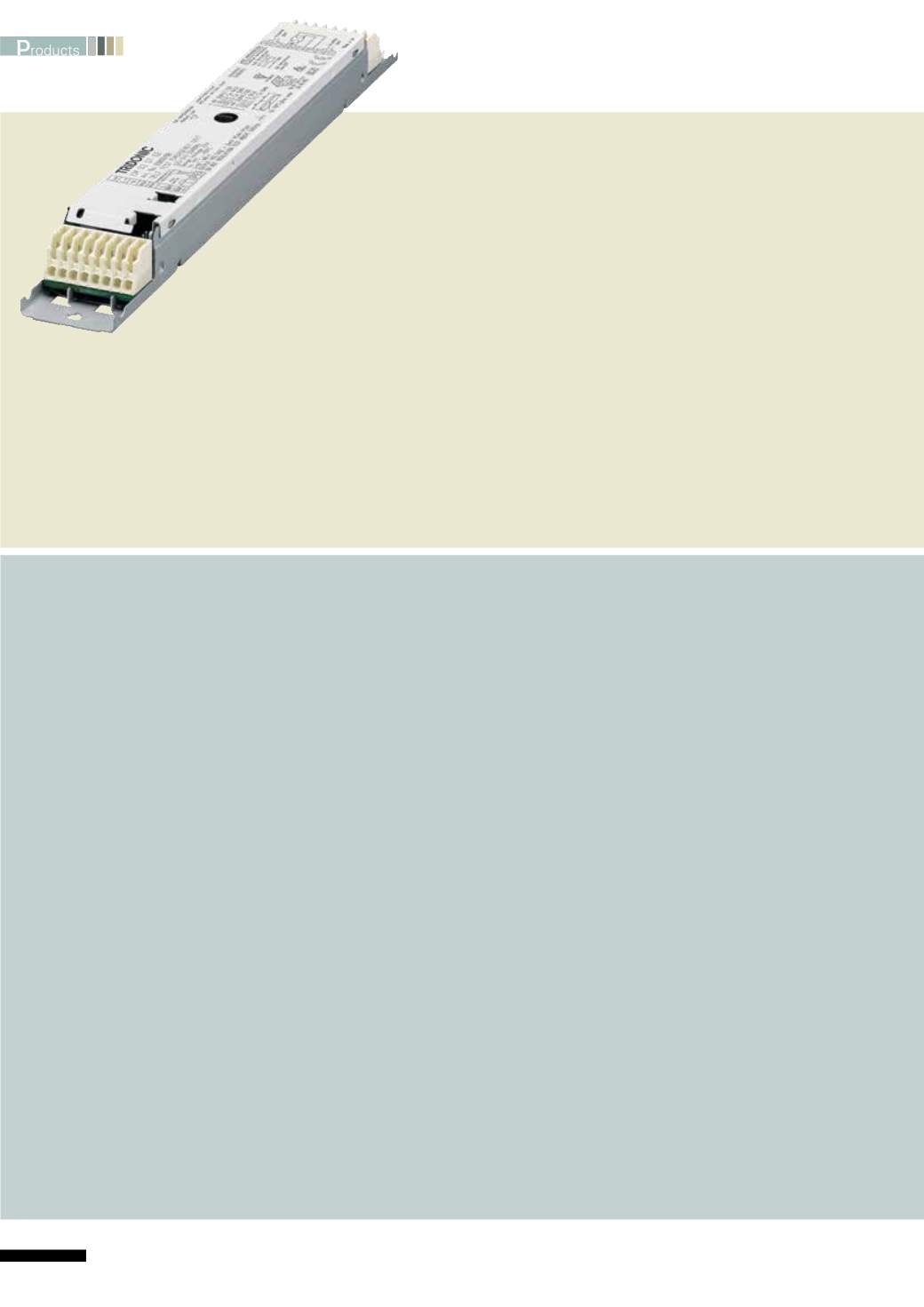
EM emergency light drivers
The 2
nd
generation of the 3-part
EM series features a new electri-
cal design that enables the standard
product portfolio to be halved and costs
for stock keeping to be correspondingly
reduced. The housing length has also been
reduced from 280 mm to 230 mm, enabling
the emergency light drivers to be more simply
installed in linear and compact fluorescent lamps.
All modules of the 2
nd
generation comply with cur-
rent standards such as IEC 62034 and IEC 62386,
ensuring safe investments for the future.
Luminaire manufacturers benefit from the
electrical design as this provides new design op-
tions for smart, purist luminaire constructions. A
further advantage of the new generation is that the
emergency light operation duration (one to three
hours) can now be directly set via a jumper on the
emergency light unit. In addition to the standard
variants, emergency light units are also available
with a special loading algorithm for NiMH batteries,
increasing the life and reliability of these batteries.
As with the predecessor version, the 2
nd
genera-
tion also consists of the EM BASIC, EM SELFTEST
and EM PRO product groups. The EM BASIC unit
enables fundamental emergency light functions
to be implemented and manually tested, while the
EM SELFTEST group features integrated self-test
functionality, the results of which are displayed via
indicator LEDs. The EM PRO version enables tests
for all devices to be individually set via DALI. Test
results are displayed here with indicator LEDs and
can also be centrally documented.
Integrated power control with emergency light
operation ensures maximum output for the speci-
fied rated operating duration (one to three hours).
Tridonic:
New compulsory specification for incandescents
VC8043, the compulsory speci-
fication for incandescent lamps,
has been published but has not
yet been reflected on the NRCS
website.The specification covers
the more efficient incandescent
lamp and lays down requirements
for light output (lamp efficacy) and
a life requirement of >1 000 h.
The following three standards
have been circulated for final
voting to SABSTC064 committee
members, and it is expected that
these standards will be published
within the next few months:
• ARP 032 Guidelines for the
modification of luminaires for
tubular fluorescent lamps.
• SANS 1662 Self-ballasted
LED tubular lamps.
• SANS 1664 Semi-luminaires
for T5 fluorescent lamps.
These standards will be published
together. SANS 1662 and SANS
1664 are standards for products
that can only be fitted to lumi-
naires modified in accordance
with ARP 032. These standards
specify that the lamp feed will
only be through one of the lamp
holders, while the lamp holder at
the opposite end is not electri-
cally connected and only serves
for holding the lamp in place.
When T5 retrofit luminaires
were first marketed locally, there
were a number of issues regard-
ing the safety of certain of the
products. In some units, the lamp
cap pins of the opposite end be-
came energised when one end of
theT5 retrofit was inserted in the
lamp holder (when the luminaire
was switched on). This certainly
would cause a safety risk.
This product was, however, not
covered by the compulsory safety
specification VC8055, just as it
was not covered by SANS 60598,
which required that semi-lumi-
naires should be either connected
through bayonet lamp holders or
Edison screw lamp holders. The
T5 retrofit, fitted with G5 lamp
caps, therefore falls outside the
scope of SANS 60598.
European countries were
strongly opposed to T5 retrofits
but these products showed merit
and flooded the market through
Eskom’s energy saving drive.The
only alternative open to the SABS
TC064 was to write a standard
and recommended practice for
the T5 semi-luminaire to ensure
that the product was safe.
LED tubular lamp require-
ments covered by SANS 1662
are based on the IEC standard
but differ in that the lamps are
only electrically supplied at one
lamp cap while the other is not
electrically connected. The lumi-
naire must therefore be wired as
described in ARP 032.
A new standard, SATS 17576
LED Luminaires – performance
requirements, has proceeded
through theworking group stages
and is now being edited. It will be
published for comment shortly.
This standard is specifically aimed
at the performance of LED lumi-
naires and covers in a fair amount
of detail, the photometric test
methods to be applied.
While this standard makes use
of various new concepts, it will
be published as a South African
Technical Standard (SATS) and
will be revised one year after
publication. Its status may then
change to SANS.
Enquiries: Connie Jonker,
LiD
08-09/14
40


