4
Mechanical Technology — August 2013
⎪
On the cover
⎪
B
earings International, a
Southern African distributor
of bearings and power trans-
mission products, takes pride
in its range of general and specialist
bearings and drive train components.
“We are a company that collects the
best brands for specialised applica-
tions,” suggests Ross Trevelyan, bear-
ings manager for Bearings International,
“and increasingly, we are finding that
these brands are better able to deal with
local challenges than traditional rotating
shaft components,” he adds.
Matthew Tyler, Bearings Interna-
tional’s Cooper product manager cites
the new ‘E Type, Cooper Split Roller
Bearing as an example of a special prod-
uct that is steadily changing traditional
attitudes towards bearing technology.
“Cooper is the world’s leading split
roller bearing manufacturer. Split bear-
ings are specially designed for ease of
maintenance and replacement when
the bearing is in trapped positions on
a drive train. On the overhanging shaft
of a mine ventilation fan, for example,
you have the electric motor, a coupling,
the outside bearing, the inside bearing
and the impeller running on the end. We
are quoting on a job at the moment and
the impeller, alone, is 12 t,” says Tyler.
“To remove a conventional inner fan
bearing fitted with a plummer block,
you have to first remove the motor – for
which you will need an electrician –
then the coupling, which will typically
need to be heated to free it from the
shaft, then the complete outer bear-
ing and housing needs to be pulled off
before you can gain access to the inner
bearing. While doing this, the whole
shaft and everything on it needs to be
supported.
“It could take 12 hours or more to
replace an inner bearing, and you would
need a whole crew with lifting equip-
ment to do it. With a Cooper split, the
electric motor stays in place, and the
coupling stays on the shaft and only
needs to be lifted a few millimetres,
which can be done with portable hy-
draulic jacks,” he explains.
“Also, as long as the pedestal re-
mains unmoved, the new split bearing
slots into exactly the same position as
the old one, so realignment becomes
unnecessary,” adds Trevelyan. “With
a plummer block housing, the housing
has to be removed, so realignment is
essential. This may take a few hours,
and often contracted technicians and
equipment are needed to do it. A
technician would have to travel to site
and wait until the bearing is mounted
before beginning work, adding further
downtime costs,” he points out.
By adopting Cooper split roller bear-
ings for trapped positions on shafts,
downtime due to bearing replacements,
can be cut by up to 80%, for example
from 10-12 hours to two to three hours.
“Also, because the split roller bear-
ing design uses a swivelling cartridge
around the shaft with built-in seals, the
sealing efficiency is excellent. More and
more clients prefer to use split bearings
for end-of-shaft applications, as well,
even though plummer blocks in these
positions are less expensive and quite
easily changed,” reveals Tyler. The
Cooper split roller bearing misalignment
is accommodated between the sphered
cartridge on the shaft and the spherical
pedestal base. So the seal, which is in-
MechTech
talks to Ross Trevelyan and Matthew Tyler of Bearings International about
the advantages of adopting special bearing and shaft mounting solutions designed
to overcome commonly experienced problems in South African industry: skills
and tools shortages; excessive downtime; and premature component failure.
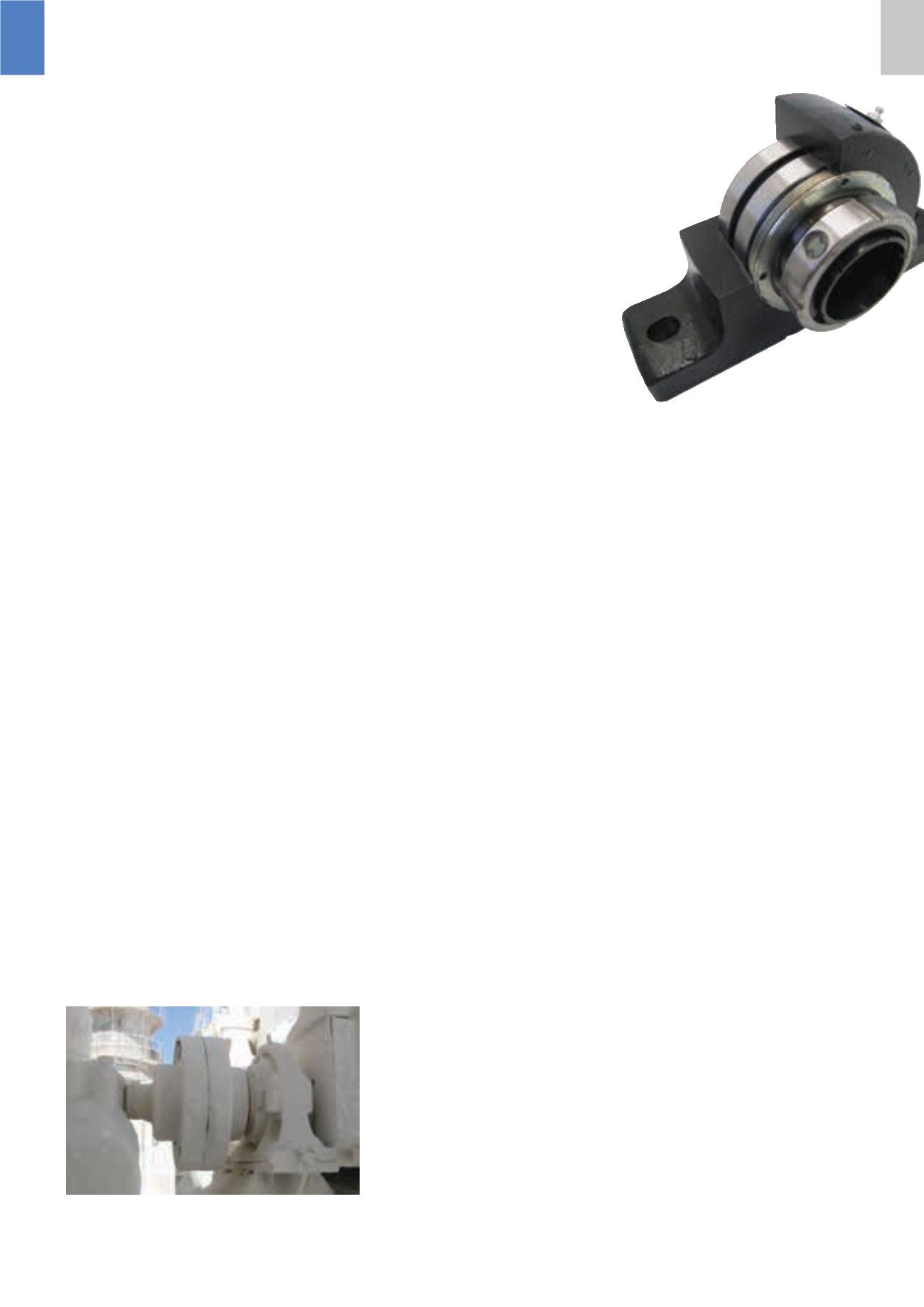
A Cooper split bearing in a trapped position at a lime
plant.
The Shurlok
adapter mount
for Rexnord’s Link-
Belt unitised-bearing range
incorporates strain gauges on the locking
collar, which change colour as the collar
tightens.
Special bearings and drives
from SA’s solutions partner
side the cartridge, remains parallel and
concentric to the shaft at all times. This
significantly extends the life of the seal
and therefore the bearing,” he explains.
Cooper’s latest split bearing de-
sign offers: high load carrying capac-
ity as standard on all shaft sizes over
155 mm; increased axial and radial
load carrying capacity; brass cages as
standard; SG iron as standard on all
heavy duty SD pedestals; and optimised
roller profiles. “The new range offers
world leading specifications and up to
135% longer L10 life,” claims Tyler.
Kaydon slimline and slewing
bearings
Kaydon, as well as being the company
that owns the Cooper brand, is also
a brand in its own right for precision
slimline bearings and slewing rings.
“Kaydon specialises in precision ground
slimline bearings typically used for aero-
space and defence guidance systems
and medical magnetic resonance imag-
ing (MRI) scanners. It is a market leader
in the USA for thin section bearings,”
says Trevelyan. “Here, we sell them to
aerospace and defence manufacturers
and for niche industrial machines, such
as granite cutting machines for making
worktop slabs, amongst other applica-
tions” he adds.
Kaydon also manufactures slewing
rings for heavy industrial applications,
used for earth moving equipment; stack-
er/reclaimer systems and mobile cranes.
“The largest bearing it manufactures has
a diameter of 6,2 m, and one of these
is a Capex component on its own, so it
needs to last,” he adds. “Kaydon is a


