14
Mechanical Technology — August 2013
⎪
Proactive maintenance, lubrication and contamination management
⎪
L
ubrication is an essential part
of machinery maintenance for
nearly every production facility.
On average, lubricant purchas-
es amount to only 3% of a maintenance
budget, but lubrication related activities
can influence an estimated 40% of total
maintenance costs.
In order to achieve optimum reli-
ability and maximum benefits from a
lubrication programme several factors
need to be taken into account. These
factors are summarised by the well-
known ‘five R’s’ of lubrication:
• The right lubricant;
• In the right quantity;
• At the right time interval;
• At the right point; and
• With the right method.
The starting point of an effective lubri-
cation programme is the detailed map-
ping of all lubrication points – including
their working conditions, lubrication
requirements and criticality. This in-
formation is needed to select the most
suitable lubricant, quantity of lubricant
needed, and to calculate the adequate
re-lubrication intervals. These are the
first three ‘Rs’.
The fourth ‘R’ refers to best prac-
tices: Tagging, colour coding (or other
methodology) of both lubrication points
and tools in order to avoid cross-
contamination.
The fifth ‘R’ can be defined once the
application conditions, asset criticality,
and maintenance strategy are analysed.
This will help make the deci-
sion on whether to lubricate
manually or use automatic
lubrication. In order to make
that decision, the pros and
cons of automatic lubrication
should also be understood
and considered.
Once the five ‘Rs’ are de-
fined, the outcome will provide
an answer to the key question:
What is the best we can do to
lubricate this component in the best
way with the resources available?
Factors affecting lubrication
method
Criticality analysis:
A thorough critical-
ity analysis of each asset illustrates the
impact of a failure in terms of:
• Overall production cost.
• Overall maintenance cost.
• Environmental impact.
• Health and safety of personnel.
The most critical assets are commonly
the first targets for automatic lubrication.
Maintenance strategy:
The matu-
rity level of a maintenance programme
(corrective, preventive, predictive) will
dictate the skill and knowledge level
required of personnel involved in lubri-
cation related activities.
As the maturity of maintenance and
associated lubrication programmes
increases, so does the complexity of
tasks that lubrication technicians must
be trained and capable of completing.
These include activities such as:
• Lubricant analysis.
• Lubrication route adjustment.
• Relubrication intervals optimisation
according to predictive techniques
(lubricant analysis, vibration, ther-
mography, et al); and lubricants
consolidation.
• Contamination control and fluid
reconditioning.
• Inspection routes.
Therefore, as more mature maintenance
programmes are adopted, the areas
where skilled maintenance technicians
can add value to your operations need
to be carefully considered. For example,
are they best utilised performing manual
re-lubrication (which might easily be
automated), or by using their skills and
knowledge to perform more analytical
tasks, lubricant analysis, and making
improvements to the lubrication pro-
gramme?
The benefits of automated
lubrication for bearings
Reduced waste and risk of bearing
failure:
Re-lubrication quantities are
dictated by the physical space avail-
The case for automatic lubrication
How to decide when to choose manual or automatic lubrication to achieve
optimum reliability...
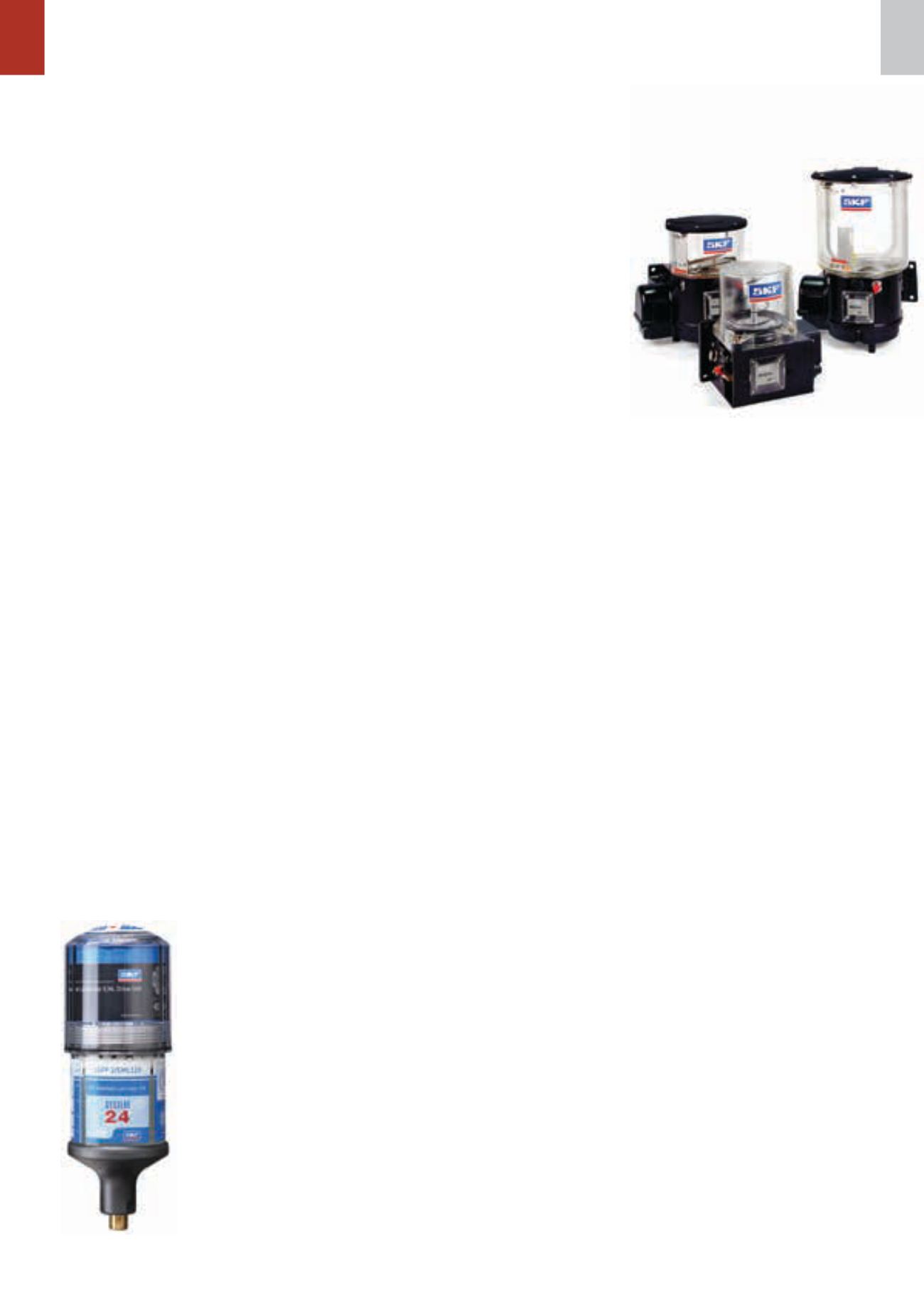
A single point automatic lubrica-
tion system such as the SKF
System 24 will deliver the right
amount of grease at the right time to
each lubrication point.
SKF’s
electrically
driven reservoir
pump units are available with and without
an integrated control unit. These units
provide automatic lubrication to central-
ised systems with progressive feeders
or single-line distributors on machines,
systems and vehicles.
able in the bearing and re-lubrication
intervals are dictated by the working
conditions that determine the degrada-
tion rate of the lubricant (speed, load,
temperature, type of bearing, etc).
A single point automatic lubrication
system such as the SKF System 24 will
deliver the right amount of grease at the
right time to each lubrication point. This
reduces both grease wastage and the
risk of bearing failure.
For example, consider a bearing that
has to be re-lubricated with 2,0 g of
grease every week. Using a standard
grease gun this would mean that the
bearing should receive about 1,3
‘strokes’. However, manually delivering
0,3 strokes is difficult. So, in reality, two
strokes would likely be given. In other
words the bearing will receive 3,0 g
instead of 2,0 g of lubricant each time.
If we assume that the technician is sat-
isfied with two strokes (even if no grease
is seen coming out of the seals), then
after a year, the bearing will receive:
52 weeks x 3,0 g/week = 156 g,
instead of:
52 weeks x 2,0 g/week = 104 g.
That means that up to 52 g (50%)
of grease will have been wasted.
This example illustrates the benefit
of accurately delivering the right quan-
tity of lubricant (the second R), but what
about the frequency of lubrication – the
third R?
Extending re-lubrication intervals
beyond the calculated limits will expose
the lubricant to excessive degradation


