8
Mechanical Technology — August 2013
⎪
Special report
⎪
I
ntertek, an independent inspection
company founded over 127 years
ago, today employs over 35 000
people in 1 000 locations and 100
countries around the world. “Intertek
is a global player in many inspection
markets. We help customers improve
performance, gain efficiencies in manu-
facturing and logistics, overcome mar-
ket constraints and reduce risk,” says
Thomas Andrews, Intertek’s business
development manager at the breakfast
launch of the new OCM laboratory.
“Today we are proud to officially an-
nounce the launch of an Intertek OCM
service for sub-Saharan Africa, and to
introduce its experienced team led by
David Beard, a graduate of Oxford, a
trained metallurgist and a man with
expertise in the OCM field gleaned from
20 years of work in the mining and
engineering fields.”
On taking the podium, Beard an-
nounced that he is not going to talk
about the merits of oil condition moni-
toring, how used oil analysis works or
the modern machines used to do it.
“Today is about how Intertek can help
to take OCM services to the next level in
sub-Saharan Africa. I am going to talk
about how we can help to overcome
some OCM challenges on the continent:
turnaround times; independence; certi-
fied tests; the range of available tests;
branding; and growth opportunities.
Turnaround time
“If you take a sample on the first day
of a month and get the results on the
31
st
, you may well have changed the
oil in that machine twice during the
interval. So, the whole point of any
condition tracking exercise would have
been lost,” begins Beard. He goes on
to point out that the turnaround time
challenge involves two separate com-
ponents. “Firstly, we have to work out
how to get a sample from your site to
our laboratory quickly. Secondly, the
issue become how fast we can analyse
the sample and how efficiently we can
get the report back to you. Clearly, us-
ing postal services is unacceptable,”
he quips.
“Intertek, because of its many other
activities, has a presence in most areas
in and around South Africa, and all our
facilities are interlinked. If a sample is
dropped off at any one of our offices,
in Richards Bay, for example, we will
have contact couriers going into that
office every day who are able to deliver
the sample to us in Isando, overnight.”
Pointing to a South African map of
Intertek offices and laboratories, Beard
says that South Africa is “well covered.
“If you have a particular
need to get samples to us
from somewhere remote,
we will find someone
within a reasonable dis-
tance of your site so that
we can test the sample
within a few days.”
Moving up into Africa,
Beard shows a map of
“pink Intertek colonies”,
countries with Intertek
offices in Africa. “Apart
from the strip of coun-
tries across the Saharan
desert, there is a lot of
pink in Africa,” he says.
“Any sample dropped off
at any of these offices can
Intertek, a UK-listed global testing, inspection and product certification specialist, has
launched an oil condition monitoring (OCM) service into Africa from a newly established
laboratory in Isando, Gauteng. David Beard, the company’s tribology specialist, introduced
the service at an event in July.
MechTech
reports.
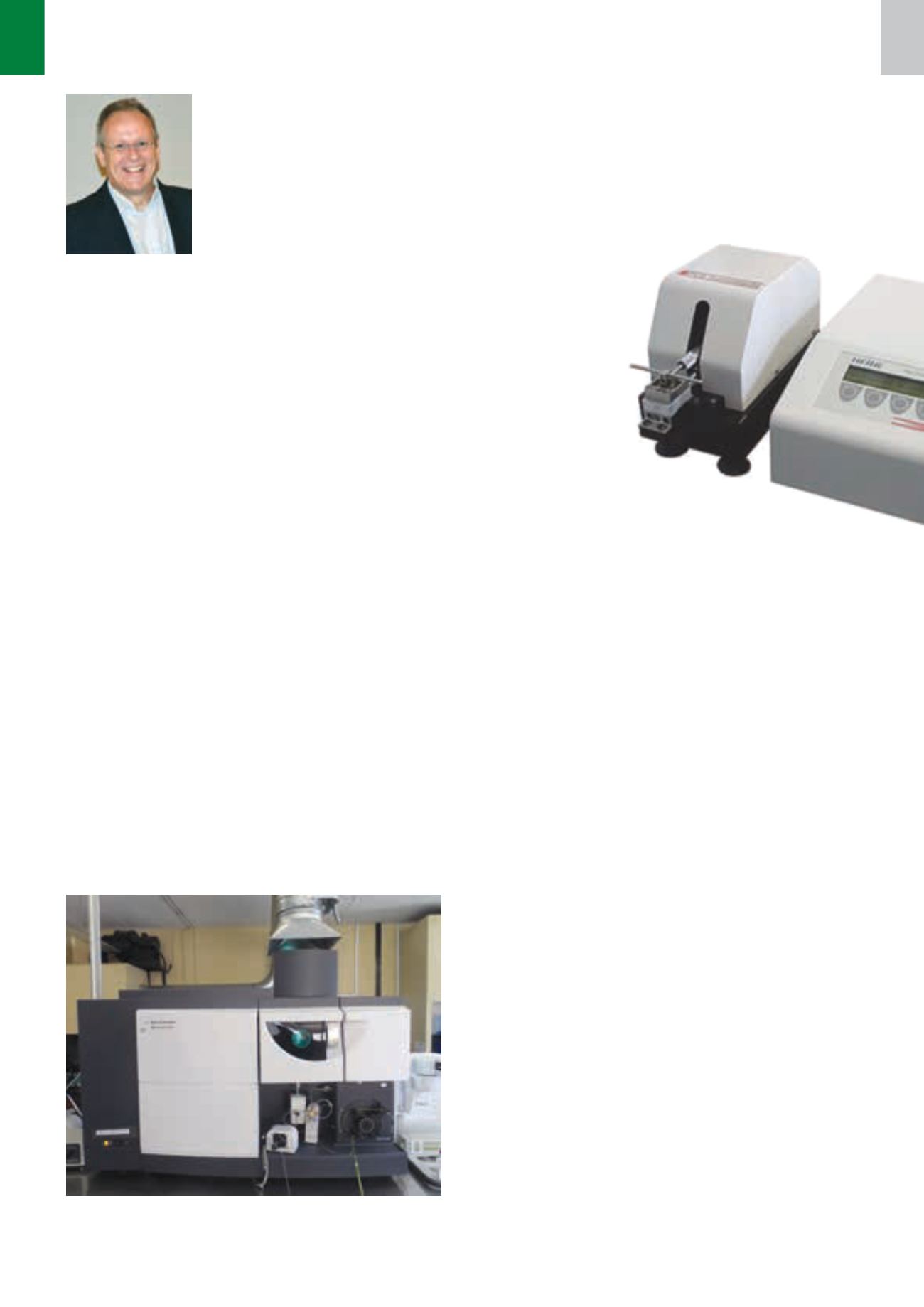
The laboratory’s new ICP spectrometer enables rapid determination of
wear metals, additives and contaminants.
Intertek’s HFRR test rig
for analysing fuel lubricity, possibly the
only one available in South Africa.
Global specialist sets up local OCM
be delivered very quickly to one of the
13 OCM facilities we run around the
world. As well as the Isando facility in
South Africa, we have OCM laboratories
in Panama, China, Singapore, USA,
Rotterdam, Dubai and three in the UK.
If any of these offers easier access, then
we can arrange for the analysis to be
done there instead,” he suggests.
“So, we can get samples from you
quickly, but how quickly can we get
the results back to you? We are cur-
rently running the machines at 50%
of their capacity. So we have a lot of
room to grow. This means that we can
very easily meet our targets of analys-
ing and turning reports around in a
24‑hour cycle.
“We can move to a double shift
should we need to further increase our
capacity and we are also ready and
willing to duplicate our current setup as
soon as demand makes it necessary,”
he adds.
On the reporting side, Beard says:
“Everything is electronic these days.
We have set up a system that will auto-
matically email copies of all completed
analysis reports every hour. In addition,
we can send a report at any time, in
response to an urgent phone call, for
example.”
A web-based system has also been
set up to enable clients to access reports
by logging onto an Internet site. “Our
commitment is to send reports within
24-hours of receiving the sample, so


