⎪
Heating, cooling, ventilation and air conditioning
⎪
Mechanical Technology — February 2014
27
rejection direct to atmosphere.
“We have two main circuits that
service demand during normal shopping
hours (roughly 7am-6pm) and a third
that deals with the ‘oddities’, ie, the
after-hours demand from restaurants,
gymnasiums and the Ster-Kinekor cin-
emas. This prevents the energy wastage
of having to run a 1,1 MW chiller at
10pm at night to meet a 250 kW cool-
ing requirement, for example,” Lund
explains.
“When not required, the large chill-
ers will go into economy mode, so that
we never generate unnecessary cooling.
All the chillers for the retail centre are
also interlinked, so any one of them can
be bypassed, while the others are used
for backup.”
Chilled water is generated at 6,5°C
and, under full loading, comes back
at 12°C, giving a
∆
T of 5,5°C. “This is
perhaps a little lower than the 6,0°C
∆
T that is typically used, but lower
∆
T
requires smaller pipe sizes, and I have
always found it to be slightly more
economical,” he says.
The chilled water is pumped to
strategically placed plant rooms with
constant volume air handling systems
in the retail spaces. These supply fresh
air to the retail spaces below. “Generally
speaking, one plant room services four
to five tenants, but some of the ‘majors’
such as Pick n Pay, sometimes require
a dedicated plant room,” says Lund.
For the Nedbank offices, the team
also conducted investigations into
tri-generation and microturbine op-
tions – available in 400, 600 and
800 kW units – “but ultimately, these
were not quite economical enough,”
continues Berry. “We also looked at
a four pipe system with polyvalent
(heating and cooling) chillers to enable
heating to be handled centrally too, but
Johannesburg’s climate is surprisingly
benign, so we eventually chose to use
resistance elements in the air handling
units to meet occasional demand on
a winter morning when heating is
required instead of cooling,” he tells
MechTech
.
But the Nedbank offices are also
using a full economy cycle system.
“Depending on the ambient outside
temperature, fresh air can be auto-
matically drawn into the building as a
substitute for the air conditioning. When
the ambient temperature is between
12 and 16 °C, outside dampers open
automatically and up to 100% fresh air
can be passed through the air handling
units instead of chilled air produced by
the chiller plant, which can therefore
be shut down, thus saving more en-
ergy. These conditions occur for around
500 hours in the year, so no energy is
required to keep the building cool at
these times. Johannesburg’s weather
profile is ideally suited to this,” Berry
explains.
This economy cycle is under the
full automatic control of the building’s
management system (BMS), and both
energy use and savings are continuously
recorded. “The whole building is full of
sensors, not only because of the green
star rating, but Nedbank also want to
monitor energy use for verification, to
trend the building and to compare it to
its other facilities. This is a key principle
of efficient energy use,” says Berry.
Also in pursuit of energy efficiency
and the 4-star Green Star rating, the
building features:
Construction and building waste
recycling.
Low energy material use, such as
reduced cement concretes.
90% of the steel, including some of
the rebar, is from recycled sources.
Special low-polluting paints have
been chosen.
Fresh air ventilation, at 10
ℓ
/s per
person exceeds the SANS minimum
(7.5
ℓ
/s per person) by 40%.
The building is designed to maximise
available natural light, while glare is
controlled via external screening and
internal blinds.
High frequency low flicker lighting is
being used, predominantly fluores-
cents, but with some LED lighting in
the meeting rooms. These are con-
trolled via lux and motion sensors.
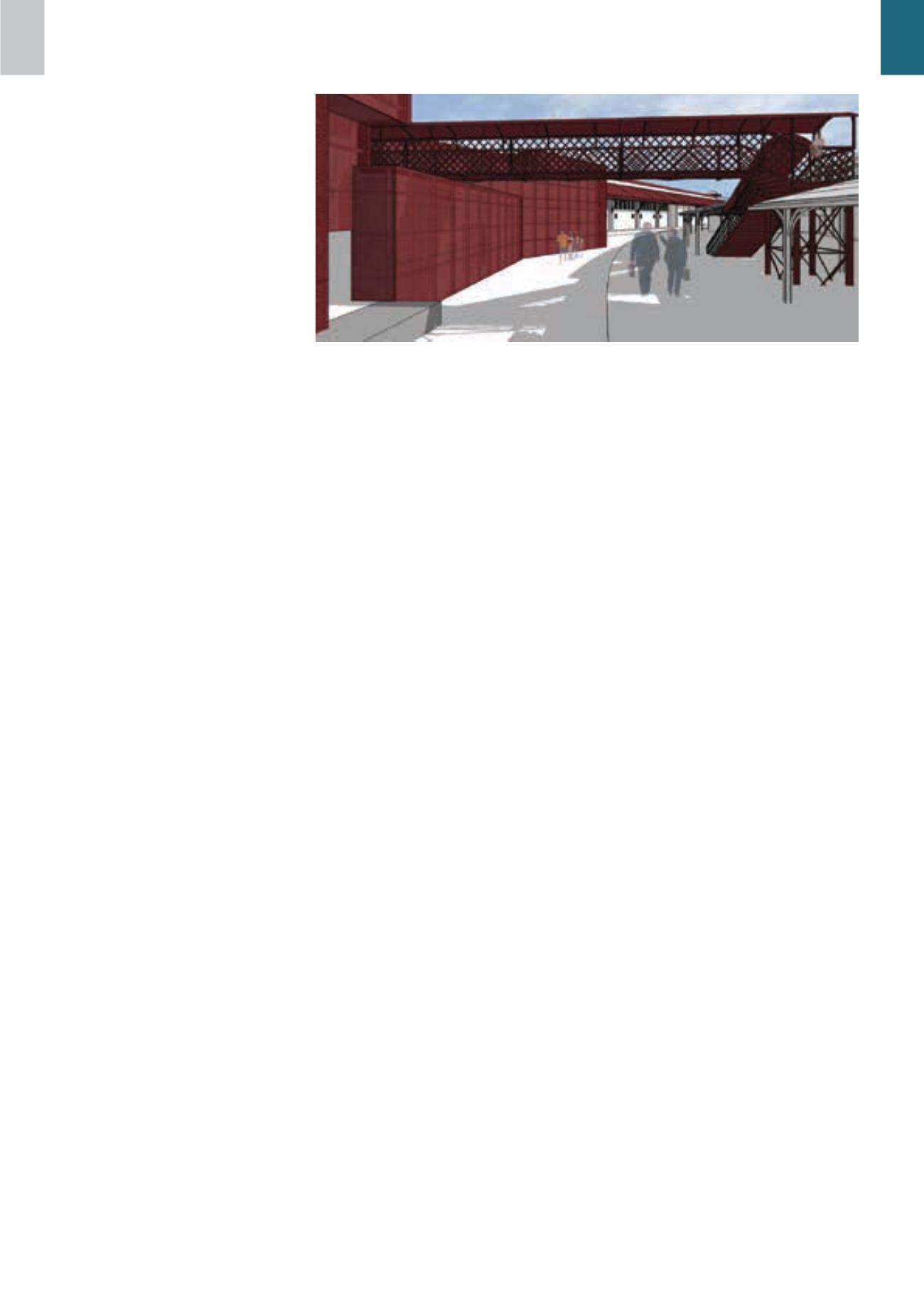
In order to preserve the local heritage, the existing pedestrian railway crossing bridge is
being reused.
From a practical maintenance point
of view, there are only three different
light fittings in the whole building,
which minimises the number of re-
placement tubes to be kept in store.
The building’s roof has been de-
signed to optimally suit PV panels,
in terms of slope and orientation –
and Nedbank is currently looking at
options for a solar PV array on the
roof.
On the water side, water efficient,
low flow taps and fixtures are being
installed throughout the building,
along with minimum flush toilets.
“HVAC accounts for up to 50% of all
energy costs in a building, and the
most effective way of improving energy
efficiency is through the building’s mor-
phology,” says Berry. “In principle, if
you can cut out heat before it gets into
a building, through shading, minimis-
ing the amount of glass or by using
high quality glass, you can achieve
up to 40% savings up front, without
any significant additional construction
costs – and these savings are passed
on throughout the 40 to 50 year life of
the building,” he explains.
“We are very proud of what we
have achieved for Newtown Junction,”
adds Lund. “This is a 150 000 m
2
development, and we have managed
to optimise energy consumption by
using almost every available technol-
ogy. The new SANS 10400XA Part 3
standard recommends a consumption
of no more than 200 kWh/m
2
per
year for Johannesburg offices and our
simulations suggest that we will come
in at 55% of this value, ie, at around
110 kWh. And previous project experi-
ence at Nedbank’s Pretoria offices sug-
gests that the real savings may be even
better,” he concludes.
q


