36
Mechanical Technology — February 2014
⎪
Nota bene
⎪
Index to advertisers
Becker Mining SA.......................... 31
BMG............................................ 15
Clyde Bergemann.......................... 30
Crown Publications....................... IBC
Donaldson Filtration Solutions....... OFC
Engen.......................................... 11
General Profiling.............................. 6
Hansen......................................OBC
Hypro Filtration............................... 2
Manitou. ...................................... 20
Metso Minerals. ........................... IFC
Modena Design Centres.................... 7
Robor........................................... 26
Tega Industries.............................. 12
Industry diary
March 2014
Electra Mining West Africa
3-5 March: Moevenpick Hotel,
Accra, Ghana
Mark Anderson; Montgomery:
+27 11 835 1565
+27 82 891 4271
Power & Electricity World Africa
11-12 March: Sandton Convention
Centre
Terrapinn Holdings
Root cause analysis
Master-Class Training Workshop
13-14 March: Birchwood Hotel,
Boksburg
Joan Bloom, 011 053 8189
R
enishaw, the UK’s only manu-
facturer of a metal-based addi-
tive manufacturing machines,
has collaborated with a leading British
bicycle design and manufacturing
company to create the world’s first
3D printed metal bike frame. Using
topological optimisation, Empire Cycles
has designed a titanium version of its
MX-6 Evo mountain bike to take advan-
tage of Renishaw’s additive manufactur-
ing technology. The technology allows
them to create a titanium frame that
is strong and light – some 33% lighter
than the original aluminium equivalent.
Titanium alloys have a high ultimate
Tensile strength – more than 900 MPa
when processed using additive manu-
facturing – and densities greater than
99,7% are achieved. The process is
therefore, more efficient than casting.
Any porosity formed, because of the fine
layer thicknesses, is small and spherical
with little effect on strength.
The was evident from the test re-
sults of the seat post bracket, which
was tested using the mountain bike
standard EN 14766. The bracket with-
stood 50 000 cycles of 1 200 N and
testing was continued to six times the
standard requirements without failure.
Testing of the completed bicycle frame
is continuing, both in the laboratory
at Bureau Veritas in the UK, and out
on the mountainside, where Swansea
University is putting a bike with portable
sensors through its paces.
Topological optimisation
software
Titanium alloys are, in fact, more dense
than aluminium alloys, with relative
densities of around 4,0 g/cm
3
and
3,0 g/cm
3
respectively. The only way to
make a titanium alloy version of a part
lighter than the aluminium alloy version
is to use significantly less material. The
design has to be altered to remove any
material not contributing to the overall
strength of the part.
From the Greek word for place,
‘topo’, topological optimisation software
is the term given to programs that are
used to optimise the placement of ma-
terial to achieve maximum strength for
a minimum mass. This is done using
iterative steps and finite element analy-
sis. Material is repeatedly removed from
areas of lowest stress until the design
calculations for load bearing suggest
that all redundancy has been removed.
The resulting model is light (due to the
low material mass) and strong.
By working together, Renishaw and
Empire Cycles optimised the bicycle
design for additive manufacture, elimi-
nating many of the downward facing
surfaces that would otherwise have
needed wasteful support structures.
The original aluminium alloy seat post
bracket weighs 360 g, while the hol-
low titanium version weighs 200 g,
44% less.
This is just the first iteration; with
further analysis and testing it could be
reduced further.
The original bike frame weighs in
at 2 100 g. Redesigned to make use
of additive manufacturing, the weight
drops to 1 400 g, a 33% weight saving.
There are lighter carbon fibre bikes
available, but Chris Williams, manag-
ing director at Empire Cycles, has re-
searched this and says, “The durability
of carbon fibre can’t compare to a metal
3
rd
Concentrated Solar Thermal
Power Conference & Expo
8-9 April, Cape Town
Daily electricity demand in South Africa has a
morning and evening peak, both in summer and
winter. This characteristic makes CSP with stor-
age a very attractive technology for generating
electricity on a large scale. While PV is currently
cheaper, its capability to match the demand is
limited to the morning demand peak. As experts
highlight, CSP is the only renewable technology
that provides dispatchable electricity that adapts
to the demand curve.
At CSP Today South Africa, 2014,
International developers Abengoa and ACWA
Power will assess thermal storage strategies,
while Eskom will discuss the role CSP can play
in improving energy efficiency, meeting demand
during peak times and stabilising the grid.
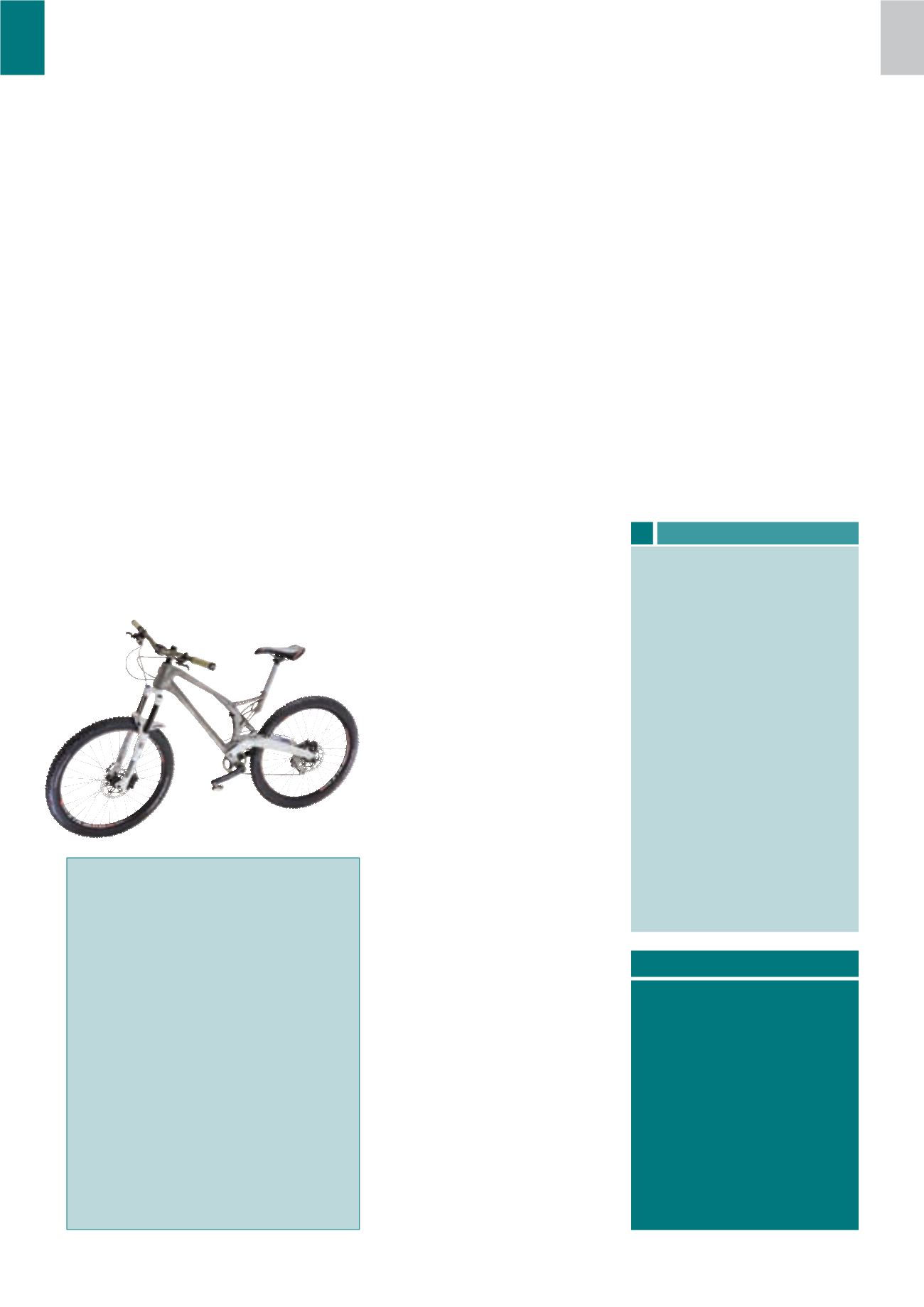
The MX-6 Evo with its 3D-printed
titanium frame and seat post bracket.
The world’s first 3D-printed titanium mountain bike
bike. They are great for road bikes, but
when you start racing down a mountain,
you risk damaging the frame. I over-
engineer my bikes to ensure there are
no warranty claims.”
Renishaw originally agreed to op-
timise and manufacture the seat post
bracket only, but after this proved
successful, decided the whole frame
was a practical goal. Chris updated his
design with guidance from Renishaw’s
3D printing applications team, and the
frame was sectioned so that it could
make full use of the AM250’s 300 mm
build height.
The design has all the advantages of
a pressed steel ‘monocoque’ construc-
tion used in motorbikes and cars, with-
out the investment in tooling that would
be prohibitive for a small manufacturer.


