Mechanical Technology — February 2014
33
⎪
Innovative engineering
⎪
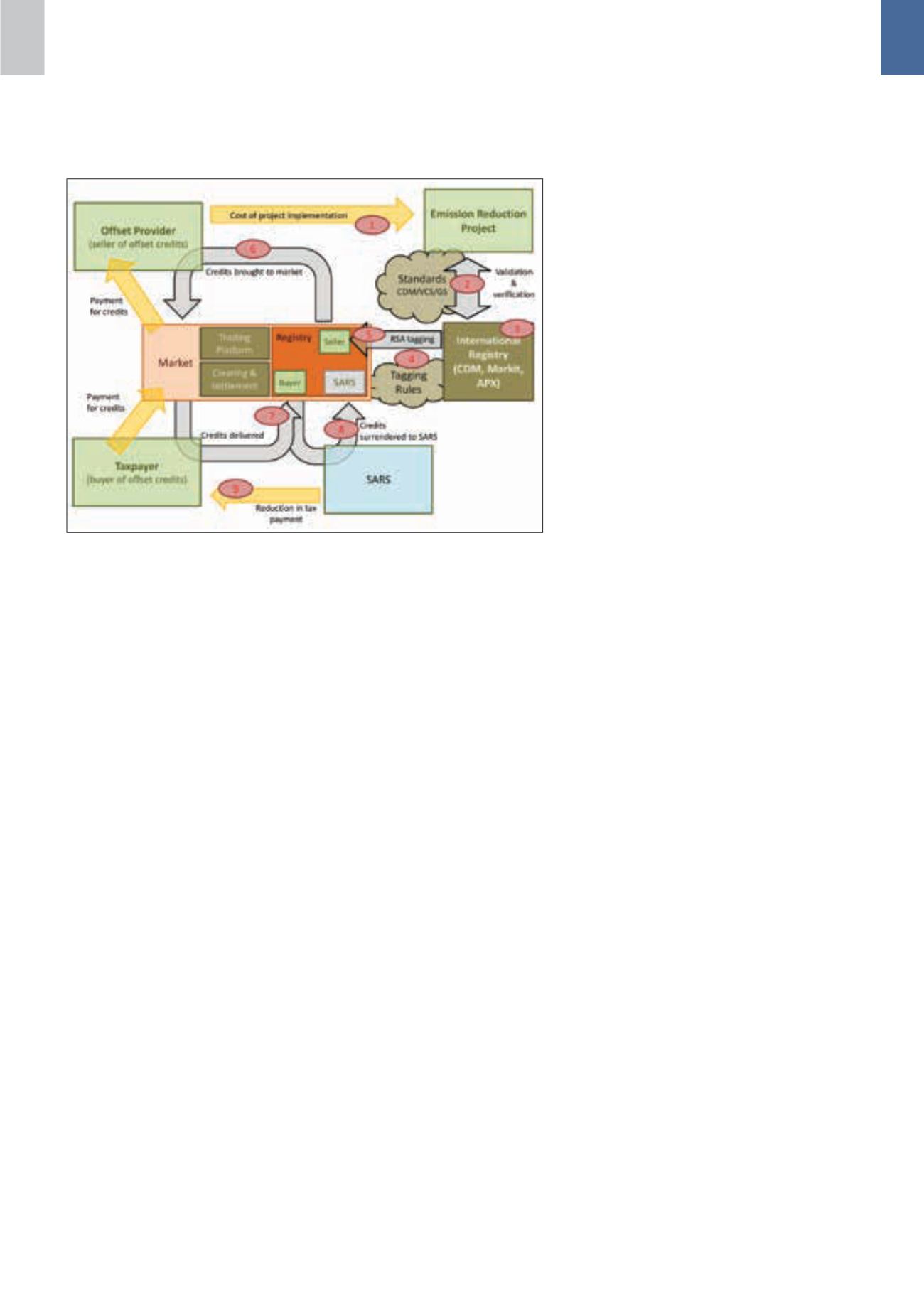
Envisaged market
structure.
proposed carbon tax
to note that offset trading can be used
in a number of regulatory regimes, and
that the work in the project is, therefore,
also applicable to a broader suite of
policy instruments or measures. Some
examples are:
Cap-and-trade: This is the traditional
application of offset trading. In such
a scheme offsets can be used to meet
an emitter’s commitment towards its
emissions cap.
Tax-and-trade: the proposal in this
report.
Carbon budget: Under such a
scheme an offset can be bought in
the market and used towards the
obligation of an emitter to remain
within a predefined carbon budget.
The role and impact of offsets is dem-
onstrated opposite. In this example a
company emitting 100 t has a tax liabil-
ity of R4 800 after taking the tax-free
threshold of 60% into consideration.
The company now buys 10 t of offsets
at a price of R80/t, and thereby reduces
its tax liability to R3 600 (10% of the
taxable 40%). The overall saving due to
the purchase is R400, which represents
8,3% of the original tax liability.
How the market would
function
A possible market structure is shown in
above. Nine process steps are indicated
and summarised below:
1 The offset provider invests in an
offset project. This project can be
either inside the business of the
offset provider or outside.
2 The project is validated and veri-
fied by an accredited auditor of the
standard used (CDM, VCS, GS). This
process guarantees the environmen-
tal integrity of the system.
3 The credits generated by the project
are issued into an international reg-
istry in terms of the scheme under
which the project was developed, eg,
the CDM registry for CDM projects or,
for VCS or GS projects, either Markit
or APX registries could be used.
4 The owner of the credits can now
apply for the credits to be transferred
to the South African Scheme. This
is done by auditing the credits for
national appropriateness according
to the RSA tagging rules. This audit
could be done by the project auditor.
5 The credits are issued into the ac-
count of the offset provider in the
RSA registry against delivery of the
tagging audit report and the cancel-
lation certificate from the registry of
origin.
6 Once the credits arrive in the ac-
count of the offset provider, he can
bring the credits to the market to be
traded.
7 The taxpayer buys the credits on the
market. The credits are transferred
to the registry account of the buyer.
8 The taxpayer surrenders the credits
into the cancellation account of the
South African Revenue Services
(SARS).
9 The taxpayer receives a reduction in
his tax liability that is equal to the
CO
2
value of the surrendered credits.
The following project participants and
their subsequent roles can be distin-
guished:
The offset provider implements an
emissions’ mitigation or carbon
offset project.
An accredited auditor is required
during the project validation phase in
order to ensure environmental integ-
rity of the carbon offset. Currently this
competency is either confirmed by
the UNFCCC, under the ISO14065
standard, and since 2013, locally
through SANAS. Local accreditation
could bring the cost of auditing down,
while creating jobs and building ca-
pacity in the green economy.
The Designated National Authority
(DNA): This report proposes to use
the chair of the custodian committee
of the SA tagging rules for the DNA
role. The DNA gives host country
approval to offset projects.
The tax payer/carbon emitter: Once
the offset provider has brought off-
sets to the market, the taxpayer can
purchase these offsets and surrender
them into the cancellation account
of SARS.
The South African Revenue Service
(SARS): upon receiving the offset
credits from the taxpayer, SARS
deduct these offsets from the total
carbon tax liability of the taxpayer.
Conclusions
As credible international standards,
such as CDM, VCS and the Gold Stan-
dard exist, it is recommended these be
used, especially during the implementa-
tion phase.
Reliable trading infrastructure,
through the JSE, for example, is
available within South Africa and will
require minimum modifications and
investments. Interviews with both in-
ternational, as well as local registries
found both to be available and suitable
for maintaining records of the ownership
of credits in the trading system.
Offsets have the potential to reduce
business as usual emissions by ap-
proximately 3% by 2020, which is
10% of South Africa’s 34% emmision
reduction target.
.


