Mechanical Technology — February 2014
31
⎪
Manufacturing technology and plant automation
⎪
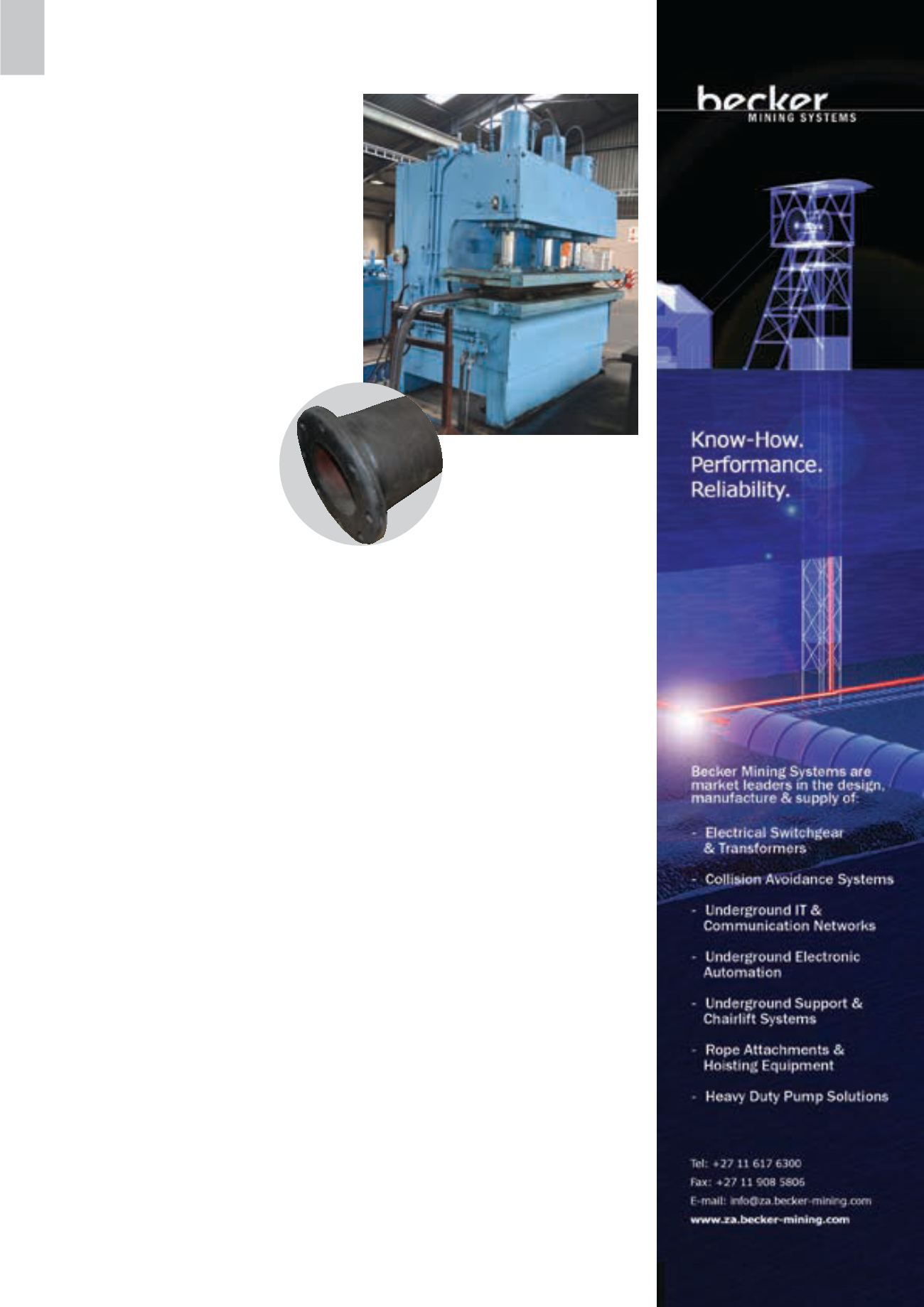
Above:
Tega is currently involved
in supplying furnace seals for
Outokumpu, the stainless steel
specialist.
Left:
In South Africa,
rubber slurry pipe is manufactured
as an alternative to rubber-lined
steel pipe
application,” Vermaak tells
MechTech
.
As with the Outokumpu project, “we don’t
do mass production. We work with clients to
produce purpose designed solutions for their
particular needs,” he continues. “Where prob-
lems arise, we engineer solutions by working
with operators. OEMs will always be willing to
sell a replacement part, which will often have
to be imported – at high costs because of du-
ties – and importing also causes delays. We
like to come up with more locally appropriate
solutions, which are then locally manufactured
to international standards at much lower cost
and without delays,” he proclaims.
He cites Tega’s cable protection solution as
another example. “These were developed
specifically for an open cast iron ore
mine, to avoid having to raise its
100 mm trailing cables by over
5,0 m to avoid damage from its
fleet of 400 t loaders. We designed
a rubber mat that could encase the
cable to spread the load. It’s an easy
to implement solution that solves a big
problem,” he says, adding that this is a
South African developed, world-leading product
that was purpose designed to solve a problem
at a South African mine.
Another such product is Tega’s Spill-ex sys-
tem for mechanical conveyors, a skirt sealing
system designed to reduce or eliminate spillage
from mine conveyors, “particularly at junction
and transfer points”. Skirt sealing is generally
provided on both sides of a skirting board. “At
a loading point of a belt, the profile of the belt
and its skirt are never ideal, though. We have
developed a skirt system with individual side
blocks that can be adjusted to seal the sides of
the conveyor, regardless of the profile. Rubber
with a very low coefficient of friction is used, so
it does not effect the flow of material at all, and
the height of the rubber blocks can be adjusted
to compensate for trough height variations,”
Vermaak explains. And when the blocks are
worn to the point where they can no longer be
adjusted, you simply order replacement rubber
blocks. The system itself remains in place.
New premises
Mill linings are manufactured in-house, currently
in the Benoni premises. “But we have already
moved the Industrial division new premises in
Vulcania, Brakpan, and we intend to move the
Mining division into a purpose-built manufac-
turing facility here in the near future,” Vermaak
reveals. “We are gearing up to being a state-of
-the-art manufacturer, with key people and
capabilities able to take the business forward.
“Tega tries not to tie capital up in stock.
Instead, we adopt lean manufacturing processes
to allow us to manufacture to order very quickly.
In the rubber industry, this has a significant
advantage because rubber has a shelf life. Our
just-in-time approach enables us to overcome
that completely. By delivering rubber products
as manufactured, none of a product’s life need
be wasted while it sits on a shelf,” he explains.
In addition, “storing rubber is a complicated
business, in terms of the heat and humidity
conditions for the warehouse. By investing in
enough manufacturing capacity, we avoid these
complications because manufacturing can re-
spond to an order almost immediately,” he adds.
“While many companies can offer standard
rubber linings, at Tega, if a compound doesn’t
work, we can explore the use of alternatives.
We have local polymer engineers who can de-
velop and optimise compounds to meet specific
requirements. Our testing lab enables us to
recreate onsite condition and expose different
components to the appropriate wear conditions
and we routinely install trial components to test
real performance. In this way, we are able to
arrive at optimum solutions that are customised
to suit their environments,” he explains.
Concluding, Vermaak says that Tega “has
excellent people with 20 to 25 years experience
in the industry” and that the company is “striv-
ing to become an employer of choice”.
“There are no substitutes for experience and,
in line with Tega’s global best-practice struc-
tures, we employ specialist product managers
for each product line and engineers with access
to both a global bank of experience and local
research and development and manufacturing
expertise to help local industry to come up with
effective, low cost solutions,” he says.
q


