safety on mines
feature
38
06.13
S
ibanye Gold spokesperson James Wellsted says
the company agrees with the approach of ‘stop
and make safe’ in the risk area. “However, in-
discriminate stopping of mines has a negative impact
on the cycle of mining and employees’ motivation,”
he says. “We don’t support the stopping of an entire
mine’s production when there has been a fatal ac-
cident. The risk must be understood and correctly
managed.”
The safety team at Anglo American Platinum (Am-
plats) says that “closing down a mine introduces a
new set of risks. If at all possible, it is safer to stop the
area where the accident occurred to effectively cor-
rect the deviations in the associated localised area,
rather than close the entire mine in an uncontrolled
manner.”
In terms of Section 54(1) of the Mine Health and
Safety Act (MHSA) 29 of 1996, a DMR mine inspector
can halt operations at a mine or part of a mine if he
“has reason to believe that any occurrence, practice
or condition at a mine endangers or may endanger the
health or safety of any person at the mine.”
Susan Shabangu, Minister of Mineral Resources,
says in her department’s recently published Annual
Performance Plan 2012/13 that “although there has
been some improvement in the number of fatalities
and injuries, the department is still greatly concerned
about the continued loss of lives at our mines.”
The current review of the Mine Health and Safety
Act “will strengthen enforcement provisions, reinforce
penalties, provide clarity in certain definitions and
expressions; and effect amendments to ensure consis-
tency with other laws, particularly the Mineral and Pe-
troleum Resources Development Act (MPRDA).”
The draft MPRDA Amendment Bill was approved
by the South Africa Cabinet in late May and is set to
be introduced to Parliament soon.
The Chamber of Mines remains concerned about
safety on the basis that “despite heightened aware-
ness and strengthened workplace commitment, the
number of fatalities in the industry was not reducing
sufficiently to meet the ‘zero harm’ milestones that
were agreed to by the tripartite stakeholders in 2003,”
says Bheki Sibiya, Chief Executive of the Chamber.
The Chief Inspector of Mines leads the tripartite
structures comprising representatives of government,
employees and employers’ organisations.
Sibiya points out in the Chamber’s 2012 annual
report that the mining industry’s safety performance
remained unaltered at 0,12 in 2011. There were 123
deaths in South African mining operations in 2011, a
3 % improvement over 2010. However, the industry
had achieved a 54 % improvement over the last nine
years since agreeing to the 2013 health and safety tar-
gets and milestones.
Amplats Chief Executive Chris Griffith says 2012
Balance
needed in the
quest for zero harm
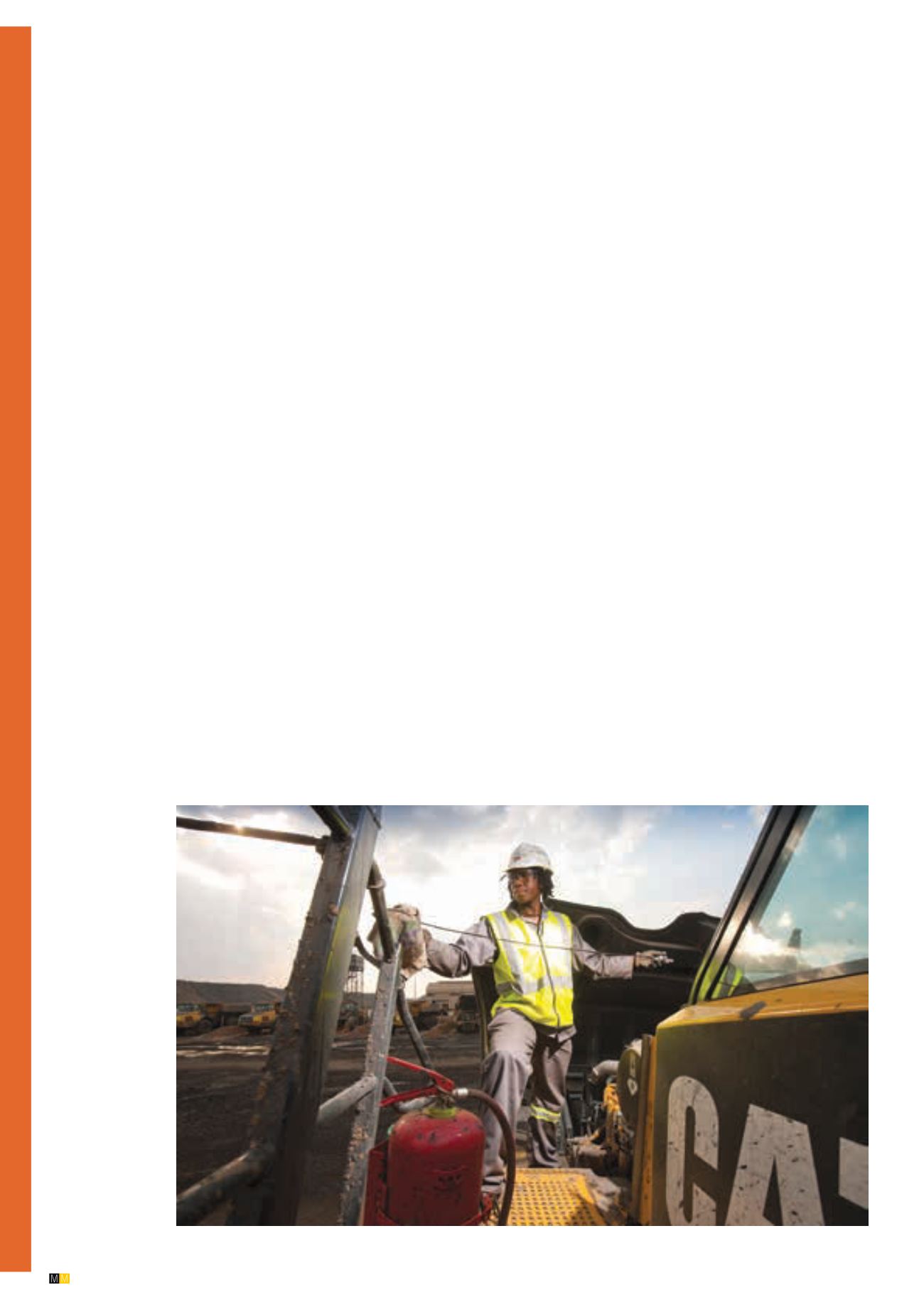
A safety check is carried out on a vehicle at Zibulo colliery (photo: AAC).
The process introduced by the Department of Minerals and Resources (DMR) of stopping mine production
after a fatal accident has heightened focus on safety across the mining sector but – according to industry
spokesmen – balance needs to be applied in order to avoid negative impacts.


